🎯 Darts Tournament Payout Calculator
Shape a payout ladder, bonus flow, and board load before the first throw.
| Item | Input | Calc | Note |
|---|
| Payout shape | Field band | Top share | Best fit |
|---|---|---|---|
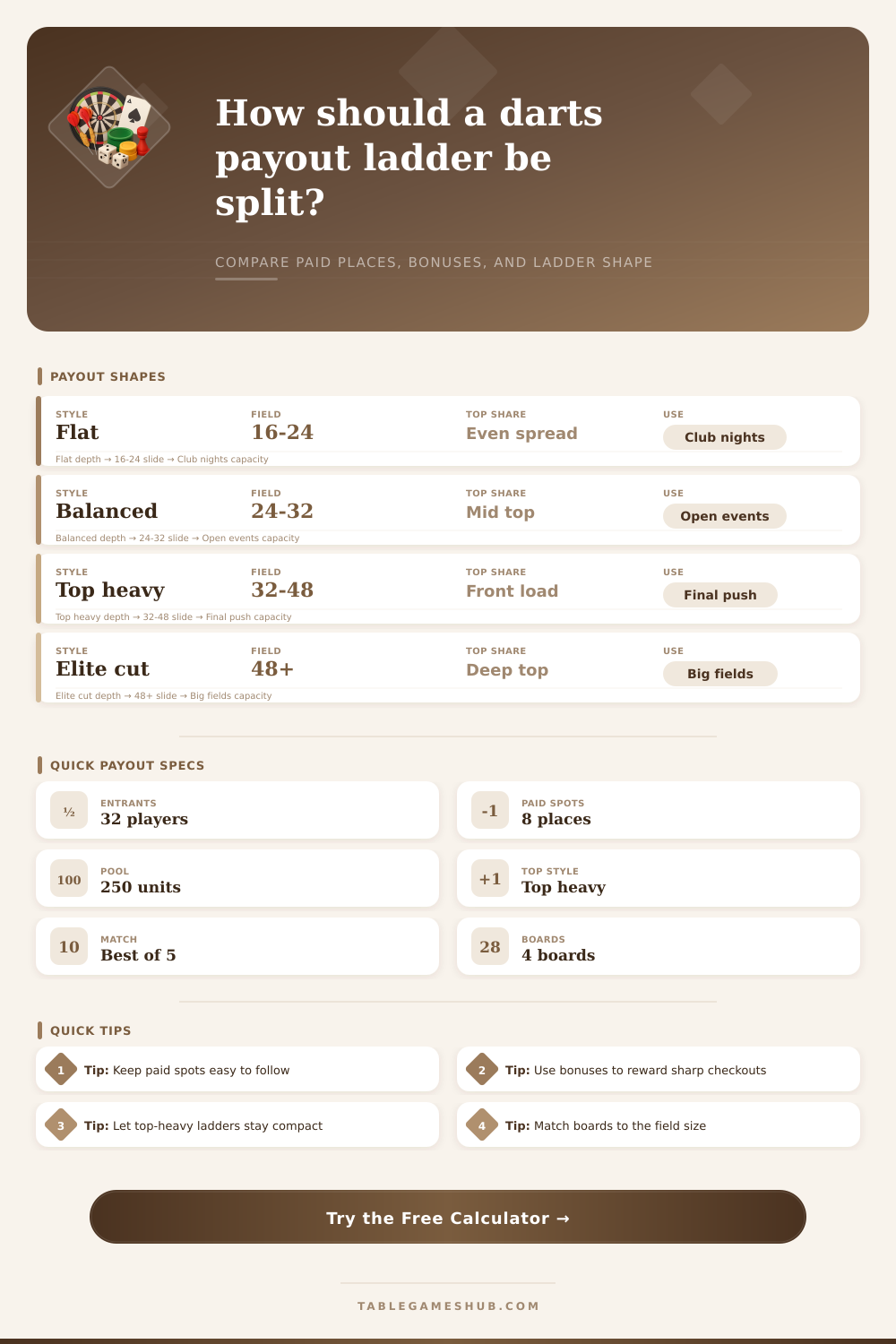
| Flat | 16-24 | Even spread | Small club nights |
| Balanced | 24-32 | Mid top | Open fields |
| Top heavy | 32-48 | Front load | Final push events |
| Elite cut | 48+ | Deep top | Large fields |
| Bracket style | Bias | Lower tail | Read on ladder |
|---|---|---|---|
| Straight KO | Front loaded | Low | Sharp finish line |
| Double elim | Balanced | Medium | More recovery room |
| Group phase | Flatter | High | Qualification first |
| Seeded bracket | Controlled | Medium | Protects early seeds |
| Match format | Pace | Pressure | Typical feel |
|---|---|---|---|
| Best of 3 | Fast | High swing | Short and sharp |
| Best of 5 | Standard | Medium | Classic club pace |
| Best of 7 | Measured | Steady | More sample time |
| Best of 9 | Slow | Deep | Endurance matters |
| Field size | Paid spots | Ladder depth | Use case |
|---|---|---|---|
| Under 20 | 3-4 | Short | Local nights |
| 20-40 | 5-8 | Medium | Club opens |
| 40-64 | 8-16 | Long | League finals |
| 64+ | 16+ | Deep | Championships |
Keep the ladder readable
When the field is small, avoid too many paid places. A cleaner spread is easier to explain and easier to verify on the night.
Use bonuses with care
Checkout and sweep extras work best when they stay secondary to the main payout line, not larger than the top award itself.
Use this darts tournament payout calculator to compare paid places, bonus units, bracket shape, and board load so the final split feels tidy and transparent.
A payout ladder determine how much prize money each player will recieve in a tournament. The payout ladder is important in determining how players feel about the tournaments fairness. If the payout ladder for a tournament is not design correctly, players will feel that the prize money is unfair to them.
Playing with unfair prize money will leave many players unhappily with the tournament that they had to attend. Hence, planning the payout ladder before the tournament begins is of the utmost importance. The size of the players competing in the tournament is one of the first factor to consider when creating the payout ladder.
How to set fair prize money for a tournament
For instance, if there are 16 players in the tournament, the payout ladder should be create so that many players win some prize money. However, if there are 32 or 48 players competing in the tournament, a top heavy payout ladder would be a better option for distributing prize money. A top-heavy payout ladder will give the winning players the most money, while giving less money to the players with lower ranking in the payout ladder.
Another factor to consider is the tournament bracket style. If the tournament use a straight knockout bracket, a top-heavy payout ladder would again be a more better option. In knockout brackets, players is eliminated quickly from the tournament.
However, if it is a double elimination bracket, a more distributed payout ladder would be used. In a double elimination bracket, players have one more chance to compete in a game and win the prize money. Because of this second chance, the prize money can be distributed to more player.
Another option is to add bonuses to the payout ladder. Checkout bonuses give extra money to players who make a checkout in their game by hitting a double. Other bonuses gives extra money to players who win all of their game without losing a leg.
However, you must ensure that the sweep bonuses are kept to a modest number so that they dont overshadow the main payout ladder for the tournament. The number of dartboards that are present in the venue in which the tournament will be held is a factor that will affect the tournament. The number of dartboards that are in the venue can impact the tournament in several ways.
For example, if there are too few dartboard for the number of players that are to take part in the tournament, then the players may become frustrated with the tournament due to the congestion that will occur at the games dartboards. To avoid this situation, it is important to ensure that the number of dartboards in the venue is sufficient for the number of players that are to participate in the tournament. One of the most common mistake in organizing a tournament is to pay too many players in a tournament that has a small prize pool.
If too many players are paid prizes within a tournament that offers a small prize pool, then each prize will pay out a small amount of money for the winner. If the prize money is too small for the effort that each player must put in to win, then the players may become disillusioned with the tournament. For example, in a tournament with 24 players, it is best to pay a small number of players so that the players who do win have a significant amount of prize money.
There are a few different metric that can be used to determine whether or not the payout ladder that is set for the tournament is effective. The champion share is the amount of money that the tournament winner will receive. The runner-up share is the amount of money that the second-place player will receive.
The top gap is the difference in the amount of prize money between the tournament champion and the runner-up. If the top gap is small, there is a likelihood that the tournament was not motivating enough for players to compete. If the top gap is very large, the tournament was likely top-heavy.
By calculating these metrics, organizers can ensure that the payout ladder for the tournament reflect the goals that organizers should of achieved by organizing the tournament. Finally, the payout ladder should be printed and posted in the tournament venue in a place where all of the participant can see it. For example, the payout ladder could be posted next to the scorers table.
By doing so, all participants in the tournament will be aware of how the tournament prizes will be distributed. The use of a printed payout ladder ensures that all players trust the organizers of the tournament and understand the payout ladder before the tournament begins.