🃏 Yu-Gi-Oh Consistency Calculator
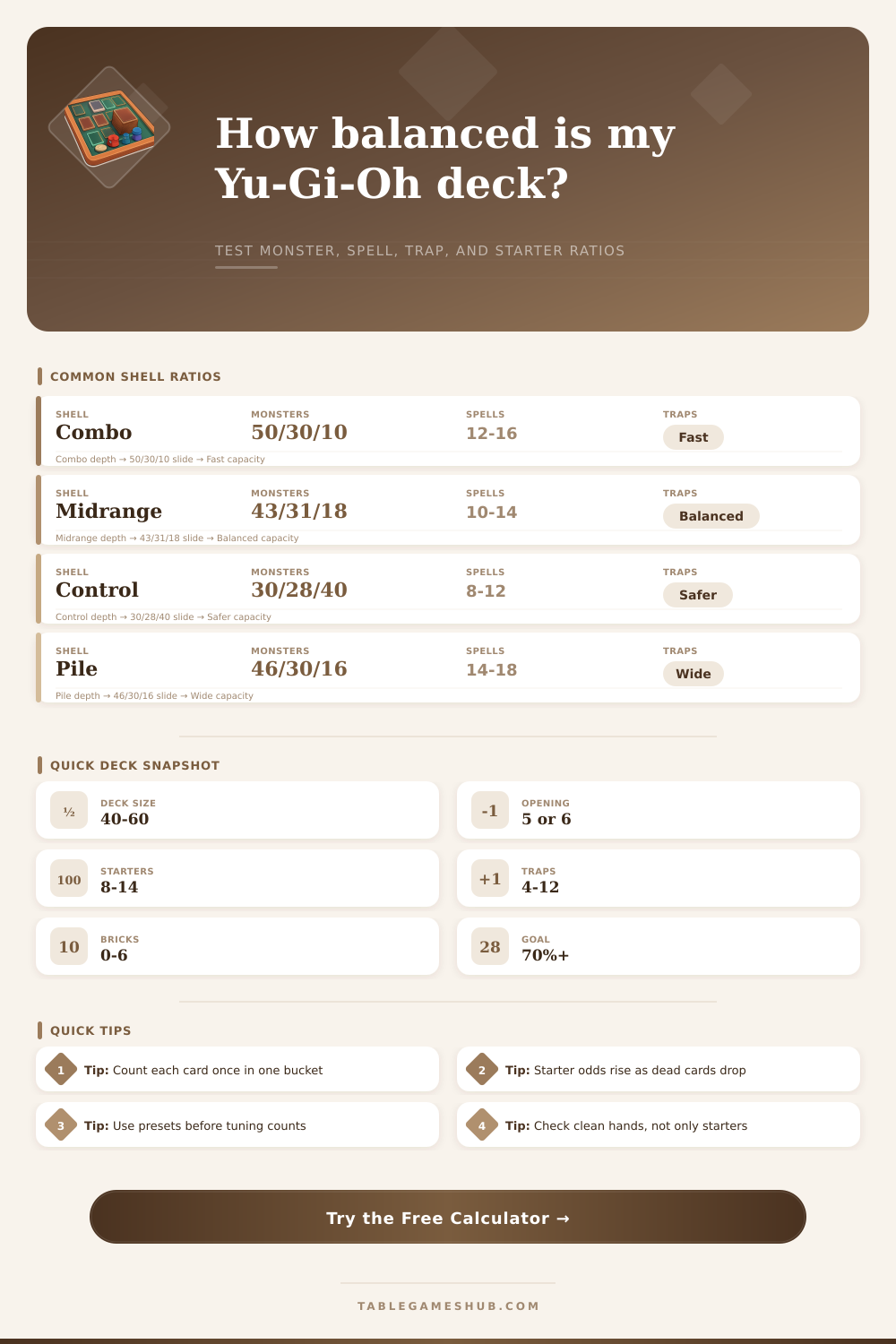
Balance the main deck, test opener odds, and see whether your list leans combo, control, or pile.
Type share
Track how much of the main deck is monsters, spells, traps, and flex.
share = category copies / main deck size
Starter access formula
Use the hypergeometric distribution to measure starter access in the opening window.
P(X = k) = C(K,k) C(N-K,n-k) / C(N,n)
Two-card line
Check lines that need both a starter-side card and an extender-side card.
P(A and B) = 1 - P(no A) - P(no B) + P(no A and no B)
Target copies
Scan upward until the desired consistency chance is reached for the chosen seen cards.
needed copies = smallest count that meets the goal
Deck Structure
Target Copies
Consistency Table
Brick Profile
Counting rule
Count each card in one primary bucket. That keeps the hypergeometric opener math exact and makes the consistency score easier to read.
Reading the result
If starter odds are short, add starters first. If starter odds are fine but your combo line is weak, push extenders or interaction before adding more bricks.
Build cover in Yu-Gi-Oh! mean to choose good mix from monsters, spells and traps. Do not exist one alone ideal that answers for everything.
Too many variations do it hardly. That game malsimilas to other commercial kartludoj because covers here have extremely big role. Many covers combine fully from one karta engine so no always are usefull to maximize make-up by means of fixed proportion.
How to Build a Yu-Gi-Oh! Deck
More well commonly use the particular arketipon as base and build around it. The proportions range according to the ferdektipo some modern escape traps in the mainstream package while others depend strongly of them. Any magnitude suits all and in competitive game probably never will be.
Cover idealas stay between 40 and 45 cards maksimume. Some players never surpass 42 in any. Guides for initial covers describe the bases.
Klasike the proportion was 20 monsters 10 spells and 10 traps, where mantrapo-cards kalkuliĝas as monsters. For covers above 40 the extra cards should follow 2:1:1. Even so it alters according to the cover and the ludstilo.
Use more monsters and spells for arketipoj as Fusion while others stressed traps. Some players favour 1:2 of spells-traps to monsters because it operates more well.
Building think whether it will be to control or comb. Kontrol-cover requires cards that searches the mainstream monitor. Exterior kampa spell helps to set the revolution.
Today one plays many startilojn for high chance open the engine. Three copies of card call “3-of”. That gives 33,8 % probability it find.
In three copies it more commonly reclines up than in one. The everything depends of your luda plan.