Lost Cities Score Calculator
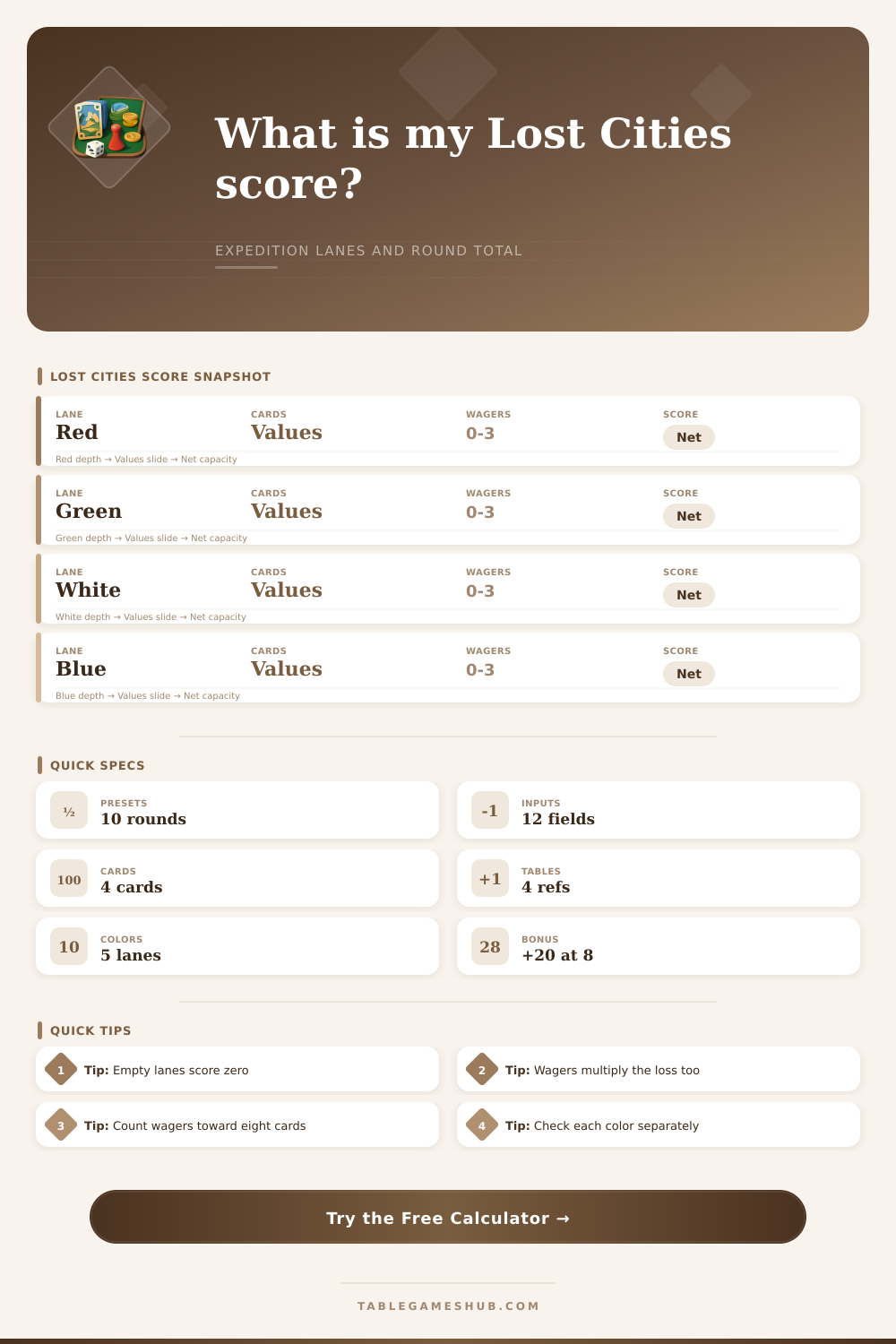
Total each expedition lane with card values, wager cards, the expedition penalty, completed expedition bonus, and a round total.
| Scoring step | What to enter | Formula role | When it applies |
|---|---|---|---|
| Card values | Numbers 2-10 | Added before penalty | Per color lane |
| Expedition penalty | Automatic | Subtracts 20 | Any used lane |
| Wager cards | 0 to 3 | Multiplier is wagers plus 1 | Used lane only |
| Completed bonus | Automatic | Adds 20 after multiplier | 8+ total cards |
| Wagers | Multiplier | Break-even values | Risk note |
|---|---|---|---|
| 0 | 1x | 20 | Smallest swing |
| 1 | 2x | 20 | Loss doubles too |
| 2 | 3x | 20 | High variance |
| 3 | 4x | 20 | Largest swing |
| Lane sample | Values | Wagers | Lane score |
|---|---|---|---|
| Small start | 4, 8 | 0 | -8 |
| Solid lane | 5, 7, 9 | 1 | 2 |
| Big lane | 2, 4, 6, 8, 10 | 2 | 30 |
| Completed | 2 to 9 | 0 | 24 plus bonus |
| Round check | Useful count | Calculator output | Why it matters |
|---|---|---|---|
| Unused colors | 0 cards | 0 score | No penalty |
| Started colors | 1+ cards | Lane total | Penalty applies |
| Completed colors | 8+ cards | Bonus count | Adds 20 each |
| All colors | 5 lanes | Round total | Final sum |
Lost Cities is a game that requires a person to managing risk and manage the mathematical outcomes of the game. A person wins at Lost Cities by managing the relationship between there starting penalties and their wager multipliers. Each color lane in the game feature a starting penalty for that color.
These starting penalties are negative values that a player must overcome with their play cards. If a player’s total value of the cards played in a lane are less than the starting penalty for that color, the lane will have a negative score for the player. The negative scores for each player’s color lanes can leads to a player having a low total score overall.
How to Avoid Negative Scores in Lost Cities
Thus, players must be careful with their played cards to ensure that their lanes does not have negative scores. Many players make the mistake of playing cards whose values is in the mid-range of the game into a color lane. These cards, while potentially helpful for another player’s lane, are often not enough to overcome a starting penalty.
Wager cards are special cards that can be played onto a color lane whose total score are positive. The wager cards will multiply the total score of that positive total. However, if the total score of a color lane is not positive, the wager cards will also multiply that total score, but it will still being negative.
Thus, wager cards can help a player’s positive score become more positively, but they can also help a player’s negative score become more negative. Players must have an understanding of the value of each of a player’s color lanes before playing any wager cards onto those lanes. Beyond playing cards into each color lane, players can also attempt to earn a bonus for completing an expedition.
To complete an expedition, a player must play eight card of the same color into a single lane. If a player completes an expedition, that player score significantly in relation to other players. This can help compensate for a negative score in other color lanes.
However, many players sacrifice the potential for a negative score in other lanes to play many high-value card into a single color lane for the potential bonus of completing an expedition. While many players focus on the number of cards in a player’s lane, they should also focus on the total value of the cards within that lane. Beyond completing expeditions and playing cards into each color lane, players must manage the relationship between the starting penalties and the wager multipliers.
For instance, if a player’s total value of the cards in a lane is fifteen, but the starting penalty for that color are twenty, the player will score negative five for that lane. If a player plays one wager card onto that lane, the total score for that lane will be negative ten. If a player plays three wager card onto that lane, the total score for that lane will be negative twenty.
Thus, the player has lost valuable point with each wager card that the player played onto the lane. The player must always ensure that their total of the cards in a lane has crossed the starting penalty; otherwise, the wager cards will only ever be useful to increase their score should they have a positive total for a lane. In some instances, the best playing strategy for a player is to not play any cards into a color lane.
By not playing any cards into a color lane, a player will always have a total score of zero for that lane. This score is always better than a negative score for the player. Thus, a player must be able to decide when to play cards into a color lane, and when to simply walk away from the lane altogether.
A player’s total score at the end of the game is the sum of all the scores from each of the color lanes that the player create. A small mistake in how many wager cards are played onto a lane, or which card is played into which lane, can lead to a large difference in a player’s total score. The reference table for the game can be used to determine how each wager card will multiply each player’s total score for each lane.
Thus, players must have an understanding of the math behind the penalties for each color lane, as well as the math behind each lane’s potential total score with the application of the wager cards.