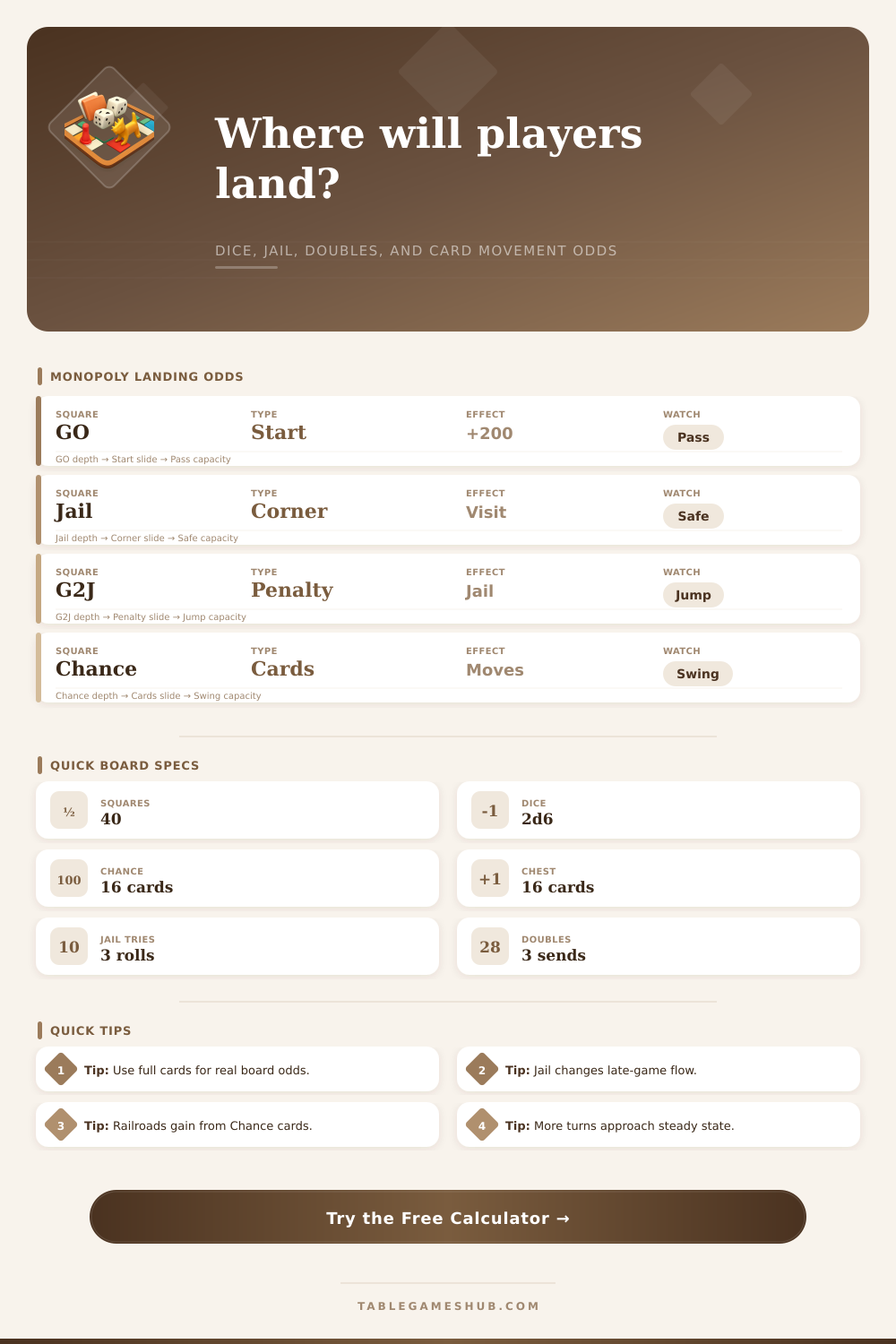
🎲 Monopoly Landing Probability Calculator
Estimate how often a token lands on any square using two-dice odds, doubles streaks, jail policy, Chance movement, Community Chest movement, and long-run board flow.
| Metric | Value | Formula note | Board interpretation |
|---|
| Dice sum | Ways out of 36 | Probability | Movement note |
|---|---|---|---|
| 2 or 12 | 1 each | 2.78% each | Rare short or long edge roll. |
| 3 or 11 | 2 each | 5.56% each | Common enough for near-square checks. |
| 4 or 10 | 3 each | 8.33% each | Important around jail-exit property groups. |
| 5 or 9 | 4 each | 11.11% each | Strong middle-distance movement. |
| 6 or 8 | 5 each | 13.89% each | Second-highest two-dice totals. |
| 7 | 6 | 16.67% | Most frequent normal roll distance. |
| Card deck | Movement cards | No-move cards | Landing effect |
|---|---|---|---|
| Chance | 10 of 16 | 6 of 16 | Moves to GO, jail, named properties, nearest railroad, nearest utility, or back three. |
| Community Chest | 2 of 16 | 14 of 16 | Only Advance to GO and Go to Jail are modeled as movement cards. |
| Nearest railroad | 2 Chance cards | None | Moves from Chance 7 to 15, Chance 22 to 25, and Chance 36 to 5. |
| Go back three | 1 Chance card | None | From Chance 36 this reaches Community Chest 33, so a second deck effect can apply. |
| Square group | Indexes | Special behavior | Calculator handling |
|---|---|---|---|
| Corner squares | 0, 10, 20, 30 | GO, Jail visit, Free Parking, Go To Jail | Square 30 redirects to jail in official modes. |
| Chance squares | 7, 22, 36 | Draw one Chance card | Full mode applies all movement probabilities. |
| Community Chest | 2, 17, 33 | Draw one Chest card | Full mode applies GO and jail moves. |
| Railroads | 5, 15, 25, 35 | Regular squares with card inflow | Nearest-railroad cards raise their long-run share. |
| Utilities | 12, 28 | Regular squares with one card inflow | Nearest-utility Chance card adds extra paths. |
| Model mode | Best use | Included effects | Limit |
|---|---|---|---|
| Full card model | Realistic board landing odds | Cards, jail, doubles, third-double penalty | Treats decks by equal probability rather than physical order memory. |
| Basic cards | Quick jail and GO checks | Advance to GO and Go to Jail cards | Skips railroad, utility, and named-property movement. |
| No cards | Dice-only baseline | Dice and selected jail/doubles rules | Understates railroad and orange-property traffic. |
| Steady-state iteration | Long-run ranking | Repeated turn transitions | Approximation quality depends on iteration depth. |
Jail path matters
Official jail rules increase traffic from square 10, which makes nearby rolls into the orange and red side of the board more visible in long-run rankings.
Cards are movement edges
Chance cards do more than randomize a turn: they push extra probability toward GO, railroads, Illinois Avenue, St. Charles Place, utilities, Boardwalk, and jail.
A landing probability calculator is an tool that help people to understand the way in which the tokens move around the game board. Many individuals believe that the movement of the tokens are random and dependent upon luck. However, there is a set of rules that determine the way in which the tokens move.
These rules include the way in which the dice are rolled, the rules regarding jail, and the way in which the Chance and Community Chest cards leads to movement of the tokens. Each of these rules can be represented in the landing probability calculator to show how the tokens is likely to move. The first major factor in the calculation of the probability of each token landing upon a specific square in the game is the way in which the two dice are rolled.
How the Landing Probability Calculator Works
The number seven is the most common result of rolling a pair of dice. As a result, the squares that are seven space away from each token are the most common in which tokens land. This is why properties like the orange and red properties is some of the most common in which tokens land.
Additionally, rules regarding doubles suggest that if three doubles are rolled in a row, the player is sent to jail. In jail, the player loses the ability to move the token, and it is sent to a specific corner of the game board. The rules regarding jail also help to indicate the ways in which the tokens will move around the game board.
For example, official rules state that a player can only roll dice to try to escape jail three times in a row. After the third roll, the player must pay a fee to leave jail. Thus, the token can become stuck in jail; it cannot move around the game board.
Thus, the squares following jail are hit more frequently than they would be based off the rolls of the dice alone. There are other house rules for Monopoly that state that players must leave jail on the very next roll. Thus, these policies can be represented in the landing probability calculator to reveal the difference in each policy for the game.
Chance and Community Chest are cards that allow for tokens to move in ways other than rolling the dice. However, ten of the sixteen Chance cards allow tokens to either move to specific squares on the game board, or to move to one of the railroads or utilities. These movement options create some of the games shortcuts and backtracks.
These movement options should be accounted for in any calculation of the probability of each token landing upon a specific square. For instance, the drawing of a Chance card that moves the player back three spaces can lead to the player landing upon a Community Chest square. In this case, the player must draw another card.
Thus, this additional movement can again be accounted for in the movement calculations of the token. Additionally, these Chance and Community Chest cards leads to some of the high-value properties and railroads being among the most common in which tokens land. Thus, if a landing probability calculator dont account for chance and community chest cards, the probabilities of these squares will be lower in the calculation.
Another factor that can impact the probability of each token landing upon a specific square in Monopoly is the number of turns that are played for each game. In the initial few turns of a game, the position of the players’ tokens is based upon their starting position on the game board and the cards that they draw at the beginning of the game. However, after twenty or thirty turns, the game can reach what is considered to be a steady state.
A steady state in the game is reached when the probabilities of each token landing upon any given square stabilizes to a consistent distribution; this can occur due to the permanent rules within Monopoly such as the rules regarding jail, chance and community chest movements, and the rules for movement to the thirty space. A landing probability calculator can perform a short or long iteration of the game to represent both the early and later stages of Monopoly. The difference between each iteration can inform players of different strategies that can be used in the later turns of the game, such as focusing upon the position of the token in relation to jail rather than its initial position upon the game board.
Some of the most common errors that are made regarding Monopoly are to believe that each of the squares on the game board is equally likely to be landed upon by a player’s token. This isnt true; the share (probabilities) of each square being landed upon in the steady state can reach up to twice as high for some of the most common squares as the least common squares. Additionally, some may believe that ending up in jail is always a negative rule for the player.
However, if many of the squares surrounding the jail are high-value properties, the holding pattern of the player in jail will protect the player from landing upon those high-value properties. Thus, a landing probability calculator does not make decisions for the player, but does provide information regarding the probability costs and benefits of each of these rules to allow the player to make those decisions themself. The tables included with the landing probability calculator allow the player to view the frequency of each roll of the dice, and the effect of each of the chance and community chest cards.
Furthermore, the player can change the bias of the dice rolled in the game. For example, the player can alter the settings of the calculator to use only low-roll or high-roll weighted dice. Furthermore, the player can turn off the rule regarding extra rolls after rolling doubles in the calculator to view how removing these extra rolls impact the distribution of each players tokens.
Thus, understanding each of these rules for Monopoly allows the player to understand the movement of each token as a connected system of rules.