🃏 Cribbage Odds Calculator
Hand scoring probabilities, expected values & discard analysis
| Combination | Points | Example | Notes |
|---|---|---|---|
| Fifteen | 2 | 5 + 10 | Any cards totaling 15 |
| Pair | 2 | 7-7 | Two cards same rank |
| Three of a Kind | 6 | 7-7-7 | Three pairs = 6 pts |
| Four of a Kind | 12 | 7-7-7-7 | Six pairs = 12 pts |
| Run of 3 | 3 | 3-4-5 | Three sequential cards |
| Run of 4 | 4 | 3-4-5-6 | Four sequential cards |
| Run of 5 | 5 | 3-4-5-6-7 | Five sequential cards |
| Double Run | 8 | 3-4-4-5 | Two runs + pair |
| Nobs | 1 | J matching starter | Jack of starter suit |
| Card | Counting Value | Run Value | Best Pairings |
|---|---|---|---|
| Ace | 1 | 1 | 4s for 15 |
| 2 | 2 | 2 | 3s and Kings for 15 |
| 3 | 3 | 3 | 2s and Queens for 15 |
| 4 | 4 | 4 | Aces and Jacks for 15 |
| 5 | 5 | 5 | 10-value cards for 15 |
| 6 | 6 | 6 | 9s for 15 |
| 7 | 7 | 7 | 8s for 15 |
| 8 | 8 | 8 | 7s for 15 |
| 9 | 9 | 9 | 6s for 15 |
| 10, J, Q, K | 10 | 10-13 | 5s for 15 |
| Held Cards | Avg Points | Min Points | Max Points |
|---|---|---|---|
| Pair of 5s + 10 + J | 16.9 | 12 | 24 |
| 5-5-10-K | 16.5 | 12 | 22 |
| 3-4-5-6 | 9.5 | 7 | 14 |
| 7-7-8-8 | 13.1 | 12 | 24 |
| A-2-3-5 | 5.7 | 3 | 12 |
Cribbage is a card game where each of two players receives a hand of six cards. Later they dump two of them to the four-card “crib“, that goes from one player to another. At the end of the discards, one flips the top card from the remaining deck.
It stays ignored until the counting, unless it is the jack, then the dealer receives two points for “heels“
Cribbage Hands: Scores and How Rare They Are
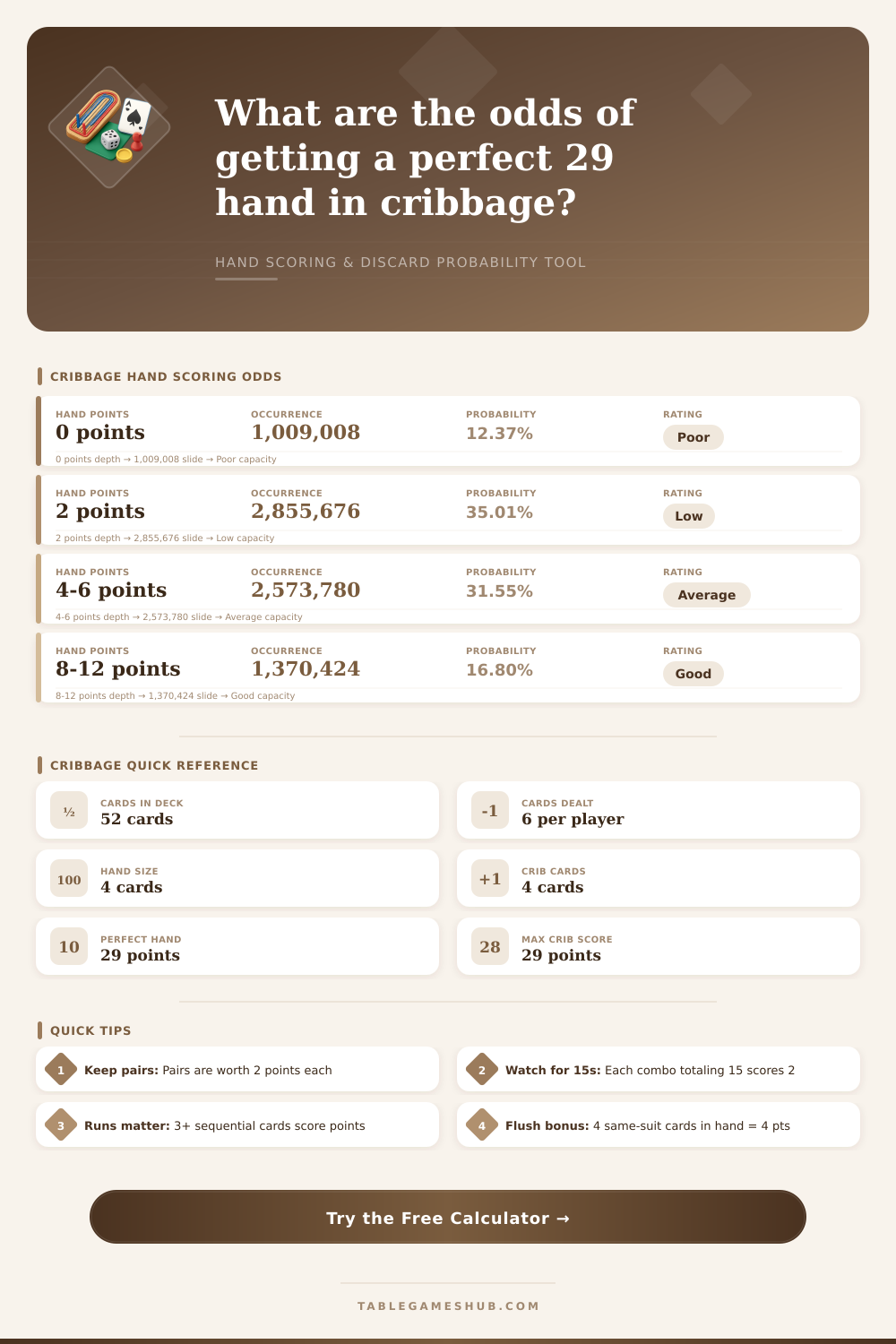
There are exactly 26 different points that can appear in a cribbage hand. They range from 0 to 29, but lack 19, 25, 26 and 27. So you simply cannot reach those numbers, no matter your cards.
The maximum score is 29. It happens if you keep three fives and the jack in the hand, and the starter card is the five of same suit as the jack. That gives one point for “his nobs“, which makes the total 29.
The chance for that perfect hand is 1 in 216 580. For it, you must receive exactly three fives, not four, together with the jack of the suit of the missing five.
28-point hand is also rare. It comes in two ways: receive four fives with starter card of 10-value, or three fives and another card, when the starter card helps. According to one calculation, the chance for 28 is 1 in 15 028.
In a two-player game with a random crib, the probablity for 28-hand is around 1 in 170 984, and for perfect 29 (1 in 3 248 700).
The card 5 has a special role in cribbage. Because all face cards value 10, keeping 5 strongly expands the chance to reach 15 in a pair. In the deck are sixteen such 10-cards, so 5 is genuinely strong.
Because of that many players keep their fives.
Zero-point hand really can happen. In practice a player chooses four from six received cards, so think the chance for a six-card zero-hand, around 1.36 percent, then a starter card that leaves you in zero.
The game is full of ups and downs. Suddenly one player seems a safe winner, but the opponent finds two or three good hands, passes him and wins. The chances for victory adjust according to points and position on the board.
Cribbage hands are not equally likely. For instance, combinations like 5-10-J-Q and 5-J-Q-K belong to the most common.