51st State Score Calculator
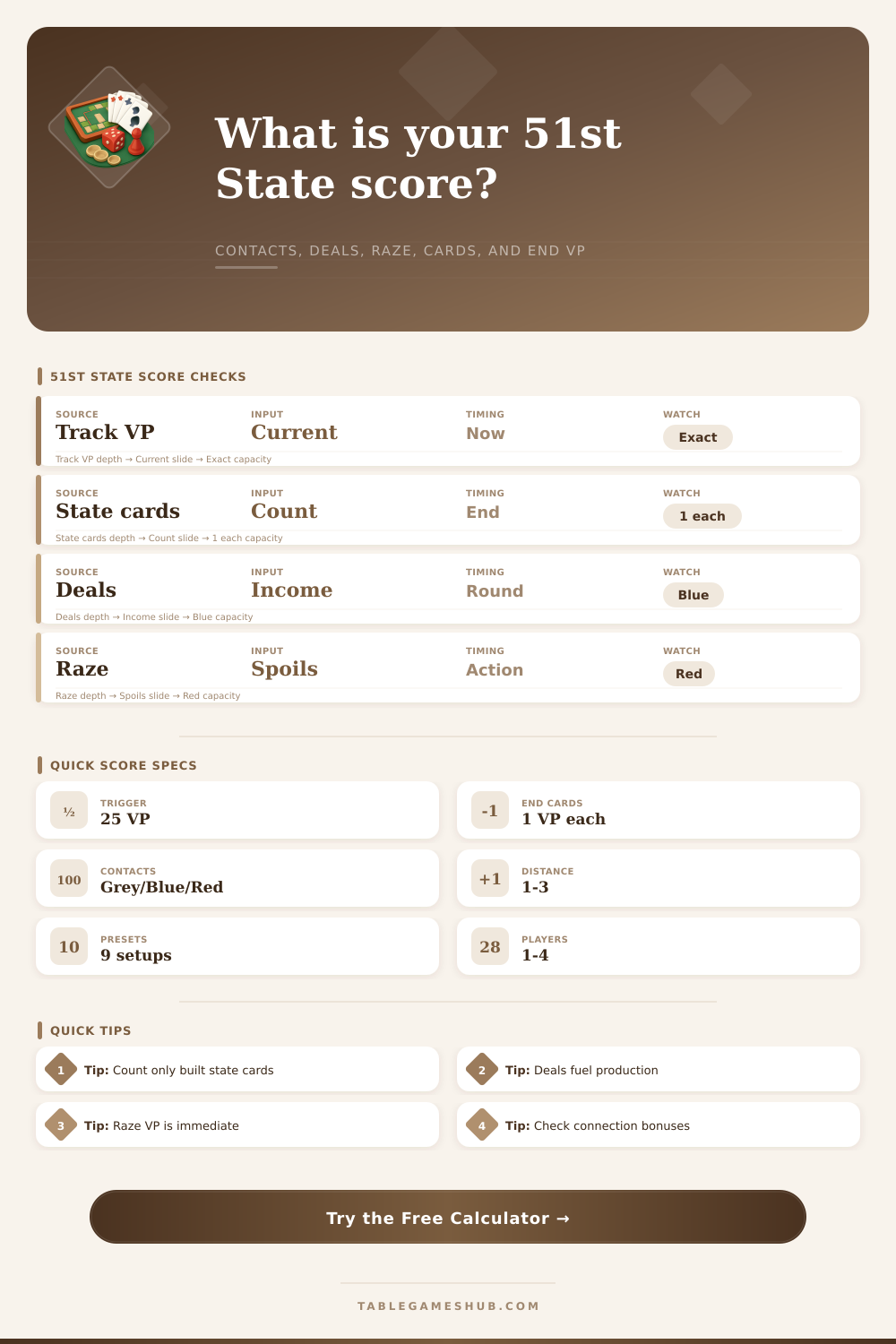
Audit current VP, state-card end scoring, production gains, deals, raze rewards, contact-token reach, resources, faction-board actions, printed card VP, and connection bonuses.
1Preset Score States
2Game State and End Scoring
3State Cards, Card VP, and Connections
4Production, Raze, Actions, and Faction Board
5Contacts and Resource Pressure
Faction hint: flexible grey contacts help build locations before converting resources into VP.
Score Breakdown
6Score Source Cards
7Reference Tables
| Score source | Calculator field | When it scores | Audit note |
|---|---|---|---|
| Current VP track | Current VP | Already scored | Include all VP tokens and score marker gains already earned. |
| State cards | Production, feature, action cards | Final scoring | Count built locations in your state, not deals tucked below the board. |
| Production VP | Production phase VP | Start of round | Includes production locations, deals, faction board income, and storage-safe goods. |
| Action VP | Action locations | During actions | Use only actions you have paid for or can still legally activate. |
| Raze VP | Raze effects | Immediate action | Count direct VP and spoils converted into scoring effects. |
| Contact type | Used for | Distance check | Common score impact |
|---|---|---|---|
| Grey | Build a location | Meet card distance | Adds a state card, printed VP, and future engine output. |
| Blue | Make a deal | Meet card distance | Improves next production and may trigger deal VP effects. |
| Red | Raze a card or enemy location | Meet distance or defense | Creates immediate goods, spoils, and burst VP opportunities. |
| Connection | Bonus cards or modules | Card-specific | Use connection fields for active icon and set scoring. |
| Faction board | Typical lean | Calculator focus | Endgame watch |
|---|---|---|---|
| Appalachian Federation | Flexible building and production | Grey contact, brick, action VP | Do not miss final state-card VP from late builds. |
| Merchants Guild | Deals and repeat income | Blue contact, deals, production VP | Deals do not count as built state cards unless a card says otherwise. |
| Mutants Union | Raze tempo and red pressure | Red contact, raze count, guns | Separate one-time spoils from repeat production. |
| New York | Card flow and conversion | Resources, card VP, connection sets | Check storage before valuing leftover goods. |
| Scoring pattern | Strong inputs | Risk | Calculator check |
|---|---|---|---|
| Wide state | Many grey builds and development | Low immediate VP | End scoring and printed card VP should justify the build. |
| Deal engine | Blue contacts and tucked deals | Too little final card VP | Production VP plus deal VP should beat one-shot raze lines. |
| Raze burst | Red contacts, guns, high-value spoils | Runs out of actions | Compare red reach and action VP before passing. |
| Connection finish | Active icons and complete sets | Missed prerequisite | Use connection cards and set values separately. |
8Scoring Tips
End card audit: count production, feature, and action locations in your state for final card VP. Deals are income cards unless a specific effect changes how they score.
Contact audit: compare grey, blue, and red contact value against the exact distance or defense of the card you plan to build, deal, or raze.
Resource audit: leftover goods only become VP through scoring cards, faction actions, storage, or conversion effects you can actually use before cleanup.
Connection audit: score active connection icons and completed sets separately so bonus cards do not get mixed into printed card VP.
Eventually, after playing through a few game in 51st State, you hit the end and your head starts splitting between what to do next. Should I spend my fuel? Should I spend my bricks? What’s the score getting towards? Can I afford to take an action? But knowing what to do is not enough; you also has to be able to act. Is it worth it? Will it put me in front of everything else?
That’s where the calculator shines. It reduces that mass of tokens and card into a single number. And with that, it eliminates the mental math from the equation. You don’t have to go through all of that when someone has done the arithmetic for you.
Why You Should Use the Calculator
Ultimately, the central conflict in 51st State boils down to timing versus tempo. You get a set of grey contacts that allow you to construct your own state. Sounds great, but then somebody steals your production line. Oh well, blue contacts will make money from deals. As long as you defend them, it’s an automatic engine. Red contacts are all aggression and they raze card for instant spoils.
The calculator helps divide up these options nicely, allowing you to quickly glance and see what is actualy working at any given time. It’s tempting to have a huge state going where you’ve got tons of location spread around the board. Looks sweet! But those cards won’t do jack if the other player gets to twenty five victory points before you can score ’em. Your pretty little grid means nothing if your opponent win first.
The tool shows this danger by displaying future totals based off your current position. In particular, deals are difficult. They stay beneath your board as untapped opportunity. When produced, they provides resources. They also occasionally provide VP during that production phase. But deals almost never contribute to the final scoring of state card without some special effect.
Players often undervalue deals, however… Thinking “I’m making money!” makes them feel strong. The calculator helps separate real-world production from end-of-game point values. It demonstrates that relying too much on deals may have you producing lots of stuff… but not actualy having many places for it! Your opponent might be building out connections slowly, but he already has enough to win by connecting all the dots first. Do you have enough production to overcome him?
Another form of pressure comes from Razing. It’s immediately worth either spoil or victory points (and disrupts an opponent) but also cost Gun tokens and sometimes red contacts. The calculator will help check if you’re close enough to an enemy location or other card to be able to raze it, while also ensuring that it’s worth the loss of the red contacts relative to its defense. You’ll need to balance short-term burst damage with long term building.
Sometimes, if you lack enough action left to legally hit something important, you’ll pass up the chance for early points because it isn’t worth the effort. And then there’s resources. These have additional wrinkles: Leftover goods only become victory points through specific conversion effects or storage safety checks. Before you clean up, you can plug all those leftover resource (iron, fuel, guns, bricks) into the calculator and determine whether it makes sense to convert them or not.
That way you won’t make the most common mistake I see people make… Thinking that any unused resource will somehow magically convert to VP at game end. In reality, most games involve some kind of mechanism where you actively convert excess resources into something useful. Then there are the Faction boards that tip this scale even more. The Merchants Guild tips towards networks of deals. The Appalachian Federation bends towards flexible builds. The Mutants Union feeds off a faster tempo of razes, and New York specializes in card flow.
Every preset in the calculator reflects those strategic biases. It shifts how the hints line up with your style of play to show you which way your faction leans and what lags behind. That contextual feedback lets you know whether or not you should of pushed for one more build or risk putting off your endgame trigger.
At its core, 51st State boils down to a race against time and your fellow player. You have to decide how aggressively to build while not being too aggressive, when to take the final score, and how much to earn versus how many points to spend in total. With the calculator, these decisions don’t come with any second guessing: no counting each token on the table. It takes the guesswork out of a game and turns anxiety into strategy.
Once you stop calculating it all out, you’re able to play it. That change in mindset often means the difference between winning decisively or losing closely. You walk into the last round knowing exactly how you’ll get your points, what you need to do to get them, and where they will come from. It is less a puzzle then more a plan.