21 Card Rummy Calculator
Check a 21-card rummy hand by declaration route, pure sequences, tunnelas, dublees, joker groups, exposed card points, value-card bonuses, drops, caps, and wrong-show penalties.
No pure: all hand points count
min(raw exposure, cap)
cut + upper + lower + marriage
value credit - capped loss
| Route | Minimum | What counts | Calculator check |
|---|---|---|---|
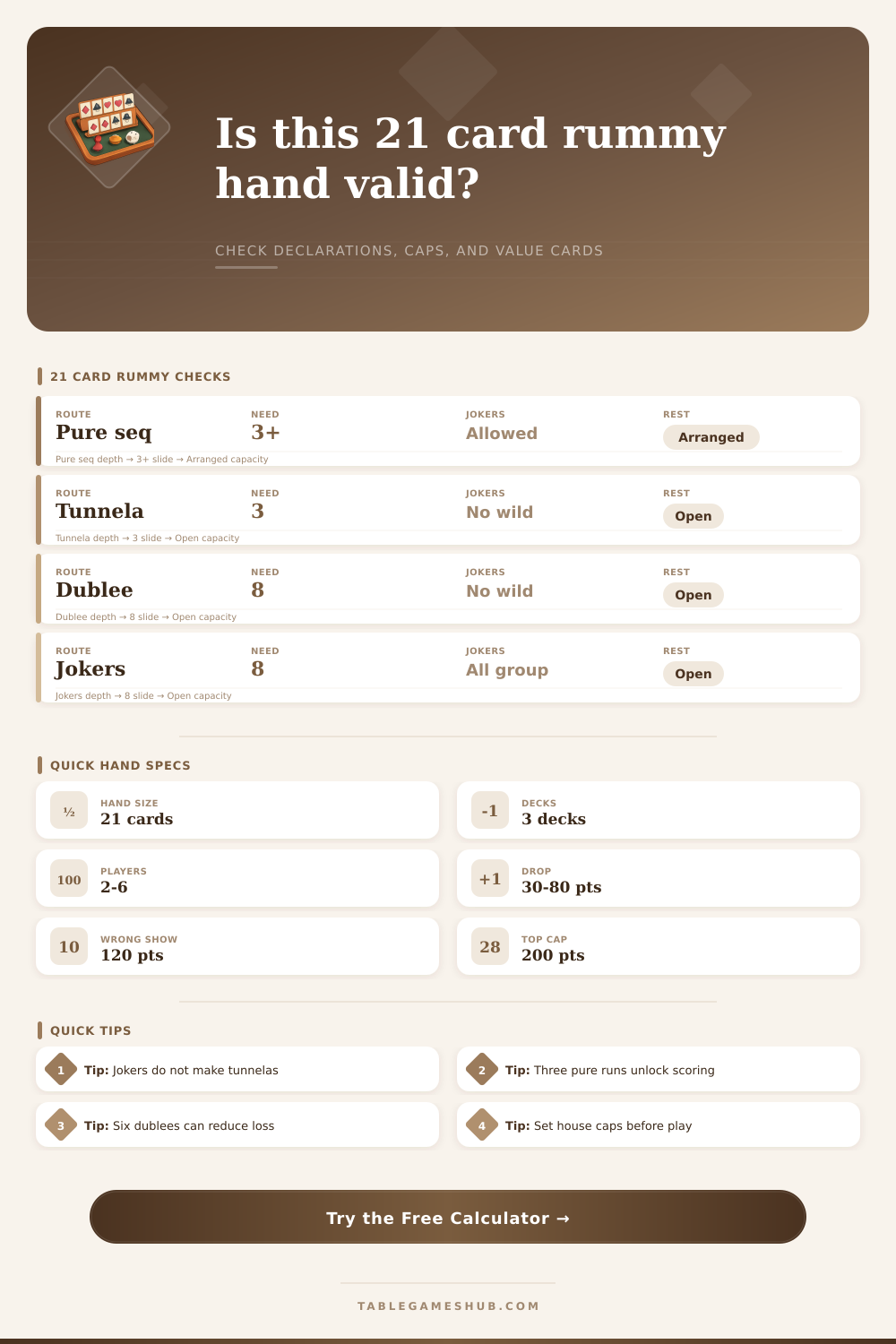
| Three pure sequences | 3 pure runs | Pure same-suit sequences; tunnelas can satisfy pure-route logic | Pure count plus no exposed points |
| Three tunnelas | 3 tunnelas | Three identical rank-and-suit cards from different decks | Tunnela count at least three |
| Eight dublees | 8 pairs | Two identical cards per pair; wild joker substitution is not used | Dublee count at least eight |
| Eight jokers | 8 jokers | Jokers grouped together in one declaration group | Joker group count at least eight |
| Value card group | One card | Two cards | Three cards |
|---|---|---|---|
| Cut joker | 10 | 30 | 50 |
| Upper joker | 10 | 30 | 50 |
| Lower joker | 10 | 30 | 50 |
| Marriage | 100 | 300 | 500 |
| Case | Common | Strict | How calculator applies it |
|---|---|---|---|
| First drop | 30 or 40 | 30 | Fixed first-drop field |
| Middle drop | 70 or 80 | 70 | Fixed middle-drop field |
| Normal exposed loss | 120 cap | 120 cap | Raw exposed points capped |
| Wrong show | 120 | 120 | Fixed wrong-show field |
| Card or state | Point value | Protected when | Score note |
|---|---|---|---|
| A, K, Q, J | 10 each | Inside valid groups | High exposure if no pure run |
| 2 through 10 | Face value | Inside valid groups | Use total pip points field |
| Jokers | 0 deadwood | Can form impure groups | Cannot fake a tunnela or dublee |
| Six dublees | Protection route | When house rules allow | Calculator uses exposed points |
When you have a twenty-one card hand and see that it’s not shaping up properly, don’t panic. Your gut instinct told you something else would of been on the table. So there are all these ranks and suits in a mess, and you’re wondering, “Is this really a sequence or am I just imagining things?”
That’s where this calculator comes into play; it will resolve such debates before they escalates to a fight around card table. It doesn’t just tally points; more importantly, it tests whether your declaration follow the rigorous rules governing this variation.
How This Rummy Calculator Works
For anyone who has played rummy before, the initial hand in game is quite strong. It changes the psychology because you get three times as many cards as normal player, so your rewards are higher, and so are your errors. To help people work through this complexity, the tool enables players to choose their declaration route upfront.
Why? Because not every winning hand are scored identically. Perhaps you believe you’ve got three tunnelas (three identical card sets each from different decks). The math will need to back up those claims, and that’s no mean feat.
The calculator alerts you instantly if you fail to reach the required threshold. You can’t declare too soon on a hand that appear great but turns out technically invalid under house rules. Most players get off-track here when they fail to distinguish between a pure sequence and an impure one. Pure sequences consists only of naturaly cards in your possession. They do not contain any joker/wildcard cards.
Since having at least three is often what makes a show legitimate, the calculator will keep track of how many pure runs you have. Lacking that third pure run means all those other random cards are liabilities. The tool then computes your exposed points based off what’s leftover after you create your melds. It divides this into protected points (those safely tucked within your runs and sets) versus raw points that is left exposed and burn money.
And of course there are doubles and jokers to consider. In some tables, if you group together eight dublee pairs or eight joker cards, then you don’t need to worry about sequence at all. You can turn those options on and off within the app’s various profiles, so it calculates your points based on whichever ruleset apply.
It will take into account marriages (or other value cards like cut jokers) that give you a credit, offsetting part of your total loss. That’s especially handy when you’re down and just trying to lessen your losses. Even though you might be at a deficit, knowing that the particular mix of cards in your hand knocks off X number of points can tell you if you should just give up now or keep fighting through.
Another layer of strategy is dropping. It’s fast math and it goes something like this. You’re deciding whether to cut your losses and drop out. The calculator takes into account the normal penalties for first, second, or third drops. These are flat fees, so they don’t care what is on your cards.
Knowing what those fees are ahead of time lets you compare the cost of staying in vs. You can choose to cut your losses. There’s no “whoops” in who gets counted right after the drop happens. No one argues about the score because there’s a clear set of rules ahead of time.
The tools come with a reference table explaining all of these variants, ranging from the stricter caps to looser house rules. In sum: Twenty-one card rummy is about finding order in a deck of chaos and learning when to take risks.
All the time you are juggling wanting to get melds but not wanting to show your opponent a bunch of good cards. Knowing what to pick up and discarding are about strategy, and that’s where this calculator comes in. It does the arithmetic so you can think about strategy. And thinking about strategy means knowing exactly how bad a hand is instead of just feeling like it is bad.
Having a clear sense of where you stand will help you make better decisions whether you are shooting for the moon with triple tunnels or hoping to keep your head down and only expose yourself enough to limp by. Understanding the cards is important; understanding the math is important too, and the game rewards both.