Wingspan Bonus Card Calculator
Estimate current tier points, expected qualifiers, hit odds, and whether another bird play is worth the endgame tradeoff.
Bonus Card Projection
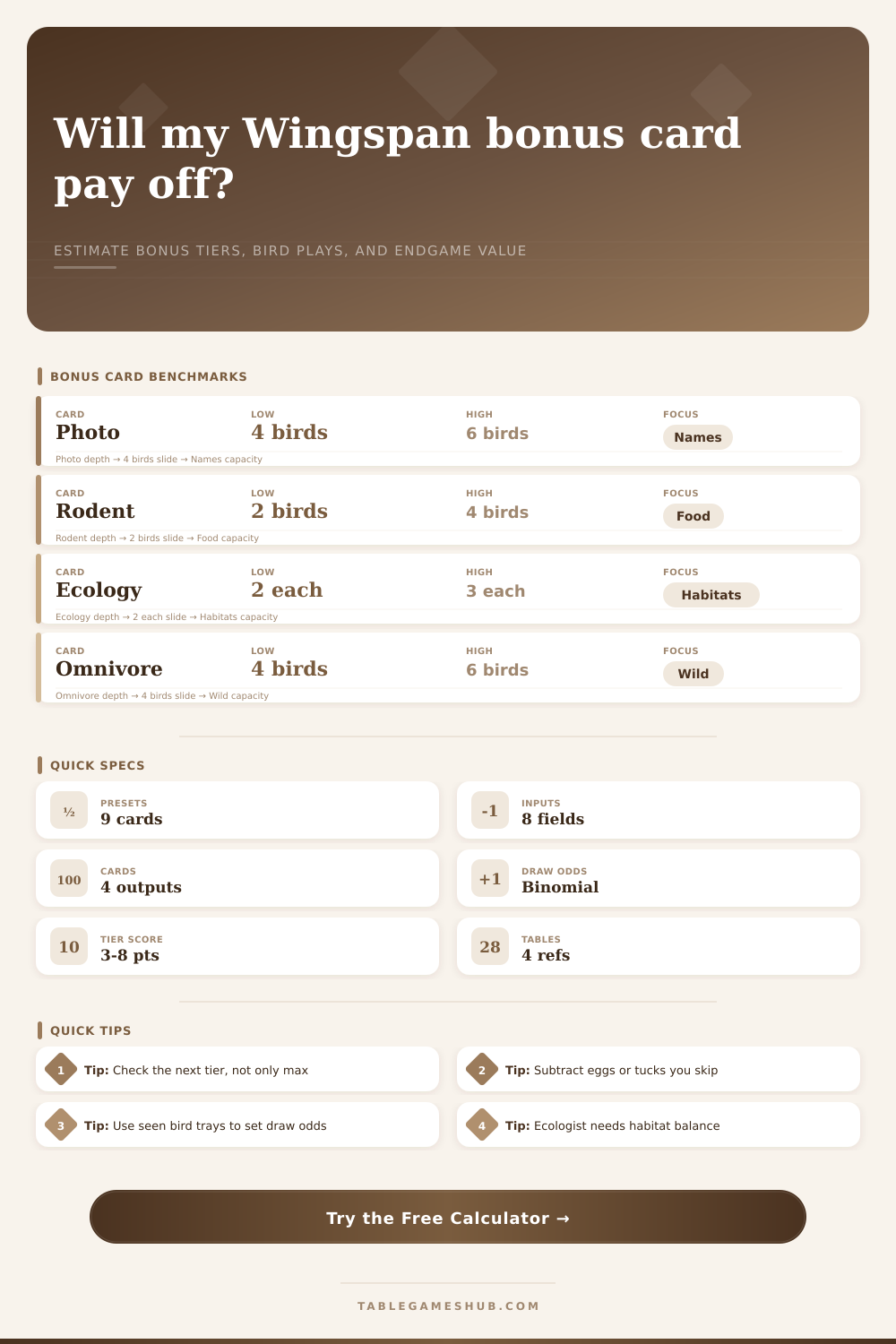
| Bonus card type | Qualifying feature | Low tier | High tier |
|---|---|---|---|
| Photographer | Bird names with color words | 4 birds for 3 points | 6 birds for 7 points |
| Rodentologist | Birds with rodent food icons | 2 birds for 3 points | 4 birds for 6 points |
| Ecologist | Qualifiers spread across habitats | 2 in each habitat for 3 points | 3 in each habitat for 8 points |
| Omnivore Specialist | Birds with wild food icons | 4 birds for 3 points | 6 birds for 6 points |
| Fishery Manager | Birds with fish food icons | 2 birds for 3 points | 4 birds for 6 points |
| Situation | Suggested chance | Use when | Calculator effect |
|---|---|---|---|
| Known bird in hand | 90% to 100% | You can pay and place it | Nearly certain target progress |
| Bird tray has one fit | 55% to 75% | Food and habitat are plausible | Strong expected qualifier value |
| Deck search only | 20% to 40% | You need blind draws or wetland churn | Moderate chance, swingy result |
| Food or space blocked | 5% to 20% | A qualifying bird is hard to play | Low hit odds, cost matters more |
| Endgame action skipped | Typical value | Use as cost | Notes |
|---|---|---|---|
| Lay eggs once | 2 to 5 points | 1.5 to 3.5 per play | Depends on open egg spaces and powers |
| Tuck engine action | 2 to 6 points | 2 to 4 per play | Higher if cards cycle and tuck together |
| Cache food action | 1 to 4 points | 1 to 2.5 per play | Predator and caching birds vary widely |
| Play bird setup | 0 to 3 points | 0 to 1.5 per play | Use lower cost if bird points are strong |
| Habitat spread | Ecologist read | Other cards read | Endgame note |
|---|---|---|---|
| 1 habitat represented | Unbalanced | Narrow search | High risk unless target is already close |
| 2 habitats represented | Almost balanced | Flexible | Useful when one more bird opens scoring |
| 3 habitats represented | Balanced | Broad search | Best for multi-habitat or food-icon chases |
In the endgame, though, it’s all about weighing the risks and rewards in Wingspan. With only three plays left for birds, it can come down to whether you’ll pursue certain qualifiers (risky) or focus on guaranteed points through tucks and eggs (safe). It’s this back-and-forth that will decide who wins the match.
Once you input where you are at any given moment, the calculator calculate the rest. No more guessing if you should risk it or not. Counting birds isn’t as important than understanding what they cost you. For each bird action you play in hopes of hunting down a bonus, you is forfeiting an additional action.
How to Use the Wingspan Calculator
That could be missing out on laying an egg on an open engine that’s about to hatch. Or it could be skipping over a card that will feed your team for free in the coming turn. Because of these kinds of common end game blunders, the tool asks for what you give up per play.
The tool asks for opportunity cost per play because ignoring it lead to the most common mistake in endgame strategy. Sure, you got the bird and made the tier; that felt good. But you paid four points of safe egg scoring to earn three bonus points, so overall you’ve lost value.
The field then subtracts those skipped actions from expected bonus gain, and displays net total, showing the true picture. And if the number is negative, the chase wasn’t a great bet, even if it looked like one on the board.
The draw chance input requires an honest assessment of the state of the deck and its trays and how much is realisticly going to come off within the next few turns. Your odds are good if there’s a bird you’re looking for face up in forest habitat and you know exactly where it is. Your odds are not so good if your target is a food type that’s been depleted from the main supply and the wild tray are empty.
The probability also depends on what you can realisticly pull from the deck over the next few turns. Use the reference tables on page to break those out. They will help you see how often you should of expect to get something, whether you are fishing blind or have some idea what you want. A realistic percentage here changes everything, don’t be optimistic in final rounds.
Certain bonus cards simply ask for volume; others ask for a certain spread of resources. For example, the Ecologist asks for a balanced spread across all three habitats, making it more difficult to pursue late-game. Since you can’t just play any bird that appears, you have to find a bird that fit into an open habitat slot and also fulfills the bonus requirement.
The Photographer role is easier, but it requires a high volume of birds (four or six birds with color names). The calculator accounts for this complexity by allowing you to enter your target tier. Do you want to go for a safe tier, or push for maximum points? How many qualifiers do you realy need? That changes the math a lot.
Finally there’s memory on the deck. How many wetland birds have you already seen? None of them qualify? That will impact your draw odds accordingly, so you should factor that into your decision making as well.
The tool won’t keep up with your own deck for you, but it gives you a framework to approximate those odds. What do you know is in your hand, and what has been played out? Feed those into the draw chance and remaining plays fields. It converts your intuition to a quantatitive risk assessment.
Wingspan is all about managing resources on the fly. The high unpredictability of the bonus cards makes them a factor in that equation. They’ll sometimes be a good investment, other times you’ll be draining your engine for very little return.
Emotionally remove yourself from the decision by running those scenarios through a simple model. Take points when the odds support it and don’t chase after points just because they sound nice. Every bird you play should be pulling its weight, because the game ends soon enough.