Wingspan Asia Duet Calculator
Total a Wingspan Asia duet sheet with printed bird points, bonus cards, end-round goals, eggs, cached food, tucked cards, duet map tokens, and optional nectar scoring for mixed-expansion games.
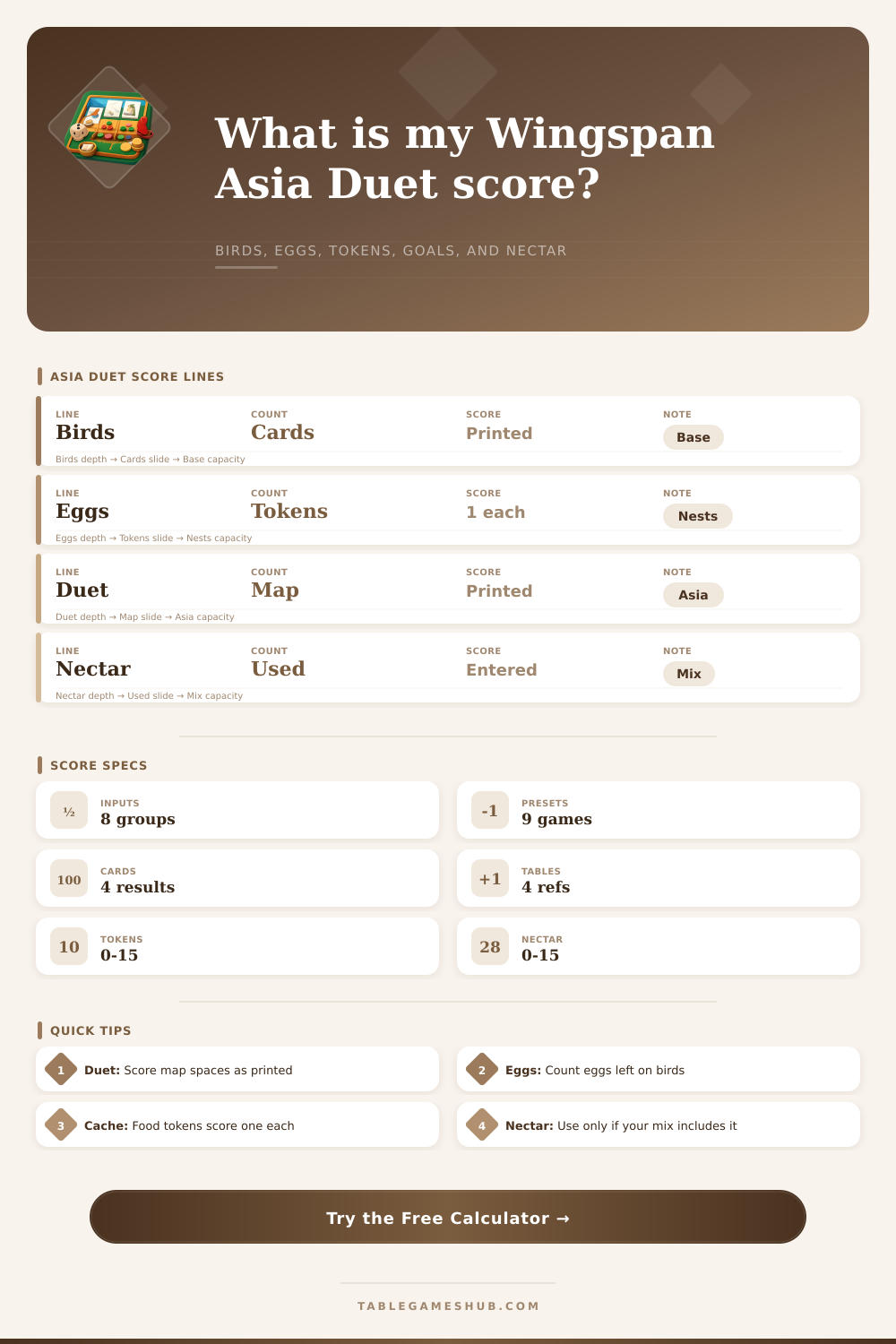
| Score row | What to count | Point value | Common audit note |
|---|---|---|---|
| Bird points | Played bird cards | Printed values | Do not count tucked cards here. |
| Bonus cards | Completed bonus cards | Card text | Check partial thresholds before final total. |
| End-round goals | Four round markers | Goal board | Use the score already earned each round. |
| Duet map tokens | Occupied duet spaces | Printed map points | Count map points after the last turn. |
| Component | Where it sits | Score each | Audit reminder |
|---|---|---|---|
| Eggs | On bird cards | 1 point | Ignore empty nest capacity. |
| Cached food | On bird cards | 1 point | Count food tokens, not food in supply. |
| Tucked cards | Under birds | 1 point | Fan stacks apart before recording. |
| Nectar | Habitat majority | Entered value | Use only with nectar expansion rules. |
| Final score | Band | Likely shape | Review point |
|---|---|---|---|
| Under 80 | Developing | Few late points | Check unused egg slots and bonus misses. |
| 80 to 99 | Solid | Balanced board | Look for one score line below 8 points. |
| 100 to 119 | Strong | Full engine | Duet map and goals likely carried weight. |
| 120 plus | Peak | Combo finish | Recount tucked cards and large caches. |
| Preset family | Main scoring source | Secondary source | Best use |
|---|---|---|---|
| Wetland and flock | Tucked cards | Eggs | Fast audit of card stacks. |
| Forest and cavity | Cached food | Bird points | Checks token-heavy boards. |
| Map rush | Duet tokens | End-round goals | Good for close two-player endings. |
| Nectar mix | Nectar points | Printed birds | Use when Oceania pieces are included. |
Separate map points from bird points: Duet map tokens are a public-board score line, so record them after birds, bonus cards, goals, eggs, cached food, and tucked cards are already counted.
Use nectar only when it exists at your table: Wingspan Asia by itself does not require nectar scoring, but mixed games can add nectar majority points as a final score line.
Wingspan Asia Duet has an ambiguous last tally unless you just add them up yourself. You can play a solid game and create nice combos, only to realize you didn’t get the results you expected as quick as you thought. This make keeping track of that much easier. All those things is automatically totaled (points from nectar), goal, bonus cards, duet tokens, tucked cards, cached food, eggs, and birds.
Bird forms provide some of the points that make up your score. Typicaly, over forty percent of your points come from numbers printed on cards. With the calculator, those points gets separated out from everything else so you can see how much your bird engine did versus how much you scavenged from public goals. If you have a high printed value, you need fewer token points to win. If your core birds is strong enough, you don’t necessarily has to go after all the map space.
How to Keep Score in Wingspan Asia Duet
Token scoring causes lots of confusion. Getting one point for an egg, cached food, or a tucked card can be part of completly different strategies. For example, tucking a card may was strengthening your long term engine, whereas using eggs may mean temporarily placing on a nest. To help with this, the tool combine these points into what it calls an “engine” total. It gives you some sense of how well you’ve constructed a sustainable system rather than simply cobbled together components.
Did you end up with a bunch of tokens but not much engine? You probably was playing reactively. That’s helpful to know when preparing for the next round.
The public scoring make it even more interesting. As the round goes on, your end-round goals and duet map tokens shift. If you grab a good spot early on Asia map, for example, its worth can go down as other player crowd your neighbors or take higher-value spaces. The calculator just grabs sum total from those filled-in spaces and adds them up nicely.
And if you’re playing with expansions (which most people tend to do), it accounts for nectar scoring without making you try to remember it all. This is one place where mental math tends to fail. Separating the nectar keep things distinct so you don’t forget about majorities from habitats in your own combination, and then accidental count ’em twice.
To get a reality check on your strategy, I recommend looking at reference tables on page. These tables categorizes the scores into bands based off their performance level, from developing through to peak performance. These will help frame if your score was competitive in that game state. If you scored below eighty it means you probably left some opportunities on the table in later rounds. Something above one-hundred-twenty means you were able to combine several scoring path and not leave too many gaps.
This is important because a raw number alone doesn’t tell you much about how well you played relative to the state of the board. For example, there are presets such as Mountain Raptor Map Rush or Bamboo Wetland Egg Bank. These names captures popular strategic archetypes that you’ll see time and again. If you choose one whose overall approach is similar than yours, then you’re able to plug in the details rapidy. That lowers the difficulty and helps you concentrate on picking apart the breakdown instead of fumbling around for misplaced tokens.
It’s one thing to have a number. It’s another to understand why that number came out as it did. Did you get a lot of points for birds, while relying too much on one kind of scoring? Was your duet map share disproportionately small compared to bird points? Questions like these transform an exercise of calculation into one of learning. After all, what do numbers mean if not something to dissect and learn from?
And when the arithmetic is finished, we are left with nothing but data, free from the distractions of adding and subtracting. You should of seen it. We can then appreciate the choices that brought us to our end point.