Water Balloon Trajectory Calculator
Estimate landing range, target error, flight time, peak arc, wind drift, and splash zone from launch speed, angle, balloon fill, wind, and target height.
| Preset | Launch method | Speed | Angle | Target use |
|---|---|---|---|---|
| Kids yard toss | Gentle lob | 14 mph | 32° | Short grass target around 20 ft |
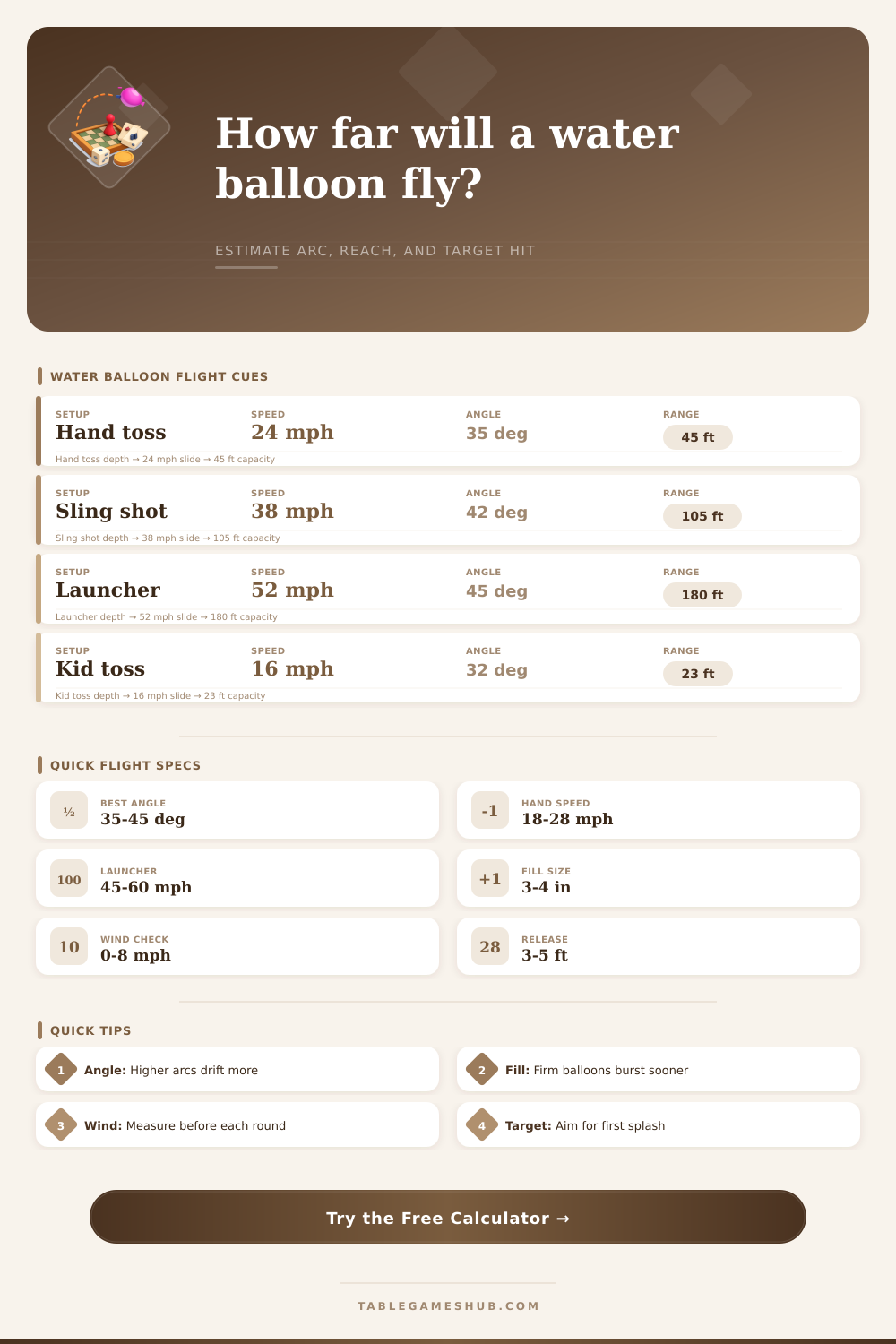
| Field day lane | Hand toss | 28 mph | 38° | Medium bucket or tarp station |
| Two-person sling | Sling pouch | 38 mph | 42° | Long lawn target with a high arc |
| Three-person launcher | Team launcher | 52 mph | 45° | Open field range challenge |
| Backyard catapult | Small catapult | 34 mph | 48° | Repeatable mechanical launch testing |
| Method | Usual speed | Consistency | Arc style | Calculator note |
|---|---|---|---|---|
| Underhand toss | 10-18 mph | High | Soft lob | Best for close targets and younger players |
| Hand throw | 18-32 mph | Medium | Flexible | Use video timing if no radar estimate exists |
| Two-person sling | 30-45 mph | Medium-low | High arc | Small release angle changes move impact a lot |
| Three-person launcher | 45-60 mph | Low-medium | Long arc | Use a wide hit buffer for early practice |
| Small catapult | 25-40 mph | High | Repeatable | Measure release height and angle carefully |
| Fill profile | Approx mass | Diameter | Drag feel | Splash behavior |
|---|---|---|---|---|
| Mini target balloon | 70 g | 2.5 in | Lower area, light mass | Small splash, easier to carry |
| Small water balloon | 120 g | 3.0 in | Balanced for hand toss | Moderate splash and good control |
| Standard water balloon | 180 g | 3.5 in | Stable but draggy | Good target splash for most games |
| Large water balloon | 260 g | 4.0 in | Heavy with larger drag area | Wide splash, shorter useful range |
| Overfilled balloon | 340 g | 4.5 in | Very draggy and fragile | Big splash with high burst risk |
| Angle band | Trajectory feel | Best distance | Wind exposure | Adjustment cue |
|---|---|---|---|---|
| 15-25° | Flat throw | Short to medium | Low | Add angle if landing short |
| 26-35° | Controlled arc | Medium | Medium | Good for bucket or tarp targets |
| 36-45° | Range arc | Medium to long | Medium-high | Best open-field starting point |
| 46-60° | High lob | Obstacle or drop target | High | Reduce angle when wind drift grows |
| Condition | Range effect | Side drift | Splash zone | Setup check |
|---|---|---|---|---|
| Still grass | Baseline | Minimal | Moderate | Mark first wet spot for scoring |
| Headwind | Shorter | Low | Moderate | Increase speed before raising angle |
| Tailwind | Longer | Low | Moderate-wide | Move target back or lower angle |
| Crosswind | Similar | High | Offset splash | Aim upwind by the drift estimate |
| Pavement target | Similar | Minimal | Wide | Use a larger buffer for spray and skid |
Water balloon flight involve several variable that will determine where the water balloon will land. Many people focus on the speed of the water balloon that is being launch into the air, but there are other variables that impact where the water balloon will land. These variables includes the angle of the throw of the water balloon, the fill level of the water balloon, and the speed of wind.
Each of these variables can be accounted for in a calculator that will help to determine where each water balloon will land. The calculator process each of these variables to reduce the guesswork involved in a water balloon game. The speed at which a person launches the water balloon is one of the primary variables that will determine the distance that the water balloon will travel.
What Affects Where a Water Balloon Lands
Slow underhand tosses will go a slowerer distance than a catapult. The speed of the water balloon must be consistent. If the speed of the water balloon change significently from one launch to the next, then the water balloon will land in different spot.
However, if the speed is held constant, the distance that the water balloon will travel can be accounted for in the calculator. Another variable to consider is the angle at which the water balloon is thrown. If the angle of the throw is flat to the ground, the water balloon will remain close to the ground.
Additionally, if the angle of the throw is flat to the ground, the water balloon will remain in the air for a shorterer period of time. Because the water balloon remains in the air for a shorter period of time, the effect of the wind on the water balloon is reduced. Throwing the water balloon high into the air allows for the water balloon to go a greaterer distance on calm days.
However, a high angle allow for the wind to move the water balloon sideways. A common angle for water balloon games is between thirty and forty-five degree. At these angles, the water balloon reach its peak height and travels the greatest distance.
The calculator allow for the angle of the throw to be selected; the calculator will display the resulting distance of the water balloon. The size of the water balloon is another variable. Small water balloons will slow down quick.
Additionally, small water balloons will drift from the intended path of the water balloon. The opposite variable of using a large and tight water balloon will allow the water balloon to carry itself farther. However, the increased chance of the water balloon burst is a disadvantage of the larger water balloon.
The calculator take into account the size and firmness of the water balloon. The speed and direction of the wind will move the water balloon several feet from the targeted spot. A headwind will shorten the distance of the water balloon.
A tailwind will extend the distance of the water balloon. Crosswinds will move the water balloon to the side without changing the forward movement of the water balloon. The calculator take into account the speed and direction of the wind so that the distance that the water balloon will travel can be accounted for.
Another variable to consider is the height from which the water balloon is released and the height of the target for the water balloon. Water balloons that is released from heights such as the shoulder will travel further than water balloons that are released from heights such as waist level. If the target of the water balloon is above the ground level, the water balloon will have to reach that height.
The calculator allows for the height from which the water balloon is released and the height of the target to be entered into the calculator. The type of landing surface that the water balloon will land on is another variable. If the water balloon lands on grass, the grass will absorb some of the impact of the water balloon.
Additionally, if the water balloon lands on grass, the splash of the water balloon will remain contained within the grass. If the water balloon hit a pavement or tarp surface, the water balloon will skid or burst upon impact. The splash of the water balloon on pavement will be greater than on grass.
The calculator take into account the type of surface upon which the water balloon will land. There are also reference tables that show the speed and angles of various type of water balloon throws. Additionally, there are other tables that show the effect that different fill size and winds have upon the water balloon flights.
These tables can be used as a starting point to create a water balloon game. These tables work in conjunction with the calculator to determine the actual flight of the water balloon. A common mistake that people make when throwing water balloons is treating each water balloon throw as if it are independent of the others.
The first few water balloons that is thrown will tell a person the conditions of the wind and the air. For example, if the water balloons land short of the target, the balloons may have been overfilled or the air may be heavy. If the water balloons consistently drift to the left, there may be a crosswind.
Balloons should be adjusted for only one variable at a time so that each individual can determine which variable is affecting the flight of the water balloon. The burst risk of the water balloon will change based on the speed at which the water balloon hit the ground. The faster the water balloon travels, the more force with which it will hit the ground.
The increased force increase the chance that the water balloon will burst upon impact with the ground. This variable is accounted for in the water balloon calculator. Before the game begins, it is useful to run the number for the different variables in the game.
For example, a higher angle will allow the water balloon to clear higher distances; however, it might be better for the water balloon games to use a lower angle on days when the wind is likely to move the water balloon laterally from its targeted spot. Additionally, small water balloons might help with the drift of the balloon from its targeted spot; however, it may reduce the distance that the balloon will travel. These variables can all be seen in the calculator in how they may impact the flight of the water balloon.
Water balloon games require attention to detail. While a water balloon calculator will not eliminate the need for practice with water balloons, it will significantly reduce the unexpected outcome that may occur during a water balloon game. If a person can estimate where the water balloon will land, it is possible to make adjustments to the way in which the water balloon is thrown.