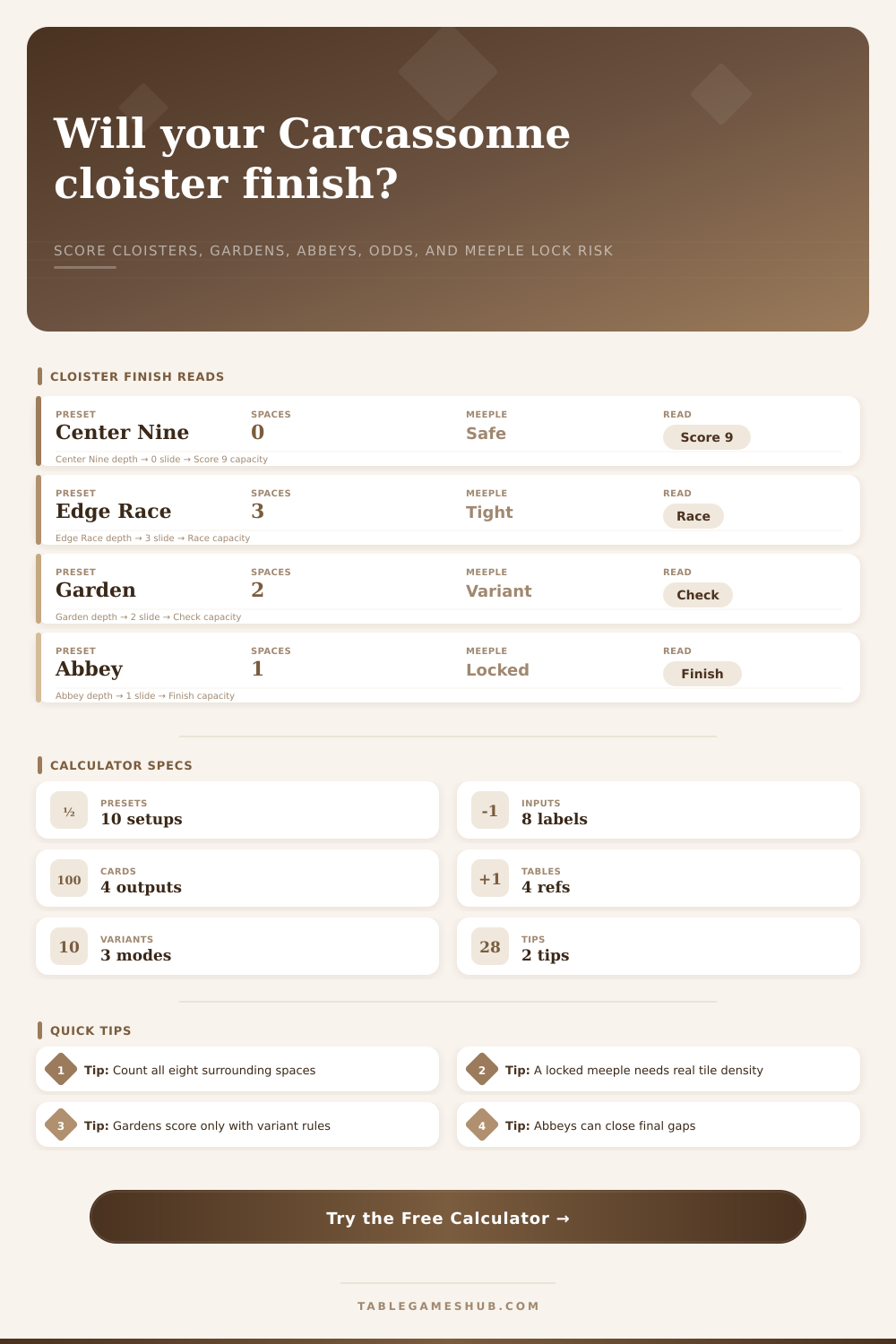
Carcassonne Cloister Scoring Calculator
Estimate cloister, garden, and abbey finish value from surrounding tiles, open spaces, meeple availability, turn tempo, tile deck density, board conflicts, and variant scoring pressure.
1Cloister Presets
2Cloister Position Inputs
Cloister Breakdown
3Cloister Reference Tables
| Placed Around | Open Spaces | Current Points | Finish Read |
|---|---|---|---|
| 0-2 tiles | 6-8 | 1-3 | Early claim only if meeples are plentiful. |
| 3-5 tiles | 3-5 | 4-6 | Playable if it does not freeze your last follower. |
| 6-7 tiles | 1-2 | 7-8 | Strong chase; watch exact fit and blockers. |
| 8 tiles | 0 | 9 | Complete immediately and return the meeple. |
| Density | Use When | Odds Effect | Planning Note |
|---|---|---|---|
| Low | Awkward city, road, or field edges | Penalty | Do not trap your final meeple for a weak promise. |
| Normal | Most midgame cloisters | Neutral | Turn estimate drives the completion chance. |
| High | Flexible open countryside or many fitting edges | Bonus | Race the last two spaces before opponents pivot. |
| Wild | Abbey or wild gap access | Large bonus | One open space can become a controlled finish. |
| Conflict | Risk | Why It Matters | Best Response |
|---|---|---|---|
| Farmer field | Medium | Useful field edges may feed someone else's endgame. | Take clean filler if it does not improve their field too much. |
| City edge | Medium-high | City caps and cloister needs can fight for the same tile. | Prefer placements that close both features. |
| Road lock | Medium | Road stubs can reduce legal surrounding tiles. | Check road continuity before committing a meeple. |
| Mixed | High | Multiple feature edges lower available tile fits. | Treat the cloister as a bonus unless completion is nearly done. |
| Mode | Base Target | Adjustment | Table Reminder |
|---|---|---|---|
| Standard cloister | 9 points | No modifier | Scores itself plus eight surrounding tiles. |
| Garden variant | 9 points | Small uncertainty cost | Use only if your table scores gardens like monasteries. |
| Abbey helper | 9 points | Completion boost | Abbey access can close a stubborn final hole. |
| Strict final | Placed tiles only | No expected bonus | Use current score when completion is unlikely. |
4Spec Grid
5Two Cloister Tips
Tip: A seven-point unfinished cloister is already strong, but the eighth surrounding tile is often worth more than one point because it returns the meeple before scoring fights start.
Tip: When farmer or city conflicts surround the target, count whether the closing tile helps an opponent; a nine-point finish can still be a bad tempo trade.
Of all the features in Carcassonne, the one that is most deceptively simple is also the most annoying: the cloister. Looks easy enough, drop a follower down there and then let nature take its course as you wait for eight adjacent tiles to be filled by any legal cardboard thing-a-ma-jiggy. It is nine points total, which is a pretty good deal, right?
Sounds nice, but the board doesn’t give a rat’s rear-end about how nice. The board only care about you having enough followers to sling around and what the future looks like. There has got to be something that helps players see through the bare potential to actualy assess their odds of getting to the finish line.
Why Cloisters Are Harder Than They Look
When most novices encounter the cloister they see it as a place to park one extra dude (but that’s where they go wrong). Unless you actualy control tiles next to the cloister, there is no point in claiming it. Fewer cards will fit legally when you’re surrounded by long roads and city walls; your open area get smaller and smaller. Plug those variables into the calculator above and let the calculator do the math: no more guessing at whether you’ve built yourself an asset or a liability.
Instead, it forces you to face facts about tile density. With a depleted deck, and few fitting pieces left, that nine-pointer become a four-pointer, with nowhere to go but into the lonely arms of orphanhood. Might as well drop that meeple on a small road and call it good.
And time isn’t kind either. If you’re planning to play a cloister early, make sure you’re willing to wait. Because every turn you spend following those last few tiles is a turn your opponent get to lock down roads and expand cities. To try to account for this, the tool will look at how many turns you have left. It will also see how much pressure you are under from opponents.
This high table pressure mean someone is going to be closing off your spaces and putting tiles out there that work for them rather than for you. It’s little things like this, but they add up. What seems like a perfect hiding spot on its own can be a trap once consider within the broader context of board flow.
To make things more difficult, you might have conflicts: occasionally you must use the tile to complete someone else’s giant city while it completes your monastery. The result? It is a standoff, as each player is unwilling to give up the other player’s win condition. This is when the calculator gives its conflict drag factor, it recognizes that sometimes, forcing the other guy to spend his turn somewhere else is better than completing your own feature. You’re not only playing against the deck now. You’re playing against the incentives on the table.
There are variant rules, too: Some groups treat gardens or abbeys with modified scoring, which changes the risk calculus entirely. And this is where house rule playing table on the page clarifies things for anyone who plays by house rules. In normal games, too, there’s the question of whether it’s better to lock down your last meeple or not. You may tie up their last meeple and end with all of yours going back home while they return with theirs. Because of this, that last point might not be enough to win by a margin.
Why does it work? It works because it encourages being flexible instead of rigid. In the end, though, cloisters reward careful thinking over brute force. They test your ability to read the board state. They test your ability to guess the deck composition. They also test your ability to consider turn economy. The calculator does the math. Judgment determine whether to take the shot.
You should of considered those eight squares surrounding the monastery. Are they loaded with hostile edges? Let it go. Is the route open, and the tempo cost low enough to make it worthwhile? Take the shot. Just keep in mind that the emptiness of a cloister is not its greatest danger. Its greatest danger is the waiting time it consume.