Gaia Project Frontiers Calculator
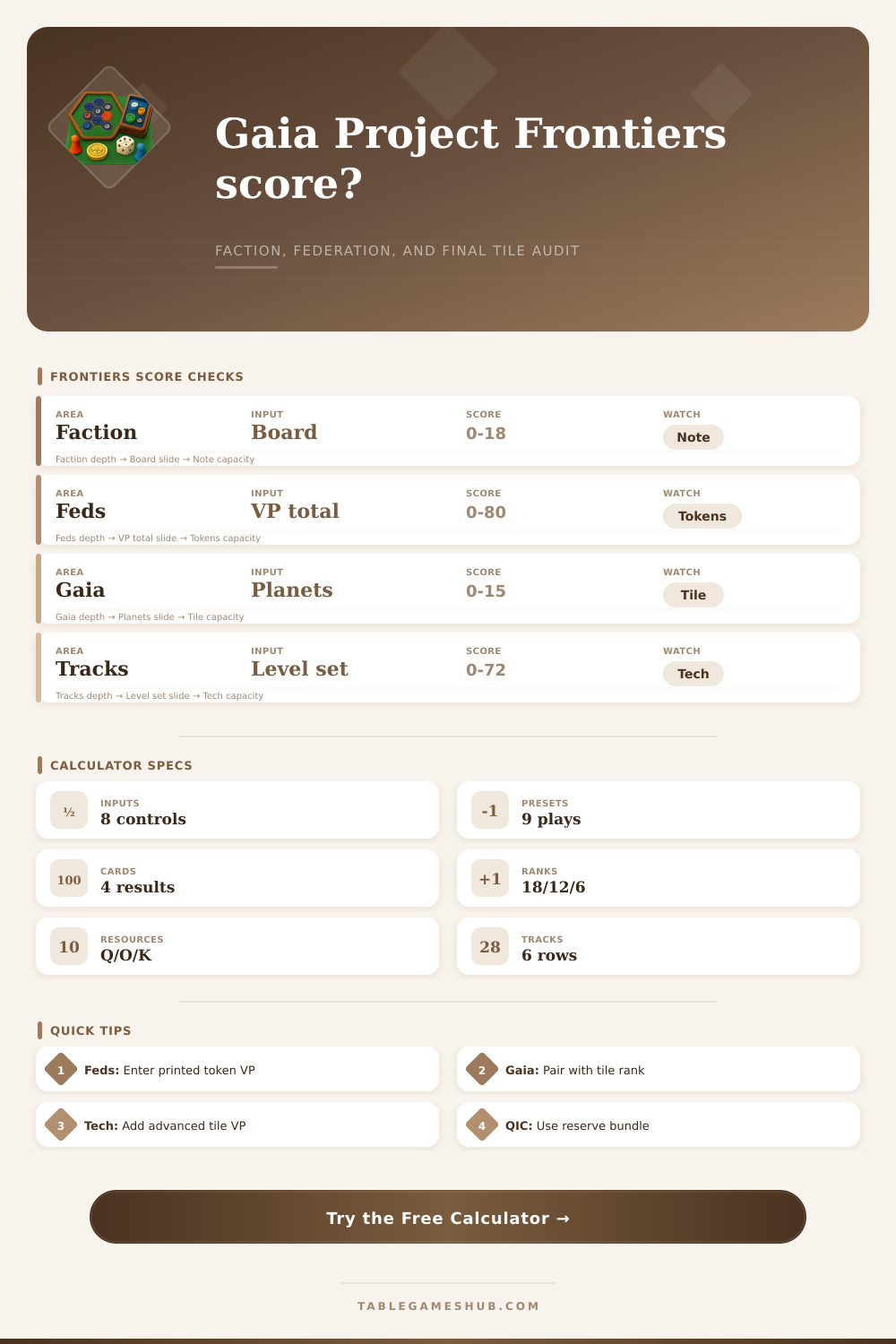
Estimate a Frontiers endgame score from faction profile, federation value, Gaia planets, tech tiles, research tracks, satellites, QIC, ore, knowledge, and final scoring tiles.
Sets the faction emphasis bonus and a preset score-track baseline.
Enter the VP printed on all federation tokens and Frontiers federation rewards.
Used for Gaia emphasis, tile rank checks, and Terrans or Gleens-style presets.
Represents basic tech VP, advanced tech tile scoring, and remembered boosters.
Models endgame VP from research track levels and top-step milestones.
Supports satellite final tiles, network density, and federation connectivity.
Resources score at 1 VP per 3 counted counters after the selected bundle.
Uses final tile rank packages so the tool stays at eight focused controls.
Applied through the named final tile packages.
QIC, ore, and knowledge are counted together.
Packages approximate the full research board finish.
Each preset loads faction, resources, tech, and tiles.
| Faction profile | Calculator emphasis | Bonus trigger | Audit use |
|---|---|---|---|
| Terrans Gaia-cycle engine | Gaia planet conversion | 2 VP per Gaia planet, capped at 18 | Checks whether Gaia count is carrying the endgame. |
| Ivits satellite federation web | Satellite reach | 1 VP per satellite, capped at 16 | Highlights connected federation pressure. |
| Xenos federation tempo | Federation token burst | 25% of federation VP, capped at 14 | Compares extra value from federation racing. |
| Nevlas knowledge research | Research and knowledge | Research tier plus reserve knowledge | Tests whether science income paid off. |
| Gleens Gaia federation | Gaia plus federation blend | Gaia count plus federation pressure | Useful for Gaia planets tied to federation scoring. |
| Package | Research VP | Tech VP | Best when |
|---|---|---|---|
| Balanced tracks + tempo tech | 28 | 12 | No single track dominates the score sheet. |
| Two top tracks + federation stack | 40 | 18 | Federation tokens and top track scoring align. |
| Gaiaforming navigation + Gaia tech | 36 | 16 | Gaia planets and reach both matter. |
| Academy spike + Frontiers advanced tile | 46 | 26 | Late lab or academy turns created a big finish. |
| Tile package | Award shape | Calculator VP | Check before scoring |
|---|---|---|---|
| Gaia planets 1st, satellites 2nd | 18 + 12 | 30 | Confirm satellites are counted in the largest network. |
| Federations 1st, Gaia planets 3rd | 18 + 6 | 24 | Count all federation tokens before rank comparison. |
| Satellites 1st, network 1st | 18 + 18 | 36 | Verify satellites and buildings are not mixed together. |
| Two 3rd-place tiles | 6 + 6 | 12 | Use when both end tiles were low but still scored. |
| Reserve bundle | QIC | Ore | Knowledge | Resource VP |
|---|---|---|---|---|
| Lean reserve | 1 | 2 | 2 | 1 VP |
| Ore bank | 1 | 7 | 2 | 3 VP |
| Knowledge bank | 1 | 3 | 8 | 4 VP |
| QIC jump stock | 4 | 3 | 3 | 3 VP |
| Large reserve | 5 | 8 | 7 | 6 VP |
Separate printed VP from modeled pressure.
Federation token VP and tech tile VP are direct score entries; the faction profile number is a comparison aid so you can spot which part of the engine mattered most.
Audit final tiles before resource conversion.
Gaia planets, satellites, and federation tokens often affect both a rank tile and another scoring line, so confirm counts first and then add QIC, ore, and knowledge leftovers.
Half the game in Gaia Project is spent constructing an efficient engine. You transform QIC into ore into colonization. Your planet transition from gray rock to lush Gaia worlds. Then it’s the last round. There are so many research tracks, tiles, and token on the board. Keeping track of victory points seem like a hard math problem you need to solve while under pressure. That’s why this reliable audit tool is important.
The calculator does all the heavy lifting for you. And knowing what it calculates allow you to go beyond guesswork and score confidently.
How to Count Points Easily
By the time people reach the end game, most will have treated faction abilities as flavor text. They’re not flavor text. Your faction profile dictate which scoring avenues actualy matter for your engine. Are you Terran? Every Gaia colony is a straight shot at VP. The tool’s default settings weigh Gaia colonization very heavily. What is it? Satellites are money. Idle piles of raw QIC don’t interest you if they won’t get used. What interests you is the number of satellites that connect your federation network.
The tool untangles those tensions to help you understand where your faction bonus is taking you, or masking a vulnerability somewhere else. That make a difference in the last three rounds. On the page, the math are laid out in the reference tables, but the strategy itself involve the tradeoffs. Tokens in Federations is notorious for being volatile. Ten tokens today may be worth 20 points today, but they can turn into liabilities instead of assets if you’re not ranked high enough in the federation at game’s end. The calculator models that risk: You input the printed VP, and select some scenarios of how tiles play out at the end. It shows you what happens when your federation score is strong but your Gaia count are weak. Maybe a few Gaia planets save you from a tiebreaker disaster. It is only a little bit, but it is very important in a close game.
Until the last minute, research trees have felt like an afterthought. They get rushed because of their up-front gains and are largely ignored until the point where it’s time to examine the final yield. This tool allow you to model various ways to finish your research: from evenly divided among all six tracks, to heavily spiking a single track. It’s easy to assume that maxing out two trees will be better than spreading out points. But as the calculator shows, high-level research doesn’t do much when you don’t have matching tech tiles to boost those numbers. The combination of both the size and content matter, not just the size alone.
Precision matters in resource conversion. You get one point for every three combined units of QIC, ore, and knowledge. That add up fast. Players drop all sorts of resources on the board without realizing it. Reserve bundles in the calculator demonstrate the hidden value of an additional cube here and there. During the game, a tight reserve may look good. Come scoring time though, those excess resources can swing five or six points your way. These are free victory points lying around for anyone who wants them.
Network and satellite deployment times matter. In all of the preset scenarios, the calculator uses “best case” assumptions about how many networks exist in an area, that’s used as a baseline for what you should aim for. The actual game may have had spotty networks instead; that will mean fewer points. Run the calculations with your own scenario to see where you currently stand and where you’d like to end up. If you are behind on satellites, adjust your tech purchases! Buy less technology, buy more satellites! Are you above average? Should you push even harder? Or should you bank points somewhere else?
The benefit of this kind of audit is that it takes away the stress of keeping score at the end of the game. There’s no need to maintain some mental scorecard as you block players and negotiate trades. Just follow your progress on each metric. If you’re a few points off from victory, then go after a few more Gaia planets. Or maybe lock down that last federation token. The calculator shows your status clearly so that you can make smart choices about how best to proceed.
Chaos becomes data. By the time the final round comes around, you’ll have a precise idea of what you should be targeting and what you should avoid. Your engine collected the points. Now you just should of total ’em up right.