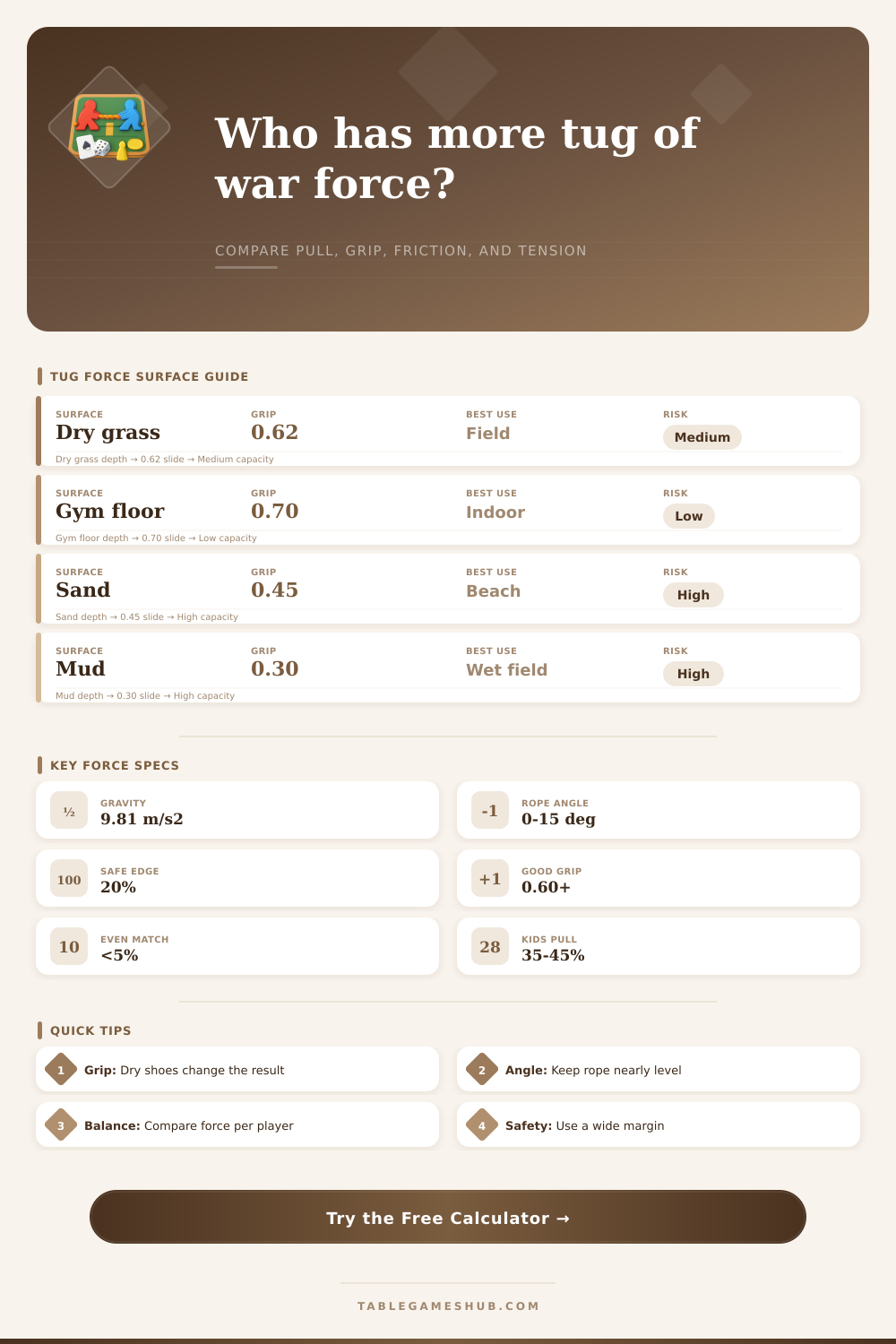
Tug of War Force Calculator
Compare team pull against shoe-ground friction, rope angle, mass, coordination, and safety margin for a balanced tug of war match.
| Match Component | Typical Spec | Force Effect | Best Check |
|---|---|---|---|
| Natural fiber rope | 25 to 38 mm diameter | More hand comfort, similar team force | No slick or frayed zones |
| Rubber soled shoes | Clean dry tread | Raises usable friction on hard floors | Wipe soles before match |
| Cleated footwear | Grass or turf only | Can lift traction coefficient above 0.75 | Confirm venue rules |
| Anchor stance | Back player low and braced | Adds 3% to 10% effective team pull | Keep rope under control |
| Surface | Coefficient Used | Traction Character | Event Note |
|---|---|---|---|
| Wet muddy field | 0.30 | Low and unstable | Small players may slide early |
| Firm beach sand | 0.45 | Moderate with foot sinking | Shorter pulls reduce fatigue |
| Dry grass sneakers | 0.62 | Good general outdoor grip | Common picnic baseline |
| Gym floor rubber shoes | 0.70 | High if soles are clean | Check for floor marks |
| Turf with cleats | 0.78 | Very high bite | Use with matched footwear |
| Rubber tug lane | 0.82 | Highest listed grip | Watch rope load closely |
| Group | Effort % Body Weight | Coordination | Use In Calculator |
|---|---|---|---|
| Young kids | 30% to 42% | Loose timing | Use 35% and 0.86 |
| Casual adults | 45% to 58% | Casual team | Use 52% and 0.92 |
| Fit recreational team | 55% to 68% | Practiced team | Use 62% and 0.97 |
| Competitive team | 65% to 80% | Synchronized pull | Use 72% and 1.00 |
| Format | Players Per Side | Rope Length | Good Safety Margin |
|---|---|---|---|
| Kids party | 4 to 6 | 8 to 12 m | 20% for mixed sizes |
| School gym | 5 to 8 | 10 to 15 m | 15% with clean floor |
| Picnic field | 8 to 12 | 15 to 25 m | 15% on dry grass |
| Festival lane | 10 to 16 | 20 to 35 m | 20% with crowd rotation |
| Step | Formula | Meaning | Output |
|---|---|---|---|
| Team weight | players x mass x g | Normal body weight before slope | newtons |
| Traction cap | mu x weight x cos(angle) | Maximum force before sliding | newtons |
| Muscle pull | weight x effort% | Usable pull from body-weight effort | newtons |
| Effective pull | min(cap, pull) x angle x stance | Force delivered along the rope | newtons |
A tug of war is an competition between two teams that involves pulling on a rope. The winner of a tug of war is the team that pulls the rope towards there side of the competition. Many peoples assume that the winner of a tug of war competition is the team with the strongest individuals on their team.
However, there are many factor that go into determining the winner of a tug of war competition. Factors such as body weight, shoe grip, the angle of the rope, and the slope of the ground can all play a critical role in the outcome of a tug of war. The tug of war calculator take into account these factors and calculates a result for the tug of war competition.
What Makes a Team Win a Tug of War
The factor of the ground that the teams will compete on is one of the most important factors in a tug of war competition. Different ground types will provide different amounts of friction for the competing teams. For example, dry grass provides more friction for the teams than mud when it is wet.
If the friction between the teams and the ground is too low for either team, then the teams will slide even if they are the strongest team in the competition. The footing type that the user chooses for the tug of war calculator will determine the maximum force that each team can produce before they lose their grip on the ground. Body mass is another factor to consider for a tug of war competition.
The body mass of each team member will only add to the strength of the team if the ground can support their weight. The heavier each team member is, the more forceful they will be able to produce with their body weight. However, if the ground is too soft for the team members who are exceptionally strong, the additional body mass of the team will work against them.
The tug of war calculator takes into account each teams body mass and the friction that the ground will provide in calculating the outcome of the competition. The angle of the rope that the teams will use in the tug of war is another factor that can affect the outcome of the competition. When the rope is held at an angle, some of the force that each team member produces will not contribute to the pull of the team on the rope.
The additional force that will be used to hold the rope at an angle will reduce the amount of strength that each team can apply to the rope. The angle of the rope can be entered into the tug of war calculator to calculate the outcome of the competition with this factor included in the calculation. Another factor that goes into the outcome of the competition is the coordination of the team members.
Teams that pull on the rope at the same time will produce more efficientally results than teams that pull at different times. The coordination factor that is included in the tug of war calculator allows for the efficiency of the team to be accounted for in the calculation of the competitions outcome. The slope of the ground on which the teams will have their tug of war is another factor in the outcome of the competition.
If the ground on which the teams will pull on the rope has a slope to it, then gravity will work against the team that has to pull upwards against the slope of the ground. This will create an uneven playing field for the teams in the competition. The percentage of the slope can be entered into the tug of war calculator to calculate the outcome of the competition that includes these effects of the slope to the competitions outcome.
As with all competitions, the safety of the participants is of the utmost importance. The tension that the teams will place on the rope in a tug of war competition can be high. High tension on the rope can lead to slips or even injury to the participants.
To accommodate for this, the user can program the safety margin for the tug of war competition into the tug of war calculator so that the outcome of the competition can be determined within a safe range for the participants in the tug of war. If the tug of war competition is between school group or young children, then the safety margin will ensure that the competition is within a manageable range for those school groups. Although there are many factors for a tug of war competition, there are some variables that cannot be accounted for in a tug of war calculator, such as if any of the participants change their grip on the rope during the competition or if the rope begins to twist during the competition.
However, the tug of war calculator will provide a baseline from which to plan the tug of war competition. Using the tug of war calculator, participants can test different sizes of teams and even change footing types to observe how the outcome of the competition may change. Thus, using the calculator will allow teams to prepare for there own tug of war competition.