Truco Score Calculator
Total one Truco hand across Argentine, Gaucho, Paulista, Mineiro, and custom tables with Truco raises, Envido ladders, Falta Envido, Flor, refusals, score order, and match targets.
accepted = current raise value
If a raise is declined, the caller scores the previous stake, not the proposed stake.
same suit = a + b + 20
Card values 10, 11, and 12 count as zero; the best same-suit pair can reach 33.
falta = rule target - reference score
Use the selector to decide whether the reference is the leader, the winner, half score, or the match.
new total = old + truco + envido + flor
The breakdown shows score order so match-ending Envido or Flor can be checked before Truco.
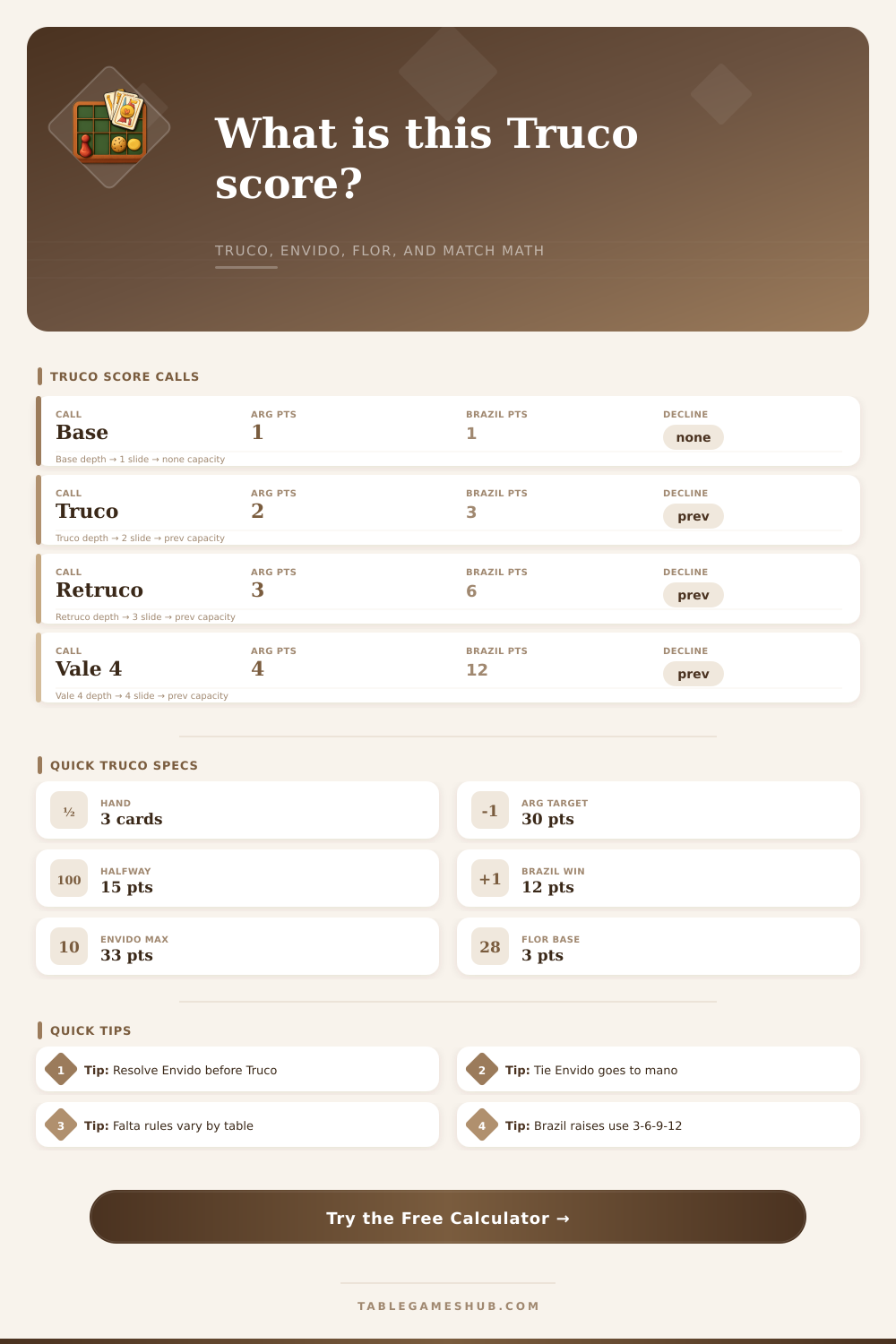
Most Truco families deal three cards and decide the hand over up to three tricks.
A common chico is 30 points, often tracked as malas below 15 and buenas above 15.
Paulista and Mineiro score races commonly use a 12-point target with larger Truco raises.
The usual maximum Envido count is 7 plus 6 in the same suit, then plus 20.
Truco stake ladder by profile
| Profile | Base | First call | Raises |
|---|---|---|---|
| Argentine 30 | 1 | Truco = 2 | Retruco 3, Vale 4 |
| Short chico 15 | 1 | Truco = 2 | Retruco 3, Vale 4 |
| Paulista 12 | 1 | Truco = 3 | Vale 6, 9, 12 |
| Mineiro 12 | 1 | Truco = 3 | Vale 6, 9, 12 |
Envido sequence values
| Sequence | Accepted | Declined | Note |
|---|---|---|---|
| Envido | 2 | 1 | Basic call |
| Real Envido | 3 | 1 | Standalone |
| Envido + Real | 5 | 2 | Accepted prior |
| Envido + Envido + Real | 7 | 4 | Full ladder |
| Falta Envido | Rule based | Prior value | Table rule |
Flor scoring shortcuts
| Flor line | Accepted | Declined | Winner test |
|---|---|---|---|
| Flor only | 3 | 3 | Holder scores |
| Flor vs Flor | 4 | 3 | Flor count |
| ContraFlor | 6 | 4 | Flor count |
| Al resto | Falta rule | 4 or 6 | Match pressure |
Score-order audit
| Step | Check | Why it matters | Calculator field |
|---|---|---|---|
| 1 | Flor | May block Envido | Flor sequence |
| 2 | Envido | Resolved before Truco | Envido line |
| 3 | Truco | Trick winner or caller | Stake level |
| 4 | Target | Match can end early | Match target |
In a packed café in Buenos Aires, the air are always heavy with tension as somebody named Truco and no one understands how to count the score. One side believes they’re ahead. The other feels like they’re behind. Suddenly, it’s a memory contest. A nice game becomes hard exercise in remembering what just occurred at the table.
Enter a calculator that does the math for you, after you enter your specific region’s rules. Forget all about uncomfortable silence when everyone stops chatting to debate numbers. Eliminate confusion, because you must accuratly recount what took place on the table before changing the score.
Why You Need a Truco Score Calculator
And then there’s the fact that Truco scoring isn’t simply number crunching: It’s also about the order in which things are done. That’s where it gets tricky: You don’t simply add up everything that happened in a given hand and plunk it down on score sheet. First, you resolve Envido, since it’s played on another timeline from the rest of the game. So if you have a good heart pair, you declare them before you even check out what cards you ended up with for winning three-of-a-kind. And this order is significant, especially late in the game as one side or the other approach half-way. Get the Envido count right and it’ll push the favored team into “buenas” territory, altering the psychology of the whole game.
The tool has allowed us to separate things out so we don’t accidently give some poor guy trick points after he lost an earlier bidding war. Most people gets tripped up in regional variations. Move from Argentina to Brazil and suddenly those point values is very different animals. Argentine Truco has a gentle rise through the ranks with one to four points. There is slow burn to the game that rewards patience and accuracy. Many Brazilian versions like Mineiro or Paulista, however, leap over to larger stakes; they pick up speed and increase volatility.
You’re able to choose these profiles in the calculator so you’re not imposing an unfamiliar system onto the table, instead matching your math to house rules. Get it backwards and what might of been a victory turns out to be a defeat. Nobody has any clue until that last card is drawn. A subtle thing, but it sets the tone for integrity of play.
Adding one more wrinkle is Flor… Which completely covers Envido in many games. If you have three cards of the same suit then you simply call your hand without even going through process of bidding Envido numbers at all. Depending on your local rules, that might mean an automatic three points or even more if there are counters like ContraFlor, which makes it a quick decision to settle pretty fastly. At some tables, you get three points if you call Flor automatically, other times there are counters such as ContraFlor that double or triple the value. So here again, the table on the page make all that clear, listing the accepted vs. It lists the accepted vs. Declined bids and how many points you get as a result. Because of this, no one can complain about someone calling Flor with a weak hand and getting a killer combination. It keeps everyone focused on both what is in their hands and how the bidding system work.
Envido (or falta envido) is maybe the most controversial aspect of the scoring. Depending on how it’s played locally, falta envido can act as a finisher that often ends the match in a single breath. There are even different ways of computing falta. Some people considers it the gap between your bid and the target. Other people use a preset amount of extra points, or they require you to meet the target for the falta to count. That’s why we couldn’t get a calculator to do what we wanted until we customized it ourself. You’ll also need to know whether falta is added onto existing bids or replaces existing bids. Different regions plays differently. The tool lets you set your default to either approach. This can make a big difference in a high stakes game where every point matter for winning.
A good score keeper also takes the pressure off the players. If both player argue about points, it becomes exhausting. You lose sight of why you’re playing in the first place, the strategy, the fun. An explicit set of inputs eliminates that ambiguity from the beginning. The calculator is the neutral third party who won’t forget the inputs when you do. It lets you play your cards well instead of arguing about whether they counted last round or how many points someone said they had.
At the end of the day you should walk away knowing exactly what happened: did I win, or lose? Was it close? Did the math work out? If so, then great; you just played a good hand. And that leads to a smooth night instead of a chaotic one where everyone only talks about whose turn it is to deal next.