🐉 D&D 3.5 XP Calculator
Estimate encounter XP, party split, encounter level, CR pressure, and advancement pace with compact 3.5-style approximations.
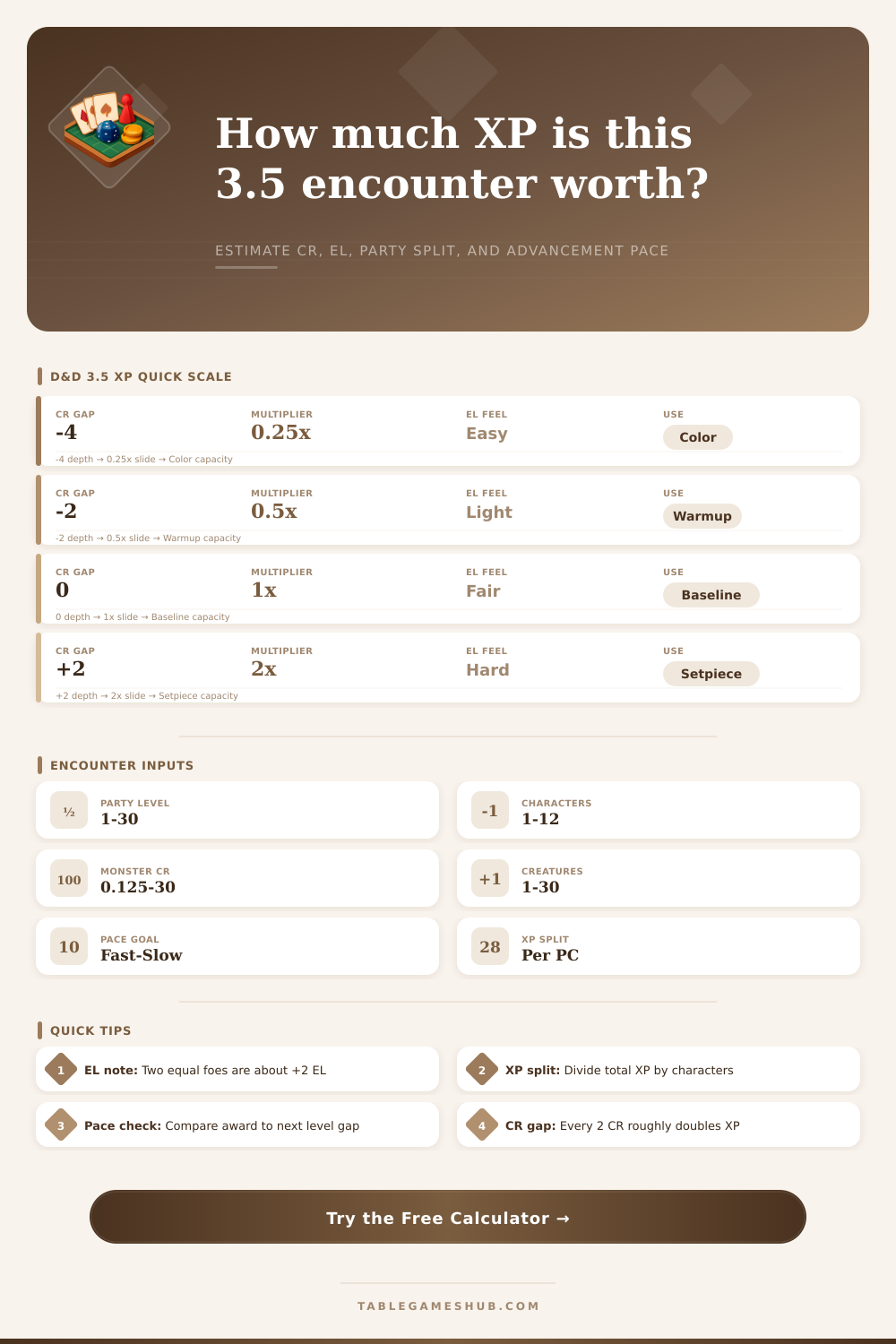
| Monster CR vs Party Level | Approx. XP Multiplier | Encounter Feel | Planning Note |
|---|---|---|---|
| CR 4 below party level | 0.25x baseline | Very easy | Use for attrition, scouting, or color. |
| CR 2 below party level | 0.5x baseline | Light | Good warmup when resources matter. |
| CR equal to party level | 1x baseline | Fair | Baseline award is about 300 XP per party level. |
| CR 2 above party level | 2x baseline | Hard | Usually a setpiece or dangerous obstacle. |
| CR 4 above party level | 4x baseline | Severe | Use carefully; action economy can swing outcomes. |
| Equal-CR Creatures | Approx. EL Bump | Power Multiplier | Use Case |
|---|---|---|---|
| 1 creature | +0 EL | 1x | Solo monster or simple hazard room. |
| 2 creatures | +2 EL | 2x | Classic pair fight with flanking pressure. |
| 3 creatures | about +3 EL | 3x | Harder action economy, often swingy. |
| 4 creatures | +4 EL | 4x | Squad encounter; watch party control options. |
| 8 creatures | +6 EL | 8x | Mob encounter, best for lower individual CR. |
| Pace Goal | Encounters per Level | XP Target per Encounter | Campaign Feel |
|---|---|---|---|
| Fast | About 8 | 12.5% of next level | Quick advancement and fewer filler fights. |
| Standard | About 13 | 7.7% of next level | Traditional adventure pacing estimate. |
| Slow | About 20 | 5% of next level | Longer arcs, more exploration, more downtime. |
| Custom | 4 to 40 | Based on your input | Useful for milestone-like XP calibration. |
| Current Level Band | XP Needed for Next Level | Equal-CR Baseline per PC | Baseline Share of Level |
|---|---|---|---|
| Levels 1 to 4 | Level x 1000 | Level x 300 | About 30% |
| Levels 5 to 10 | Level x 1000 | Level x 300 | About 30% |
| Levels 11 to 16 | Level x 1000 | Level x 300 | About 30% |
| Levels 17 to 20+ | Level x 1000 | Level x 300 | About 30% |
The calculator uses compact derived math for CR, creature count, and level gaps. Check unusual encounters by judgment, especially when terrain, spell access, or action economy dominates.
A high-EL encounter can be worth plenty of XP but still be easier than expected if the party counters its main threat. The breakdown keeps those assumptions visible.
Dungeons & Dragons 3.5 Dungeon Masters must find a balance in the difficulty of the combat encounters that they design for the player to experience. The Dungeon Master utilizes the Challenge Rating and the Encounter Level to determine the pressure that the players controls should be placed upon the adventurers. The Challenge Rating is the number assigned to each monster in particular.
The Encounter Level are the number associated with a group of monsters. Understanding these two values and their relationship to one another is essential for a Dungeon Master. The action economy is another factor to consider in the difficulty of the encounters.
How to Balance Dungeons & Dragons 3.5 Combat Encounters
The action economy compare the number of actions that monsters can perform with the number of actions that adventurers can perform. It is common for Dungeon Masters to find that increasing the number of monsters increases the difficulty of the encounter more then increasing the Challenge Rating of an individual monster. For instance, four monsters of a moderate Challenge Rating tend to be able to defeat a group of adventurers more effective than one monster of a higher Challenge Rating.
One way of determining the Encounter Level of a group of monsters is by using an online calculator. The Encounter Level is a separate value from the Challenge Rating of each monster. The Dungeon Master must keep track of the Encounter Level to determine whether the encounters are baseline or severe.
The encounters will be considered severe if the Encounter Level is significantly higher than an average level of the adventurers. In these encounters, the Dungeon Master must consider the resources of the adventurers. For instance, they must know if the adventurers still have remaining spell slots or if they have become exhausted from previous encounter.
The location of the encounters also impacts the difficulty of the combat encounters. Encounters in narrow corridor is more difficult than those in open fields because fewer adventurers can attack the monsters at a time. The experience points that the Dungeon Master awards to the players after each combat encounter determine the pace at which the adventurers increase in power.
If the experience points are too high, the adventurers will reach higher levels too quickly for the Dungeon Master to prepare new content for them. The experience point calculator allow the Dungeon Master to determine the percentage of a level that a combat encounter provide the adventurers. Based off this figure, the Dungeon Master can better determine the experience points to award to the players.
The Dungeon Master can choose to provide experience points at a slow or fast rate, but they should remain the same throughout the campaign. Some Dungeon Masters will award the experience points equally to each player. Others may award more experience points to adventurers who performed better in the combat encounters.
Experience points can also be awarded to adventurers who performed poorly. The general goal is to provide the adventurers to reach there next milestone without rushing them through the power tier of the game. While mathematical calculations of the Challenge Rating and Encounter Level will provide the baseline difficulty for combat encounters, the tactics of the adventurers and the rolls of the dice for the players will create the actual difficulty.
It is possible for a group of adventurers to defeat even the most difficult of encounters if they use great tactics or roll high number on the dice. They may struggle with encounters deemed to be easy for the same reason that their dice rolls low numbers. Dungeon Masters should use these figures to balance the encounters to ensure that players feel danger but have faith that they are able to win the encounters.
When balanced properly, adventurers will feel as if they have won the encounter that they fought in.