Trampoline Difficulty Calculator
Estimate a single trampoline element or pass using rotation degrees, twist count, body position, connection credit, execution deductions, and safety readiness gates.
| Somersault Rotation | Common Skill Cue | Base Value Used | Calculation Note |
|---|---|---|---|
| 0° to 180° | Jump, drop, half-turn | 0.1 to 0.2 | Non-somersault elements use minimum credit and half-turn value. |
| 270° | Three-quarter front or back | 0.3 | Three quarter-rotation units before position or twist additions. |
| 360° to 630° | Single somersault family | 0.5 to 0.8 | Quarter rotation value plus completed single-somersault credit. |
| 720° to 900° | Double somersault family | 1.0 to 1.2 | Double base value, then position, twist, and backward bonuses. |
| 1080° to 1260° | Triple somersault family | 1.6 to 1.8 | Triple base value with higher load and advanced twist checks. |
| 1440° | Quadruple somersault family | 2.2 | Highest listed rotation input; use strict readiness review. |
| Twist Input | Half-Twist Units | Base Twist Value | Advanced Bonus Trigger |
|---|---|---|---|
| 1/2 twist | 1 | 0.1 | No advanced bonus. |
| 1 twist | 2 | 0.2 | Used for full, half-in, or full-out notation. |
| 2 twists | 4 | 0.4 | Double-somersault skills are still below the extra twist threshold. |
| 2 1/2 twists | 5 | 0.5 | Double skills above 720° twist gain extra 0.1 per half twist. |
| 3 twists | 6 | 0.6 | Triple skills above 360° twist gain extra 0.2 per half twist. |
| 4 to 5 twists | 8 to 10 | 0.8 to 1.0 | Very high load; confirm official credit and repetition constraints. |
| Factor | Calculator Treatment | Typical Range | Use in Review |
|---|---|---|---|
| Tuck position | No position bonus | 0.0 added | Useful for first credit checks and lower readiness load. |
| Pike position | Adds position value per completed salto | +0.1 to +0.4 | Requires clear hip angle and opening timing. |
| Straight position | Adds position value per completed salto | +0.1 to +0.4 | Highest shape demand for layout-style work. |
| Late twist finish | Enter as execution deduction | 0.1 to 0.3 | Use when twist continues too late into landing. |
| Landing instability | Enter as execution deduction | 0.1 to 1.0 | Separate form value from safety readiness. |
| Benchmark Skill | Rotation | Twist | Typical Estimated Value |
|---|---|---|---|
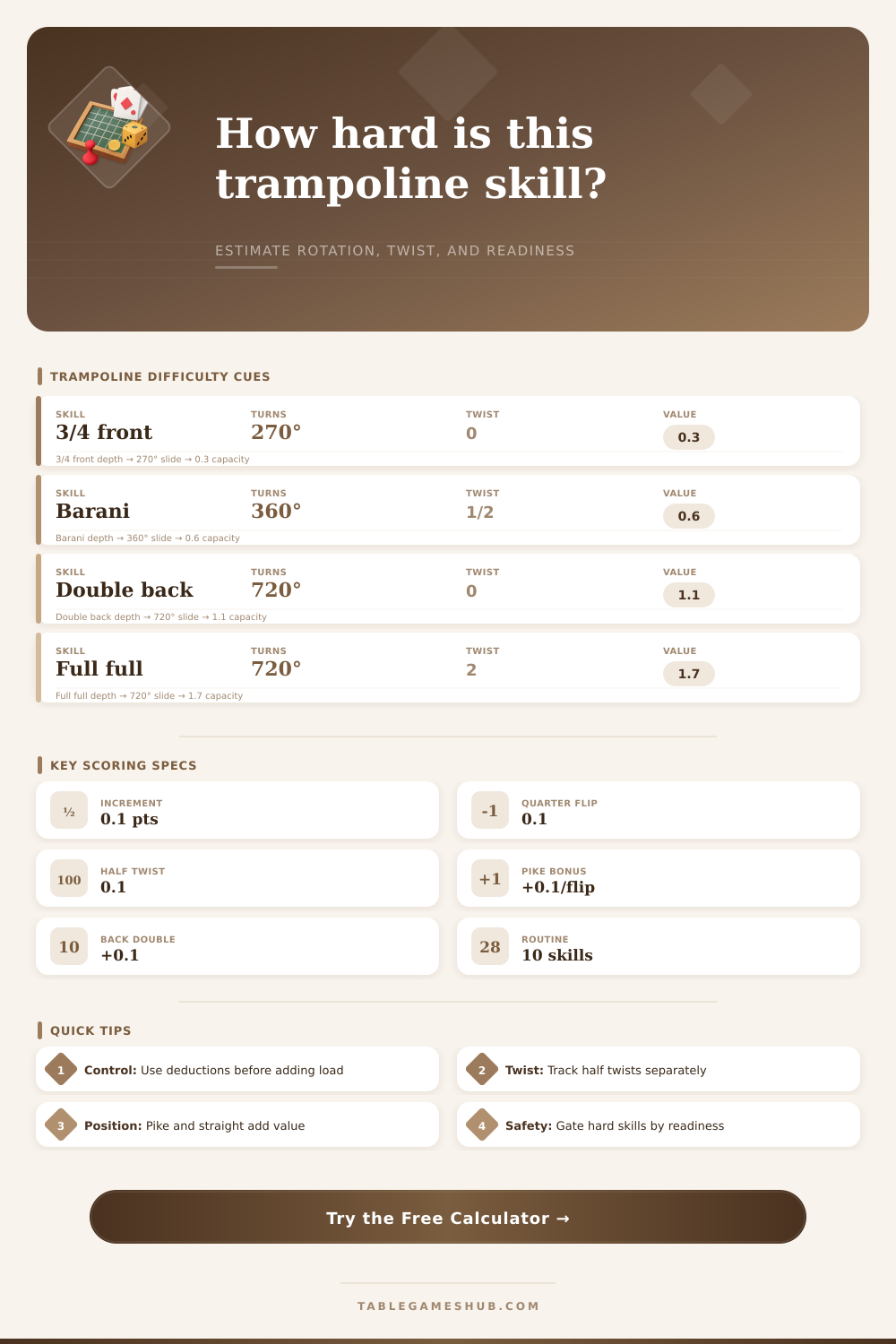
| Three-quarter front | 270° | 0 | 0.3 before deductions. |
| Barani | 360° | 1/2 | About 0.6 before connection input. |
| Back full straight | 360° | 1 | About 0.8 with straight position. |
| Double back tuck | 720° | 0 | About 1.1 with backward double bonus. |
| Half-in half-out pike | 720° | 1 | About 1.5 with pike and backward bonus. |
| Full-in rudy-out straight | 720° | 2 1/2 | About 2.1 before execution deductions. |
Trampoline scoring are mathematical because the scoring of trampoline depends on the difficulty of the skill and the execution of that skill. To recieve the most highest possible score on the trampoline, a gymnast must find the balance between the difficulty of the skill and the possible deductions for the execution of that skill. The difficulty of a skill isnt a constant value for that particular skill; the value of the difficulty of a skill can change based on the body position of the gymnast that is performing the skill.
Skills that requires gymnasts to perform in a position like a pike will have a higher level of difficulty than gymnasts that perform in a tuck position. This is due to the fact that a gymnast’s increased moment of inertia in a pike position make it harder to rotate their body in that position. Thus, skills that use a position like a pike have a higher degree of difficulty than skills that use a tuck position.
How to Plan Trampoline Routines: Balance Difficulty, Clean Execution and Consistency
However, the degree of difficulty of a skill is only beneficial if the gymnast executes the skill without deductions. Should a gymnast perform a skill that has a high degree of difficulty but have poor execution of that skill, those deductions will lower the score that the gymnast receive for that skill. Many gymnasts often focus on the degree of difficulty of the skills that they perform.
However, the degree of difficulty of a skill is only beneficial if the gymnast can perform that skill with consistency. A skill that is not performed with high consistency is potentially a liability for the gymnast’s total score. A gymnast may be physically capable of performing skills of high difficulty, but they may not have the consistency required to perform those skills without accumulating deductions to their score.
Thus, instead of focusing solely on difficulty, gymnasts should focus upon the net value of the skills that they perform; the net value of a skill is equal to the difficulty of that skill minus the deductions for the execution of that skill. Another factor that gymnasts must consider when planning the skills that they will perform on the trampoline is the physical fatigue that they will experience while performing the routine. When gymnasts first begin to perform their routine, they can perform their skills with high precision and control.
As, however, they continue to perform skills, they will experience fatigue. Performing gymnastic skills with fatigue lead to the gymnast’s legs becoming heavy, which makes it difficult for the gymnast to maintain spatial awareness in relation to their physical body. Thus, as gymnasts fatigue, their spatial awareness and precision of their skills will decrease.
As a result, the number of deductions for the execution skills will increase. To counteract this potential deduction, gymnasts must plan their routines with skills that is manageable with fatigue. Many of the skills that are performed on the trampoline include a component of twisting.
Thus, gymnasts must ensure that they perform the timing of their twist during the execution of their skills. Performing a twist too early in relation to the skill will cause the gymnast to lose height, while performing the twist too late will pose a danger to the gymnast when they land on the trampoline. Both of these mistakes will result in execution deductions for the skill.
Thus, using a calculator to estimate potential deductions is a way for gymnasts to create a more realistic plan for their net score for the trampoline routine. Creating a plan for a net score that is realistic based off the gymnast’s skills and consistence to perform those skills is more beneficial than attempting to plan a score that is high but that cannot be achieved. The landing for each gymnast on the trampoline is the final part of the skill that is performed.
Errors in landing can lead to deductions in the execution score for that gymnast’s skill. For instance, if a gymnast stumbles while landing on the trampoline, the gymnast will receive an execution deduction. Gymnasts should continue to track their landings; the ability to land on the trampoline without stumbles is a more accurate measurement of a gymnast’s progress in compared to the skills that they may execute successfully only occasionally.
Thus, consistency in the skill of landing on the trampoline is key for gymnasts to receive a stable score for their performance on the trampoline. A calculator allows gymnasts to find the best balance between difficulty and execution. A gymnast can use the calculator to determine if it is better to perform a skill of high difficulty but with a higher potential for deductions for execution than a skill of lower difficulty.
The optimal score is one that incorporates the potential difficulty of each skill with high enough difficulty for the gymnast to be competitive in their event, yet with execution scores that are low enough to avoid high deductions. Thus, by understanding how rotation and position can impact the degree of difficulty of a skill, gymnasts can use the rulebook to plan the routine that they will perform.