💰 Poker Tournament Bankroll Calculator
Size your roll, compare risk levels, and see how field pressure changes the bankroll you need
Target bankroll
Multiply your average buy-in by the number of buy-ins your risk target demands.
target roll = ABI x required buy-ins
Variance load
Field size, re-entry count, late reg, and format all push the swing profile higher.
load = field x format x re-entry x late-reg
Cushion test
Use remaining bankroll after reserve cash to see whether the roll clears the target.
cushion = effective roll / target roll
Set your bankroll, ROI, and field size to see the required tournament roll.
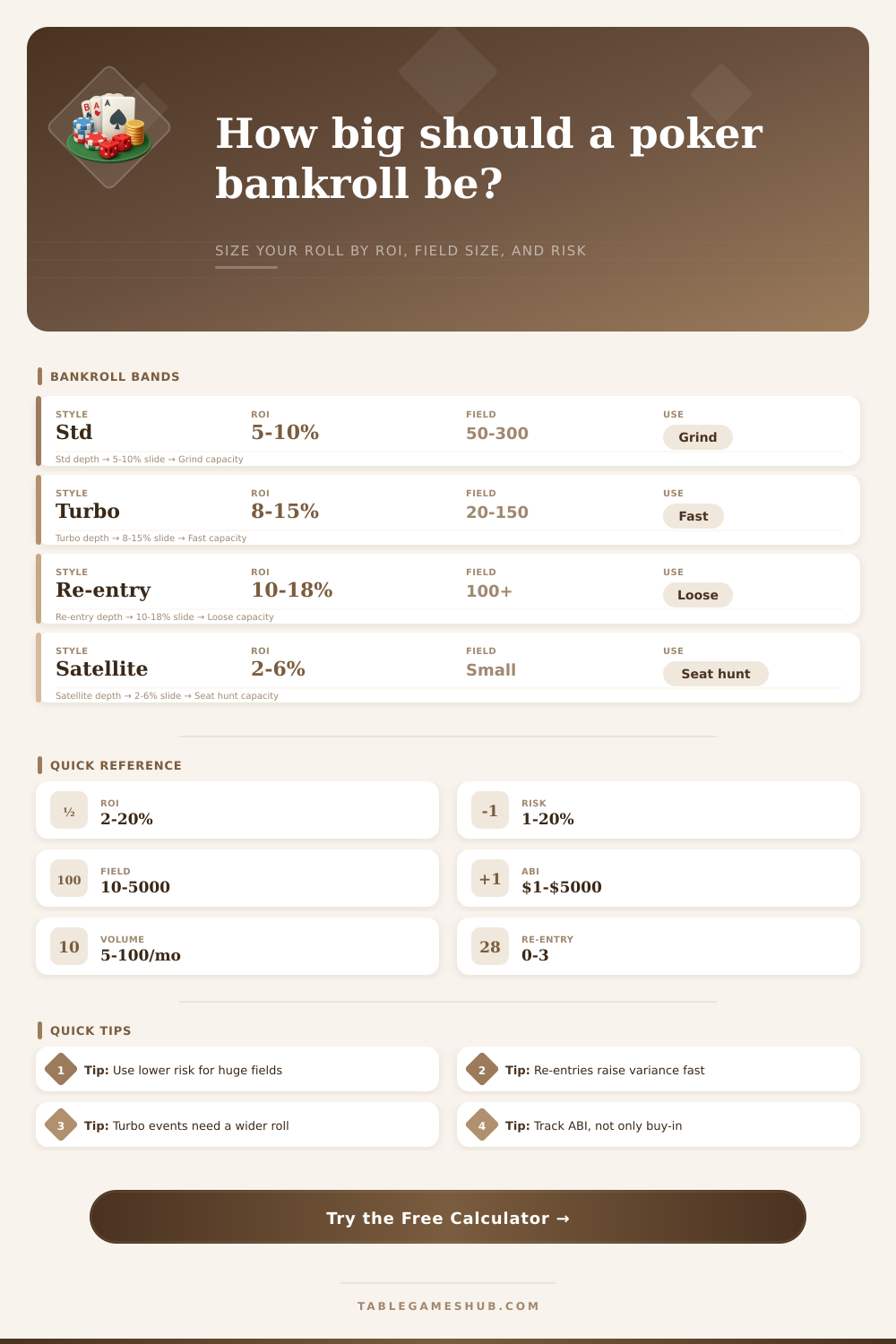
The calculator estimates required buy-ins from ROI, field pressure, format volatility, and your target ruin risk.
| Band | Buy-ins | Roll | Shot size | Risk feel | Field | Volume | Use |
|---|
Format notes
Freezeout structures keep the cleanest bankroll curve. Re-entry and turbo fields usually demand a larger roll because the variance tail gets wider.
Field-size guide
Small fields often work with thinner cushions, while huge fields push the target buy-in count much higher. Plan for the tail, not just the average.
Risk bands
Lower ruin targets and higher re-entry counts both push the bankroll target upward. If you want safety, give the calculator more room.
Reserve rule
Hold reserve cash outside the bankroll if you need living-expense protection or a safer buffer for swings and travel.
Watch the cushion
If the bankroll cushion falls under 1.0x, the model says you are under-rolled for the chosen risk cap.
Model re-entry honestly
Every extra bullet increases the bankroll demand. Count them before deciding the target roll.
A poker tournament bankroll is simply the amount of money set aside for playing poker tournaments. Bankroll management is made up of rules that control the stakes according to the money available. For example, if you have $1,000 for poker, a good bankroll strategy says which games or tournaments fit that budget.
The size of the tournament field matters for figuring out the needs of a bankroll. In a normal multi-table tournament with up to 1,000 players, the bankroll should have around 100 buy-ins. For tournaments with 1,000 or more players, aim for roughly 200 buy-ins.
How to Manage Your Poker Tournament Money
If you play tournaments with 50 to 100 people, it is possible to start with 35 to 50 buy-ins. For fields with 500 or more entries, 150 to 200 buy-ins is the safer choice.
For sit-and-go tournaments at least 40 buy-ins are needed. In cash games the bankroll must be at least 20 times the buy-in. So for $22 tournaments the bankroll should be between $2,200 and $4,400 dollars.
For $10 online tournaments a minimum of $1,000 in a poker bankroll is needed.
Some successful players operate well with 30 to 40 buy-ins, while others choose 75 to 100 for more security. It ultimately depends on your risk aversion. There does not exist one right number.
Beginners should aim for 100 buy-ins for tournaments with low stakes.
Online poker websites offer cash games with very small stakes like $0.01/$0.02, and sites like PokerStars, 888poker and PartyPoker have sit-and-go and multi-table tournaments with buy-ins from $0.50. There really is no excuse for playing outside bankroll limits.
Common beginner mistake is depositing $50 and spending it on two or three tournaments, then repeating the cycle. Never buy in with money that you cannot lose comfortably. If you feel tilted, take a break or stop for the day, that is the smart choice.
Late entry or rebuying in a tournament with less than 30 big blinds also depends on luck. That hurts your ROI.
Limit games work for building a bankroll, because variance is lower and the opponents usually are not as tought. With a small bankroll under $100, favor sit-and-go or cash games instead of tournaments. The idea is to invest part of the bankroll in a tournament like this, so that risk of loss and chance to win will be in good balance.
Poker does not deal only about playing hands well.