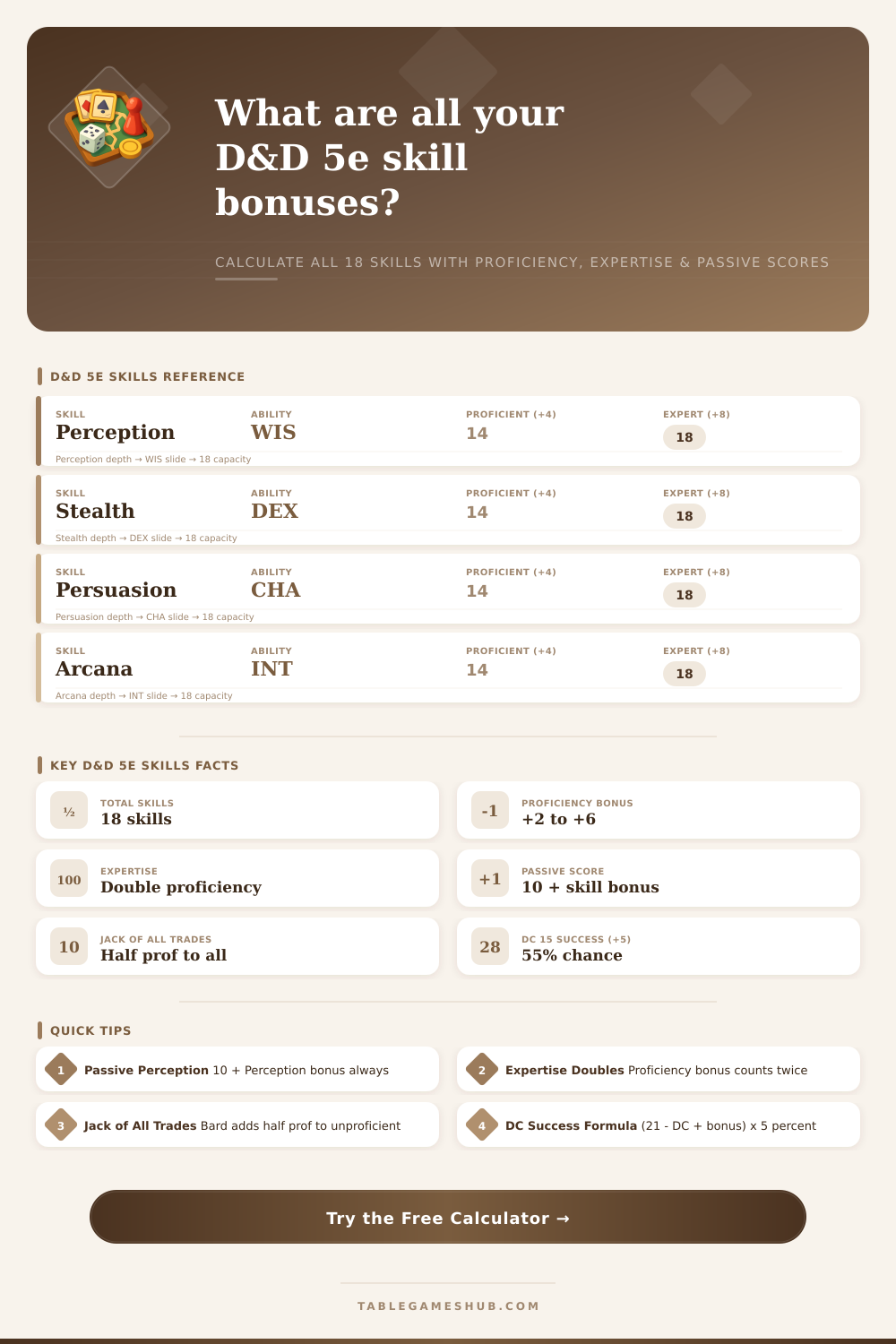
🎲 D&D 5e Skills Calculator
Calculate all 18 skill bonuses with proficiency, expertise, passive scores & DC success chances
| Skill | Ability | Prof / Expert | Breakdown | Total Bonus | Passive |
|---|
Showing success % for your best skill bonus. A d20 roll adds your bonus; success on meeting or beating the DC.
| Skill | Bonus | DC 10 | DC 15 | DC 20 | DC 25 |
|---|
| Skill | Ability | Your Bonus | Passive Score | DC 15 Success % |
|---|
Expertise doubles your proficiency bonus for a skill. At level 5 a Rogue or Bard with expertise gets +6 on that skill instead of +3 from normal proficiency. Combined with a high ability score, bonuses of +10 or more are achievable at mid levels, making success near-automatic on moderate DCs.
Your passive score (10 + skill bonus) determines what you detect without rolling. A Ranger with a +7 Perception bonus has a passive Perception of 17, automatically spotting anything with a DC of 17 or lower. Rogues with Reliable Talent also treat any roll below 10 as a 10, making passive scores even more reliable.
In D&D 5e, abilities are those big categories that cover a set of actions a character or monster can do, and inside each of them are skills that you can actually specialize in. Proficiency in a skill shows that you mastered one part of that ability and get a bonus for it. Want to know if your character will succeed in a risky task?
Then you roll an ability check. Proficiency in skills shows that you actually worked to master that particular skill
Skills and Proficiency in D&D 5e
When your character levels up, your proficiency bonus grows according to your level, and indeed that is the only factor that affects it. Your class does not matter. Race also does not alter it.
Only the level decides. Every skill that you are proficient in receives the same bonus, which depends simply on your expeirence level.
D&D 5e has eighteen skills distributed between the six abilities: Athletics, Acrobatics, Sleight of Hand, Stealth, Arcana, History, Investigation, Nature, Religion, Animal Handling, Insight, Medicine, Perception, Survival, Deception, Intimidation, Performance and Persuasion. Some of them show up more often in game than others. Choosing a skill only for thematic reasons; like Religion for background, can seem like you are hurting your self when Perception simply sits here on the table.
Perception shows up again and again, almost always.
If you rank skills by pure use, Perception and Investigation fight for the first place. Even so Perception wins. Why?
Investigation checks commonly fall under Perception more than you expect, which creates weird discord in the rules.
Athletics is one of the only two skills in 5e with direct combat use in the system. Grappling and shoving; whether you attack or defend, both depend on it. Acrobatics helps against shoving, but to defend yourself in physical fights beyond simply stabbing, Athletics is a must.
Here everything becomes complicated occasionally. You find a spell or situation that seems to require a saving throw, but no, it wants an ability check. For instance Telekinesis: the person resisting rolls a check, not a save.
Weird, but that is how the rules work.
When you create a character, it pays to think how your skills work as a team. It matters more to combine complementary skills than simply choose the strongest alone.

Skill systems in tabletop RPGs are not easy to nail. Designers test several versions before finding something that feels right, and balance is part of the process. The rulebook cannot predict everything, so house rules almost alwayscreep in.