Tien Len Score Calculator
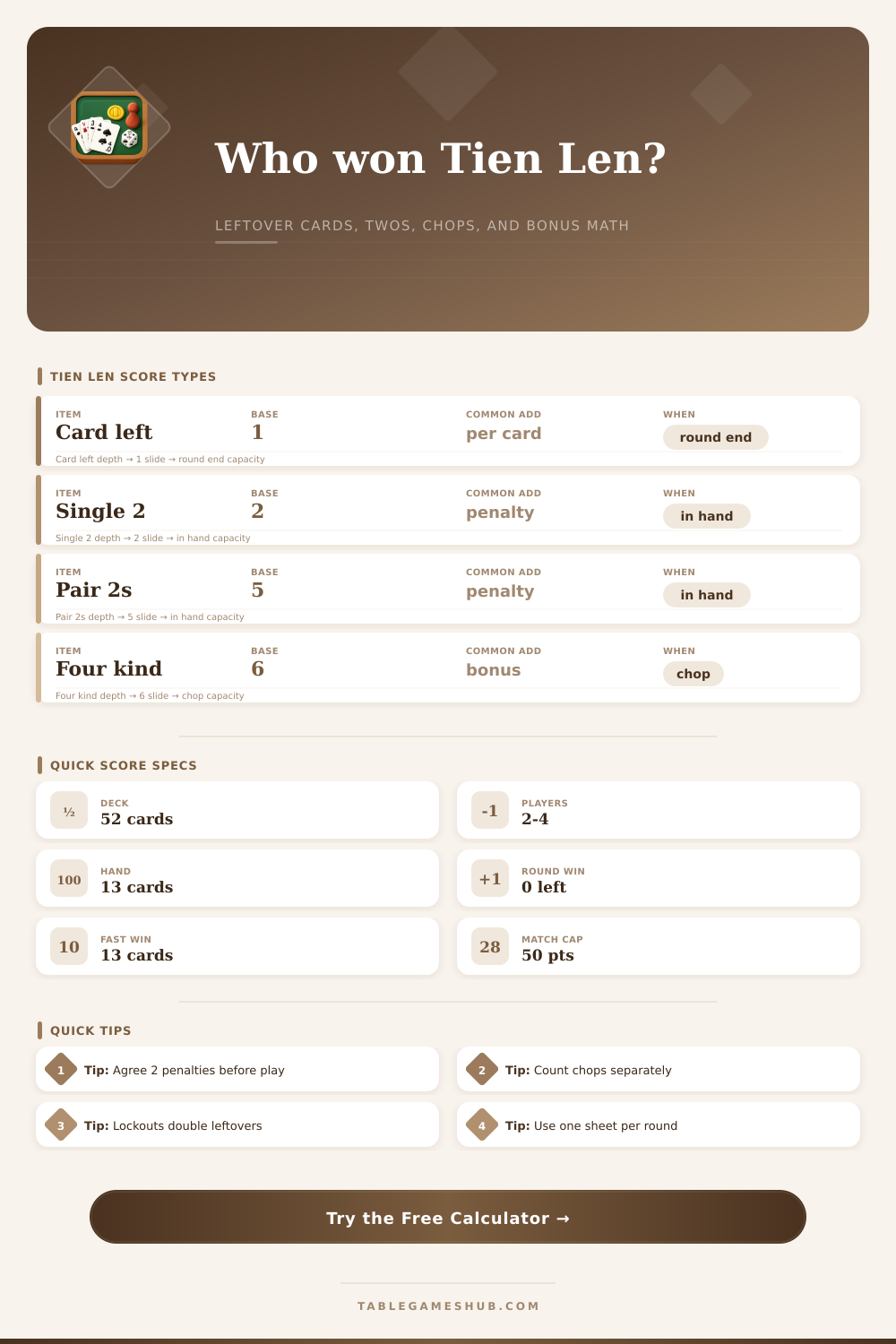
Total a Tien Len round with leftover cards, 2-card penalties, chop bonuses, lockout rules, instant wins, and match progress in one score sheet.
| Score item | Casual | Standard | Southern-style | Tournament sheet |
|---|---|---|---|---|
| Each leftover card | 1 point | 1 point | 1 point | 1 point with cap review |
| Single unplayed 2 | 1 point | 2 points | 3 points | 2 points |
| Unplayed pair of 2s | 3 points | 5 points | 6 points | 5 points |
| Successful chop | 2 points | 4 to 8 points | 5 to 10 points | 4 to 8 points |
| Instant-win bonus | 8 points | 13 points | 16 points | 13 points |
| Condition | Card pattern | Calculator value | Common table action |
|---|---|---|---|
| Dragon straight | 3 through A, twelve-card run | Highest instant bonus | Round ends immediately |
| Six pairs | Six separate pairs in hand | Standard instant bonus | Declare before first play |
| Four 2s | All four 2 cards in one hand | Highest 2-related bonus | Usually automatic win |
| Same color hand | Thirteen black or red cards | Lower instant bonus | House-rule dependent |
| Component | Beats | Typical weight | Score note |
|---|---|---|---|
| Three consecutive pairs | Single 2 | Medium | Useful as the default chop entry |
| Four of a kind | Single 2 or pair 2s | High | Often scores more than three pairs |
| Four consecutive pairs | Pair 2s or smaller chop | Very high | Use for strong round swing |
| House chop | Local agreement | Variable | Enter as standard chops if allowed |
| Players | Cards dealt | Unused cards | Score sheet note |
|---|---|---|---|
| 2 players | 13 each or house variant | 26 if dealing 13 each | Use inactive seats as 0 leftovers |
| 3 players | 13 each | 13 cards unused | Compare only active leftover hands |
| 4 players | 13 each | 0 cards unused | Standard full-deck scoring |
| Match play | Same deal format | By player count | Add round winner score to leader total |
Disputes over Tien Len arise most frequently when people has cards that aren’t playable. This happens when one person is holding on to a pair of twos until last minute. The room will get silent as everyone starts shuffling around their card nervously, then there will be a collective sigh as the round concludes with many cards still in hand.
Because these arguments center around particular math, they begin early. Does having a two in your hand count against you? Or is it simply a card that didn’t fit? How does the chop bonus contribute to the final score of winner? All of these questions are important since they’ll decide who gets to drink next. By running the math behind them, the calculator removes any doubt from your post-round discussions before anyone can spoil the fun.
How to Keep Score Fairly
Beyond the card count, Tien Len get interesting. Each community develops their own set of house rules which evolve over time. While some friends believe a trapped two should be worth three for demonstrating bad strategy, others will maintain it should only cost a single point like all other discarded cards. These variation lead to table friction.
The tool does this by allowing you to pick a scoring profile based off your preference. Options include: casual play, standard penalties, or stricter tournament sheets. It’s more than a numerical choice. It’s an exercise in matching everyone’s expectation pre-deal. Define how much each rule will cost you before dealing with the first card (saving hours of post-game debate).
We crafted the input boxes to match how your hand moves through the game. First, you input the remaining cards from every player hands. That becomes the starting score. Next, you include any special situation that change the nature of the hand.
Because a two not played is considered more a matter of strategy than bad luck, we handle it different. On average, one unplayed two should result in a bigger hit against you then a jack or even a seven. To adjust for that, our calculator use some different multipliers depending on what version you use. Having two twos result in an even higher penalty. This reflects the difficulty of playing those cards and the advantage they give to opponents who managed to shed their own high-value cards earlier in the round.
Skilled play is rewarded through bonuses, which work in reverse. Disrupting the natural order of the game by chopping a double sequence or two off a four-of-a-kind is a satisfying move that deserves recognition. When it happens successfuly, you’ll log the event on the calculator, which will then add its value to winner’s tally. Because the leftover count and chop bonus are separate items, it will show you precisely how much each part went into making the final total.
Higher bonuses occur when there are instant wins, like holding all four twos or even a straight of dragons. These element let you enjoy the thrill of getting rare hands without having to do any math under pressure.
Another wrinkle that increases both tension and tactics is the lockout. If the winner exhausts his hand before the other player make a move, it’s known as a lockout. In many circles this is considered an embarrassment and your house rules will likely contain some sort of multiplier on losers’ unplayed cards. Soft and hard lockout multipliers can be applied with the tool to represent just how much this should of hurt. This creates a point swing based on a normal round win or loss that keeps things interesting and keeps the competitors’ attention focused.
For those who have set a goal number to win, like fifty points in a match, you’ll know if the current leader is nearing total domination for the game. As you will see on the page, it’s laid out clearly in the reference tables what the point values are for various scoring styles. It shows scores for casual play versus tournament standard play. These guide then allow you to set up the calculator properly for your group.
Enter the information and it spits out a breakdown including match progress, bonus points, penalty points, and round scores. No more arguing about who has how many points, no more doing math in their heads. Just a clean score card that everybody accepts. Now you’re able to concentrate on the game rather than the calculator app on your phone.
And it turns out that playing Tien Len isn’t just about cards; it’s also about people and their relationships with each other. Because they play fairly and keep track of scores accurately, everyone knows exactly where they stand. There is no finger-pointing over miscalculated sums or vague rule interpretations. No hard feelings. It is just a way to stay in sync and continue playing together as friends until someone finally declares the last number.
And then there’s the discussion of who pays for drinks. Now that’s something we can argue over.