Terraforming Mars Greenery Calculator
Estimate plant conversions, oxygen/TR gains, city adjacency points, placement bonuses, and endgame timing for a greenery push.
Greenery Result
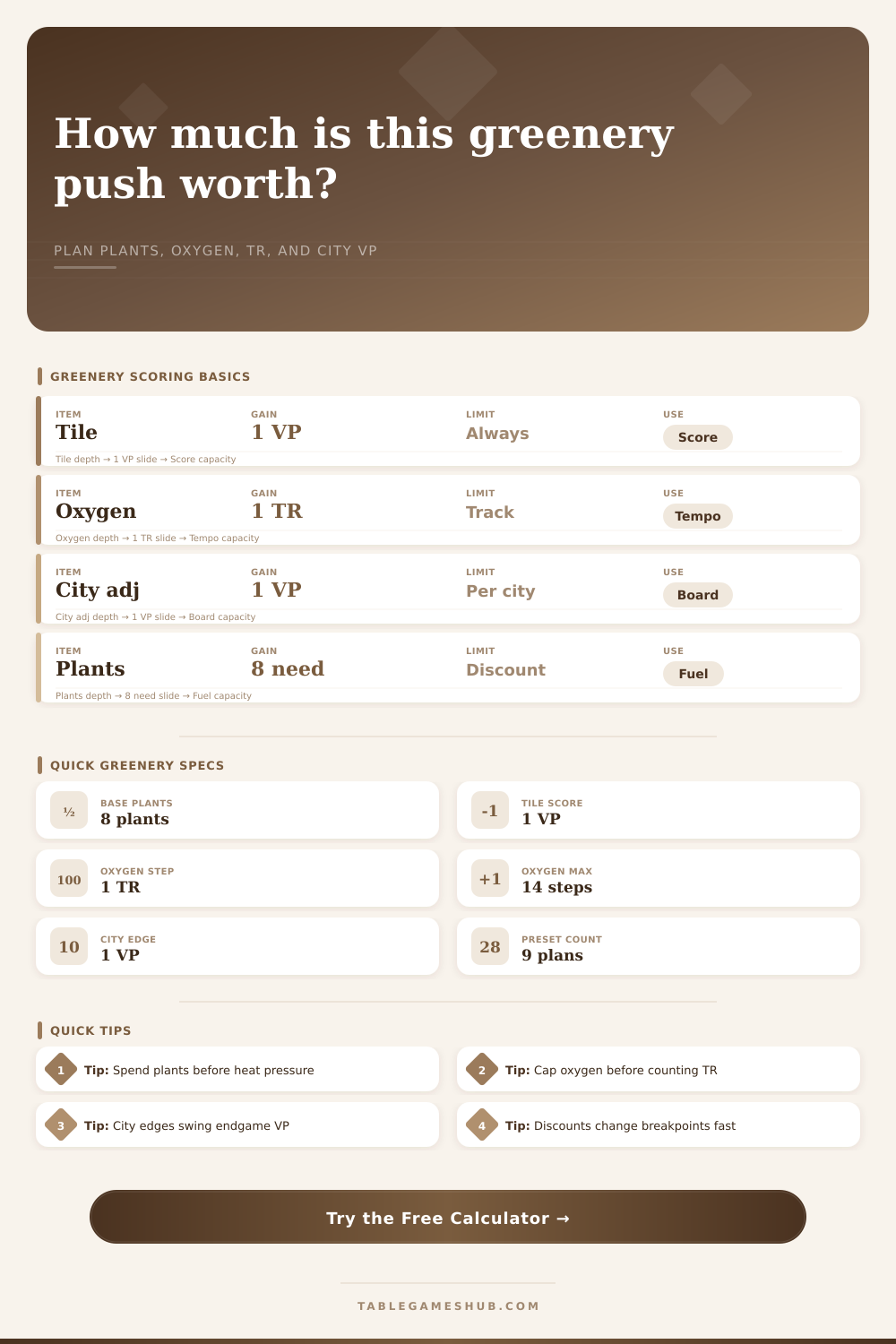
| Layer | What It Counts | Typical Range | Calculator Input |
|---|---|---|---|
| Greenery tile VP | Printed endgame point from each greenery tile | 1 per tile | Greeneries placed plus plant conversions |
| Oxygen/TR tempo | Terraforming rating from raising oxygen | 0 to tile count | Oxygen spaces remaining and TR value |
| City adjacency | Endgame city points created by adjacent greeneries | 0 to 6 per tile | Total city adjacencies |
| Placement bonus | Board resource, card, or ocean bonus converted to value | 0+ equivalent | Placement bonus value |
| Plant Need | 1 Greenery | 2 Greeneries | 3 Greeneries |
|---|---|---|---|
| 8 plants | 8 plants | 16 plants | 24 plants |
| 7 plants | 7 plants | 14 plants | 21 plants |
| 6 plants | 6 plants | 12 plants | 18 plants |
| 5 plants | 5 plants | 10 plants | 15 plants |
| Scenario | Best Signal | Main Risk | Score Focus |
|---|---|---|---|
| City adjacency burst | 2+ city edges per tile | Helping an opponent city | Board VP density |
| Oxygen push | Track has spaces remaining | Oxygen caps before all tiles resolve | TR plus tile VP |
| Plant engine | Several generations left | Plants are vulnerable before conversion | Repeat conversions |
| Endgame greenery | Final scoring is close | No income time remains | Tile and city VP |
| Remaining Generations | Plan Type | TR Weight | Placement Emphasis |
|---|---|---|---|
| 0 to 1 | Final scoring | VP only unless income matters | Maximize city edges |
| 2 to 3 | Endgame tempo | TR still affects final pace | Balance oxygen and board VP |
| 4 to 5 | Engine payoff | Higher TR value can be justified | Preserve future plant flow |
| 6+ | Early development | Tempo compounds longest | Claim premium hexes early |
Greenery isn’t always “just” putting down a tile in Terraforming Mars; it’s an assessment of future points, pressure, and tempo. Does it close out the game? Is it building engine? How will it change final tally? Most players looks at greeneries as simple point sinks, converting eight plants into one victory point and a little bump on oxygen track. It also provides a little bump up in the oxygen track. And they’re not wrong. But they’re also not considering placement.
Once you put down greenery, here’s where it changes everything: Once you enter your available resources, the calculator do the math for you. No need to guess coefficients in a hurry. Before you trust the result, though, you must know what these inputs mean.
Why Greenery Placement Matters
First, what’s the status of oxygen track? Each greenery increase total worldwide oxygen by one. If the oxygen track hasn’t maxed out at fourteen, then it gives you one point of Terraforming Rating (TR). That TR point convert immediately into income for all future generations. For example, if you’re five generations away from the end and increase your TR by four, you’ve just accumulated an extra twenty resources in the bank. That TR gain provide extra income for every generation that follows.
You can set that number here to reflect how important you think it will be: do you want more points in the long run or are you more concerned with boosting short-term money flow? If so, your plan of attack may vary depending on how far away you are from the end. A late-game park may not be as valuable for its TR payoff.
On the other hand, placing that same greenery next to a city makes it much more valueable. This is especially true if you think that city could score endgame adjacency points that no one else can dispute. The board becomes dynamic because of its adjacency to cities. A greenery placed next to any number of cities earns a VP for every one. Three cities and you score three VP right then. Add the point from the tile itself. You get four VPs for eight plants if you can make that work with discount cards.
The tool’s reference table spells this all out nicely. It lets you decide whether to go for a quick spike of adjacency points or just slowly grind along on the oxygen track. And be mindful of how you might help other players. Place a greenery next to an opponent’s city? They reap the reward, not you. It doesn’t seem like much but when the margins are close…
The second wrinkle in all this timing is that there’s pressure to get things done now. That makes planting things so early in the game seem wasteful; you don’t have any plant produced yet to support the stream. You need an engine first, and after that you’re spending the extra money on tiles.
There’s also an option in the calculator for how many more generations remain. This is useful for classifying what your plan is: cash-out for points or setup for income? How many turns do you have left? If it’s just the last couple, the value of TR goes down. At the same time, the value of straight-up victory points go up. Why care about income next turn anymore? All that matters now is box scores.
Discounts play a critical role in making these moves feasible. Projects that cut the plant cost of greeneries (like Red Spot Observatory) alter their breakpoint, when you would start planting them. The tool allows you to set the plant conversion discount (normally 8) all the way down to 4. This shows how much influence large companies has. Without it, you’d have no sense if a move was worth taking or if numbers didn’t add up.
Perhaps you think “I could totally fit three greeneries.” But once you take into account what you give up by not purchasing another card as well as the real-world plant cost, its a different story. You should of considered that too.
So in short, greenery placement is a two-step-ahead game. And it’s not just about plopping down some plants. You’re changing the shape of the board’s geometry and its race to terraform victory. That applies whether you’re trying to secure city edges or push for TR leads. Each tile shows your strategy, which is what makes difference between good players and great ones. It becomes less of a resource dump and more of a strategic match on the board.