Takenoko Objective Calculator
Estimate completed plot, panda, and gardener objectives, then project hand readiness with irrigation, bamboo, enclosure, and weather die effects.
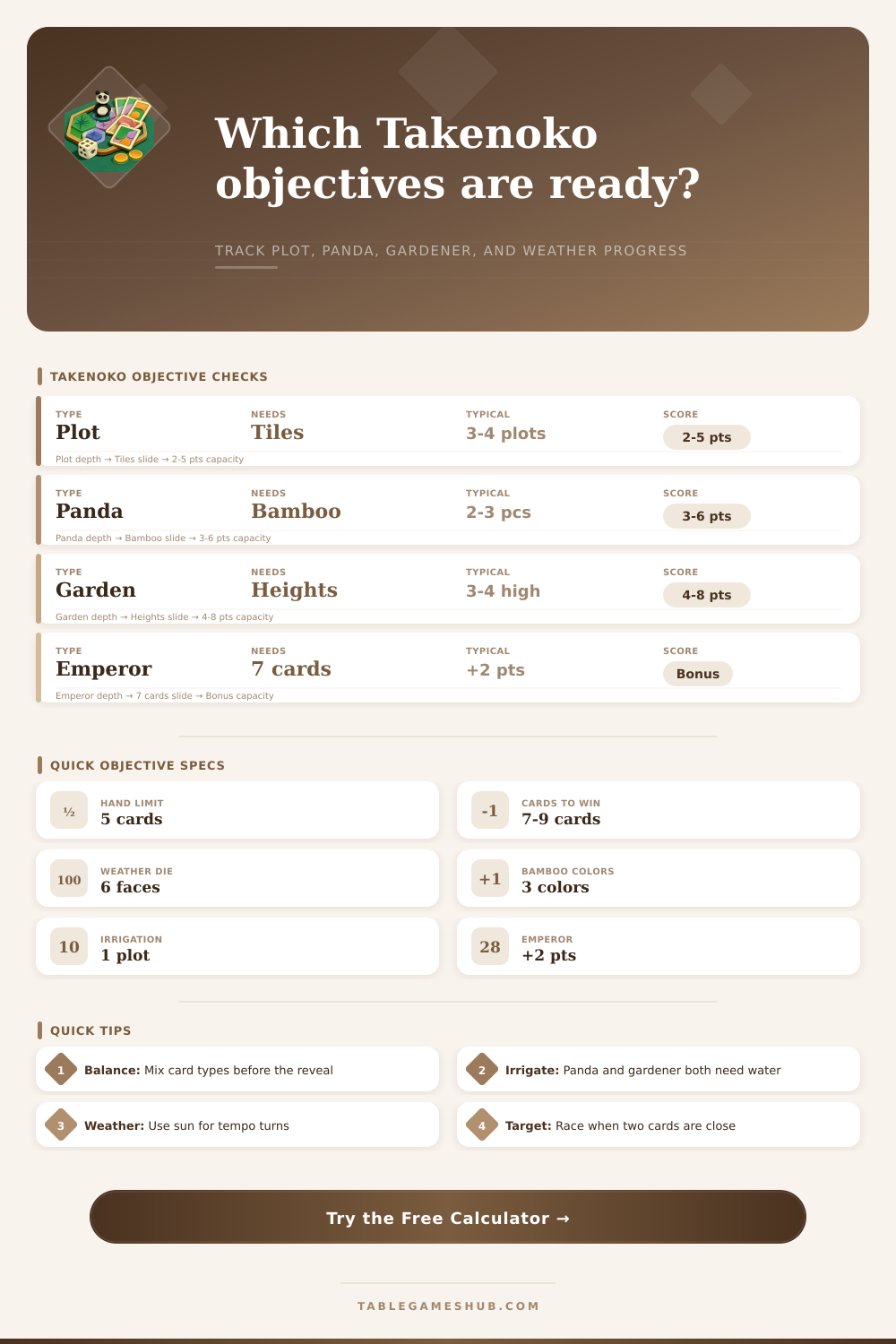
| Objective Type | What It Checks | Common Board Need | Usual Point Band |
|---|---|---|---|
| Plot objective | Specific plot colors arranged in a pattern | 2 to 4 plots, often irrigated | 2 to 5 points |
| Panda objective | Eaten bamboo sets by color | 2 or 3 bamboo sections removed | 3 to 6 points |
| Gardener objective | Bamboo heights on colored plots | One or more stacks at height 3 or 4 | 4 to 8 points |
| Emperor bonus | First player to complete target cards | 7, 8, or 9 objectives by player count | 2 points |
| Player Count | Trigger Target | Race Meaning | Calculator Use |
|---|---|---|---|
| 2 players | 9 objectives | Longer scoring arc | Favor higher gardener values |
| 3 players | 8 objectives | Balanced pace | Track two near-ready cards |
| 4 players | 7 objectives | Fast finish pressure | Push quick panda and plot cards |
| Private target | 1 to 9 objectives | Planning checkpoint | Use before drawing new cards |
| Weather Face | Objective Boost | Best Pairing | Calculator Adjustment |
|---|---|---|---|
| Sun | One extra action | Any objective type | Reduces action gap by 1 |
| Rain | Grow one bamboo section | Gardener objective | Adds bamboo readiness |
| Wind | Repeat an action type | Plot or irrigation turns | Improves focused objective pace |
| Storm | Panda eats after moving | Panda objective | Adds one eaten-bamboo equivalent |
| Cloud | Take an improvement | Enclosure or watershed need | Adds improvement readiness |
| Question mark | Choose any face | Closest objective | Uses strongest available boost |
| Board Signal | Plot Card Effect | Panda Card Effect | Gardener Card Effect |
|---|---|---|---|
| Many irrigated plots | Pattern cards become safer | More edible bamboo appears | Stacks can grow reliably |
| Many enclosures | Protects shapes from panda movement | Limits available eating targets | Preserves height objectives |
| Extra canals in reserve | Connects pattern edges | Opens new bamboo colors | Turns dry plots into growth spots |
| Uneven color supply | Can block exact color patterns | May finish single-color sets | Points to color-specific gardener cards |
| Objective Family | Fastest Input | Main Bottleneck | Best Weather | Risk Check |
|---|---|---|---|---|
| Plot pattern | Placed plots and irrigation | Exact color and shape match | Sun or Wind | Dry plots do not count for many cards |
| Panda bamboo | Visible bamboo and storm movement | Right color pieces in stomach | Storm | Enclosures can block eating |
| Gardener height | Irrigated plots and rain growth | Reaching height 3 or 4 | Rain | Panda can reduce exposed stacks |
| Balanced hand | Multiple near-ready categories | Hand limit before completion | Question mark | Too many unfinished cards slow the trigger |
In the game Takenoko, the player must manages the relationship between the game board and the player’s hand. A player can have many bamboo and irrigated plot on the game board, but still lose the game if the player dont have an appropriate cards in there hand. There are different type of cards for the game, each requiring a different state of the game board with the weather die in play.
The plot objective reward a player for creating specific patterns of colored tile on the game board. A player must take into consideration how many plot they have placed on the game board and how usable those placed plot are for the plot objectives. Irrigation of plots increase the usability of those plots for the player’s plot objectives.
Match Your Cards to the Game Board
For instance, a player may place many tiles in the plots in the game without irrigating those plots. As a result, the player may be prevented from fulfilling their plot objective. The calculator for the game take these considerations into account.
Beyond the plot objective for the game, there are different rule for the panda objectives. The storm face on the die can provide food to a panda objective. However, enclosure can prevent a panda from eating a player’s bamboo.
Enclosures can be useful for gardener objectives but harmfully for panda objectives. Thus, the presence of enclosures can help one player, but prevent another player from reaching there objective. Color variety can be useful for panda objectives, as well, if a player’s panda objective requires different color of bamboo be placed in the plots.
Gardener objectives require irrigation, growth, and protection of the bamboo placed in the plots. Thus, gardener objectives award a player for the creation of tall bamboo stack in the plots. Both the rain face on the die and the enclosures can aid a player who is attempting to fulfill their gardener objectives.
A player who is aiming to fulfill their gardener objectives must pay attention to both the enclosure and bamboo count on the game. The weather die is not a random die for bonus for players. The value of the weather die is based off the cards that a player intend to complete.
For instance, a question mark on the die is only useful if one player has a completed objective and many objective that are yet to be completed. Thus, choosing a weather die face to complete the nearest objective to completion is the best play rather than rewarding players for completing many objectives with small additions of bamboo. Such consideration is taken into account in the calculator.
Because a player can only hold five cards at a time in their hand, a player cannot hold too many objectives that are yet to be completed. For instance, the player could potentially have a plot objective and a gardener objective for the same plots yet required to be completed. Thus, the player should of consider the completion of all objectives of each of the three different family of objectives before drawing a new card for their hand.
The number of players playing the game also change the requirements for when the game ends. With four players in the game, the game ends when any player reach seven cards. However, with two players, the game ends at nine cards.
This changes whether or not a player choose to complete the quick objectives versus the high-scoring objectives. The calculator is adjusted for the number of players in the game. Overall, the game reward the player who notices the difference between the game board and the player’s hand.