Shuffleboard Court Dimensions Calculator
Size an outdoor deck shuffleboard court, scoring triangle, baseline, shooting area, dead line, clearances, and scaled-down layout from one plan.
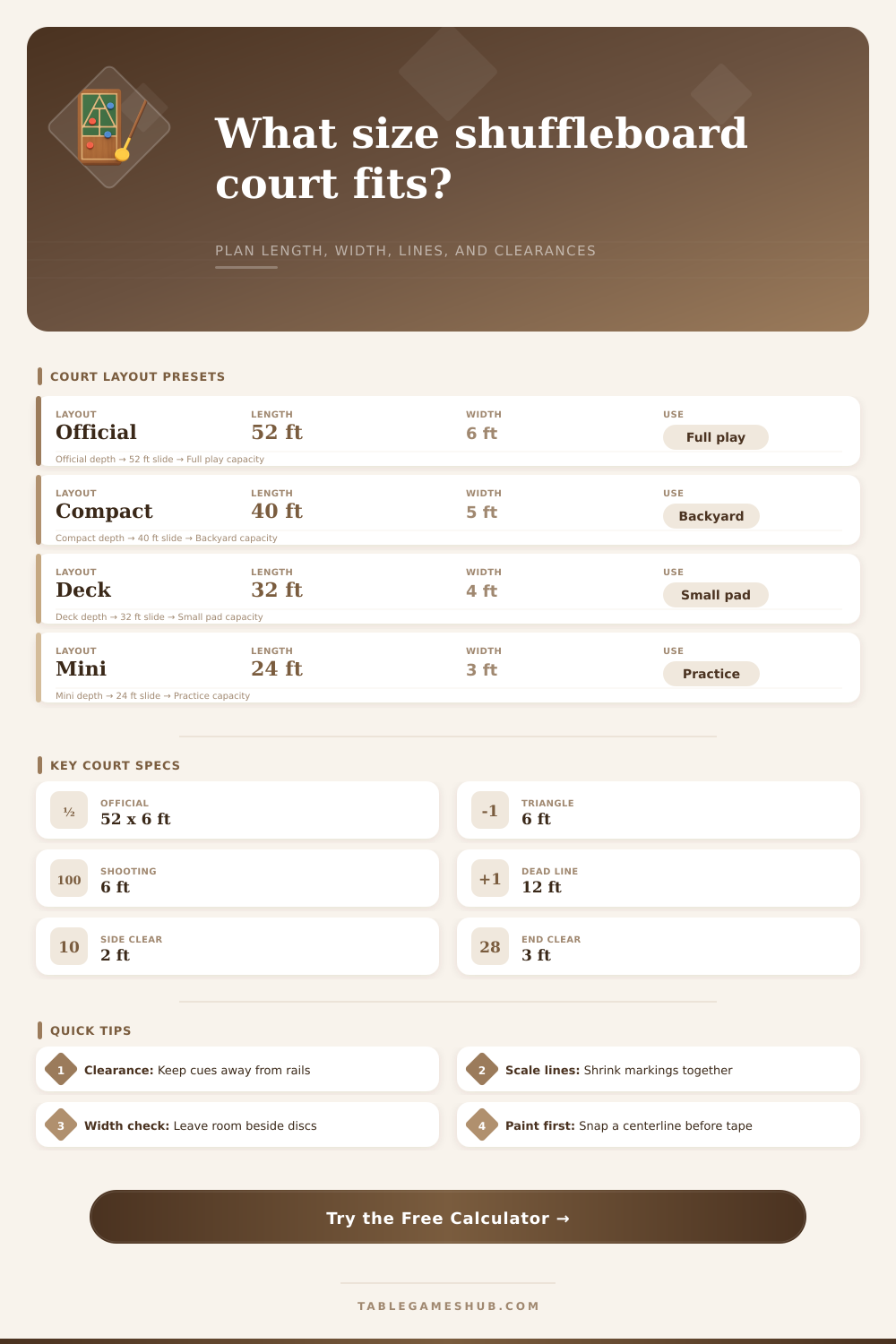
| Court style | Playing length | Playing width | Best fit |
|---|---|---|---|
| Official outdoor | 52 ft | 6 ft | Dedicated court or club surface |
| Long backyard | 44 to 48 ft | 5.5 to 6 ft | Large patio, driveway, or sport slab |
| Compact backyard | 36 to 40 ft | 4.5 to 5 ft | Residential play with scaled markings |
| Deck practice | 28 to 34 ft | 3.5 to 4 ft | Narrow deck, side yard, or practice lane |
| Mini practice | 20 to 26 ft | 3 to 3.5 ft | Short aiming and weight-control practice |
| Marking | Official reference | Scaled by | Layout note |
|---|---|---|---|
| Scoring triangle | About 6 ft deep | Length or manual | Keep centered on the court width |
| Baseline | About 6.5 ft from end | Length or manual | Back edge for the shooting area |
| Shooting area | About 6 ft deep | Length or manual | Leave stance room outside the court |
| Dead line | About 12 ft from baseline | Length or manual | Mark from each end toward center |
| Centerline | 26 ft from end | Court length | Snap this first for symmetry |
| Scale ratio | Example court | Triangle depth | Dead line distance |
|---|---|---|---|
| 100% | 52 x 6 ft | 6 ft | 12 ft |
| 85% | 44 x 5.1 ft | 5.1 ft | 10.2 ft |
| 75% | 39 x 4.5 ft | 4.5 ft | 9 ft |
| 62% | 32 x 3.7 ft | 3.7 ft | 7.4 ft |
| 50% | 26 x 3 ft | 3 ft | 6 ft |
| Clearance zone | Minimum | Comfortable | Use when |
|---|---|---|---|
| Behind each end | 2 ft | 3 to 5 ft | Players stand behind the baseline |
| Along each side | 1 ft | 2 to 3 ft | Players walk beside the court |
| Near walls or rails | 3 ft | 4 ft or more | Deck rail, fence, or garage edge nearby |
| Maintenance margin | 6 in | 12 in | Paint edge, border strip, or drainage gap |
When you are planning a shuffleboard court, the dimensions of the shuffleboard court is the most important factor to consider in the planning of the court. The dimensions of the shuffleboard court will determine in what way the game is to be played on the shuffleboard court. For example, if the dimensions of the court are incorrectly constructed, the game may feel awkward to the players when they attempt to play upon the shuffleboard court.
The length of the shuffleboard court will determine the scale of the game that is to be played on the shuffleboard court. Shuffleboard courts is officialy fifty-two feet in length, as this length permit the players to control the speed at which the disc will travel across the court. If, however, the length of the court was shortened, such as to forty feet, the game would have a different rhythm when played on that court.
How to Plan a Shuffleboard Court
Courts that are thirty-two feet in length are another option for shuffleboard courts, but are most suitable for players who is engaged in practicing their skill rather than competing against others. The width of the shuffleboard court is another critical dimension of the court that must be construct appropriately. Courts that are six foot in width are considered to be of the standard size for shuffleboard courts.
If the shuffleboard court was only five or four feet in width, though, it may feel as if the players is engaging in a more crowded game. Additionally, it is possible that the players may bump into some of the objects in the area if the court is too narrow. The space that is located beside the shuffleboard court is referred to as the side clearance, and such space is required for the players to walk past the court without hitting the walls of the area.
The scoring triangle is located at each end of the shuffleboard court. The depth of each scoring triangle should be scaled according to the length of the shuffleboard court so that the angle of each scoring triangle are consistent. If the triangles are too small for the length of the shuffleboard court, the players may feel as if the scoring triangle is too small and cramped.
The baseline is another line that is located a short distance behind each scoring triangle. Players must stand behind the baseline when they are attempting to throw the discs onto the shuffleboard court. If the baseline is too close to the end of the shuffleboard court, players may not have enough room to properly establish themselves into their playing stance.
Dead lines are drawn across the shuffleboard court. If any of the discs do not cross the dead line, the players are to remove the discs from play. The placement of the dead lines will determine the amount of speed that is required for the discs to cross the court.
For instance, if the distance of the discs from the dead line is long, players are rewarded for using a controlled amount of force when throwing the discs; if the distance is short, players are punished for not using enough speed to allow their discs to travel to the other end of the shuffleboard court. In addition to the shuffleboard court itself, there are areas outside of the court that are important to consider in the construction of the shuffleboard court. Most notably, there is an area at each end of the court that is referred to as the end clearance.
This area is where the players are permitted to stand when playing on the shuffleboard court. The other area is the side clearance, which permits the players to avoid the walls in which the shuffleboard court may be placed. Both of these areas should be included in any calculations made for the total footprint that will be occupied by the shuffleboard court.
If the area is not included, the shuffleboard court may feel too tight for the individual that wish to use the court. Before beginning to paint the shuffleboard court, it is important to measure the area in which the court will be constructed. Many individuals wish to utilize all of the concrete available to themselves for constructing their shuffleboard court.
However, it is possible that using all of the available concrete will not provide enough room for the individuals to walk to the shuffleboard court. It is better to make a decision as to how much of the available area will be used for the shuffleboard court itself and how much will be allotted to the players for walking. Additionally, the width of the paint lines for the shuffleboard court is another consideration; standard paint lines are one inch in width.
However, because the painting surface may be slightly rough and the paint may bleed slightly from the discs, extra paint must be accounted for. Finally, the way in which the shuffleboard court will be used is another consideration before painting begins. For instance, if a shuffleboard club is to use the shuffleboard court, a full size shuffleboard court will be required of that area.
However, courts that are scaled to fit more residential areas may be better utilized by families that would use the shuffleboard court for less competitive games. Additionally, narrow areas, such as decks, are best used for constructing courts that allow for practice of shuffleboard skills rather than competitive play. Once the use of the shuffleboard court is determined, the dimensions of the scoring triangles, the baseline, and the dead lines can be determined.
Finally, the dimensions of the shuffleboard court itself can be adjusted after the decision is made regarding the number of individuals that will use the court.