Sheepshead Schneider Calculator
Calculate picker team status, opponent Schneider, Schwarz flags, blitz/crack/recrack multipliers, and final payout units for a completed hand.
| Situation | Picker Team Points | Opponents Points | Scoring Status |
|---|---|---|---|
| Picker loses | 0 to 60 | 60 to 120 | Opponents win; check whether picker side was Schneidered |
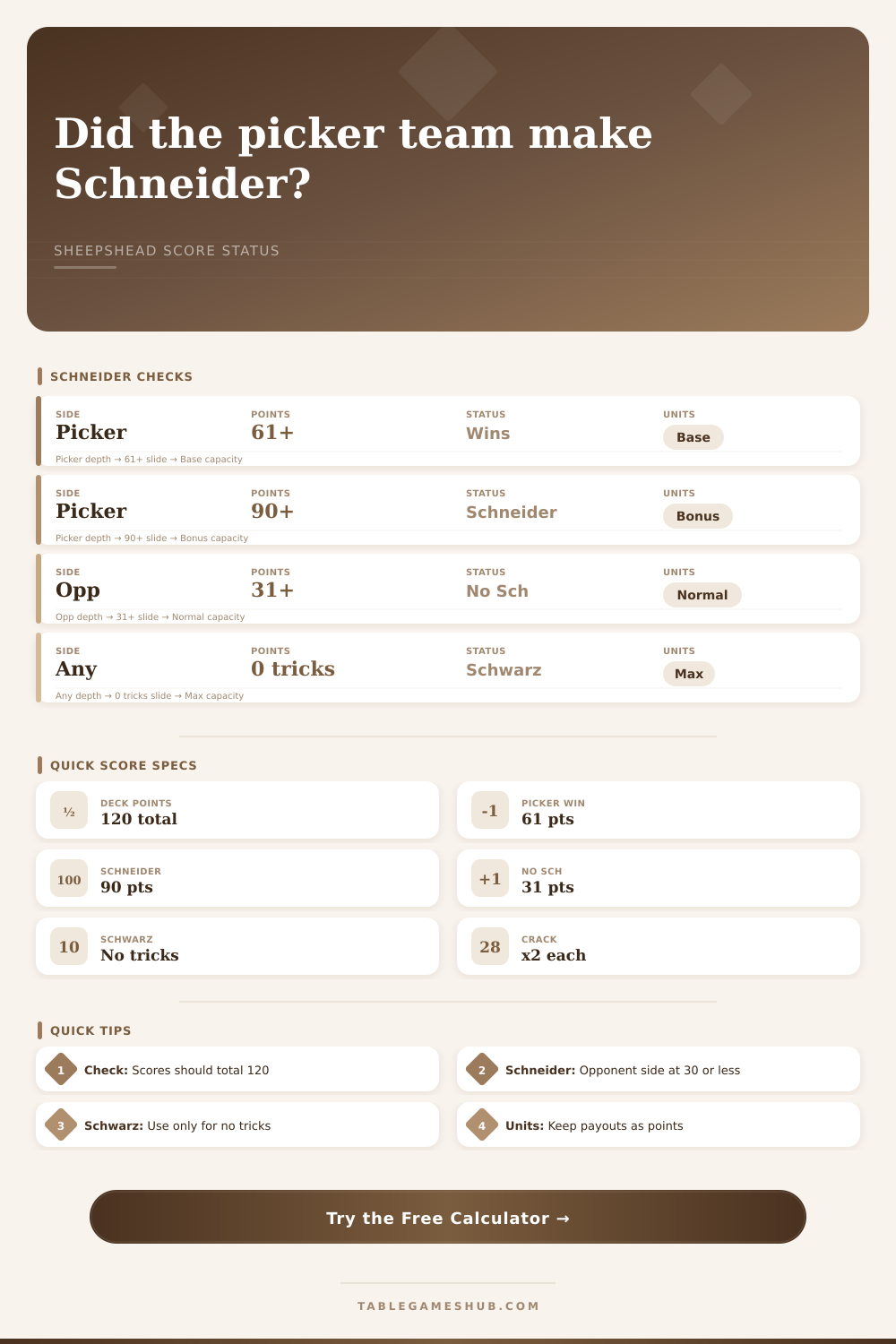
| Picker wins normally | 61 to 89 | 31 to 59 | Hand made without Schneider bonus |
| Picker wins Schneider | 90 to 119 | 1 to 30 | Opponents failed to escape Schneider |
| Picker wins Schwarz | Usually 120 | 0 and no tricks | Schwarz overrides ordinary Schneider label |
| Item | Calculator Treatment | Typical Effect | Use With Care |
|---|---|---|---|
| Base hand | Base units times status units | Starts every result | Set base units to your score sheet unit |
| Schneider | Adds one status unit | Rewards holding the losing side to threshold | Threshold can vary by table agreement |
| Schwarz | Adds two status units | Used when one side took no tricks | Do not mark from points alone unless table rules allow it |
| Blitz, crack, recrack | Each selected level doubles | Creates x2, x4, x8, or higher multipliers | House rules differ on when these apply |
| Picker Points | Partner Points | Opponents Points | Status Before Multipliers |
|---|---|---|---|
| 52 | 14 | 54 | Picker team wins normally at 66 |
| 72 | 19 | 29 | Picker team wins Schneider at 91 |
| 39 | 21 | 60 | Picker team is stopped at 60 |
| 18 | 10 | 92 | Opponents win Schneider against picker side |
Picker Made
Picker plus partner reaches at least 61 points. The calculator then checks whether opponents stayed at 30 or fewer for Schneider.
No Schneider
The losing side has enough points to avoid the Schneider line. This usually keeps the hand at the base status units.
Schwarz
Use the Schwarz flag when one side took no tricks. It is separated from raw points so unusual point splits can still be reviewed.
There is no math; that’s why there is a app called Sheepshead calculator. It do the math for you so you can concentrate on the game. No one argues over who owes whom. You can focus on socializing and keep the math out of it.
In Sheepshead, there is a hard ceiling on the score: One Hundred Twenty Points. That’s it. No matter what. It’s never changed. You need to know not only who won more tricks, but also if the other team fell below a certain limit. In most group, that line is Thirty. The losers recieve a bonus if they score less than thirty points.
Why You Should Use the Sheepshead Calculator
When you’re tired, you may forget this. It is a good thing the calculator check the math for you. Bonus: You think that guaranteeing a bonus means the whole team did so and you get it wrong way to often. Did the other side go under the limit? Did the partner do most of the work? How do you know? The tool split out the partners’ share from the picker’s. That lets you see who took on how much of the load.
Some tables applies multipliers if the picker did all the work. Others give it flat even if the partner saved the hand. To adjust for those rules, turn the toggles on/off in the calculator. Others give it flat even if the partner saved the hand. To adjust for those rules, turn the toggles on/off in the calculator.
Every Trick include Schwarz. Players often forget to claim this status, which is rare. So you’ll get a high score and think oh that’s just a regular win. But Schwarz usualy has a higher multiplier then Schneider does. The interface flags this out separately because your points could be misleading on their own. You could’ve gotten a hundred twenty points and then not made it into the highest tier payout, if the tricks fell funny. Marking Schwarz specifically guarantees that what shows up on the payout reflect how dominant this play was.
That adds layers to confuse new players. Blitz and crack are examples of those layer. They increase the risk. Certain cards (black queens in this case) trigger them. Announce bonus points up front. If you make it, the multiplier applies to the extra points you declared upfront. Don’t make it, lose more. Only after the base status decision has been applied does the doubling happen.
Before the calculator can do its math on the bonus points, you have to figure out whether or not you’ve reached Schneider. In this case, getting that right makes a huge difference. There is also a sanity check in the form of the reference tables on the page. These tabulate typical scenarios so you can place yourself into them. Did you get stopped? Were you forced Schneider? Was it normal to win? That’s how you know whether you played well enough or not. Did you come up short and realize you were too aggressive for a bonus?
It allows for clear rules that don’t cause any bad blood, and keep the game moving. It adds an impartial arbitrator to disputes. Input the info, see the answer, go onto next deal. Take the frustration out of doing mental math in the moment. Save it for actualy playing. Let the device sort out the points for ya.