Seven Wonders Leaders Calculator
Total a 7 Wonders Leaders score with printed leader points, leader coin costs, discount and coin effects, science symbols, military, civilian, commercial, guilds, wonder stages, player count, and age scoring pace.
Live score breakdown
| Scoring module | Entered value | Rule used | VP |
|---|---|---|---|
| Age other subtotal | 24 | direct VP | 24 |
| Wonder stages | 10 | stage VP | 10 |
| Leader printed VP | 8 | card text | 8 |
| Science symbols | one set | estimated swing | 10 |
Leader card value checks
| Leader signal | Typical input | Score effect | When it matters |
|---|---|---|---|
| Printed VP leader | 3-6 VP | Direct points | Stable floor in any player count |
| Coin discount leader | 2-8 coins | Coins divided by 3 | Strong if it also enables builds |
| Science symbol leader | 1 symbol or set | Square and set swing | Best when completing a symbol set |
| Guild-style leader | Neighbor scaling | Variable end VP | Higher with 5-7 players nearby |
| Military leader | Shield or conflict VP | Conflict track pressure | Needs Age II and III follow-through |
Board category profiles
| Profile | Military | Civilian | Commercial and guild read |
|---|---|---|---|
| Balanced table | 5 VP | 13 VP | 4 commercial, 7 guild |
| Rhodes push | 14 VP | 7 VP | 3 commercial, 4 guild |
| Blue-card build | 2 VP | 24 VP | 2 commercial, 3 guild |
| Commercial engine | 4 VP | 9 VP | 12 commercial, 5 guild |
| Guild finish | 3 VP | 10 VP | 5 commercial, 16 guild |
Player count and score bands
| Players | Normal band | Strong band | Leaders note |
|---|---|---|---|
| 3 players | 48-60 | 61-70 | Lean guilds, direct VP is safer |
| 4 players | 52-64 | 65-74 | Neighbor effects are readable |
| 5 players | 56-66 | 67-76 | Guild and commerce leaders improve |
| 6 players | 58-68 | 69-79 | More neighbor scaling and denial |
| 7 players | 60-70 | 71-82 | Wide table boosts guild ceilings |
Seven Wonders is a frustrating game to play, in that someone might hit you with a powerful military move while you’re building science sets and suddenly it’s all falling apart. Maybe you think you did everything right, but the score tells a different story. Leaders become a wild card that can ruin an otherwise calm game. That’s also where some of the most careful strategy play out.
For most people, Leader drafting is about reacting to other players. But acting proactively in this phase alter your turn economy. You aren’t selecting cards, you’re bidding on what you hope will be available later and there’s a ticking clock to do so. Leaders drafting is all about that balance between end-game points vs. Immediate utility.
How to Choose Leaders in Seven Wonders
A leader that give you three coins right now might save your engine from collapsing, but at what cost? If it cost you the high-value card your neighbor coveted, then you sacrificed long-term security for immediate survival. There’s a reason this strategy works, but more often than not, it doesn’t win the game by itself.
Enter your printed points and coin expenditures into the calculator and let it run the math. Did that cheap discount leader pay off, taking into account any lost guild bonuses/science symbols? Net value, not just face value on the card, is what you need to track.
Each science point has value, though it’s contextual value. An individual one isn’t useful alone. However, if it completes a set that was otherwise blocked by your neighbors hoarding tablet, that compass suddenly shines as part of a set. There are partial sets and wild cards. The science point tries to make an estimate based off all of those things combined. While that might seem insignificant, consider that science points compound fast once you’re at the threshold for several sets.
Then there are many who don’t bother with leader science until Age III. By that time, all the good ones has been taken or cost too much to keep your gold reserves full.
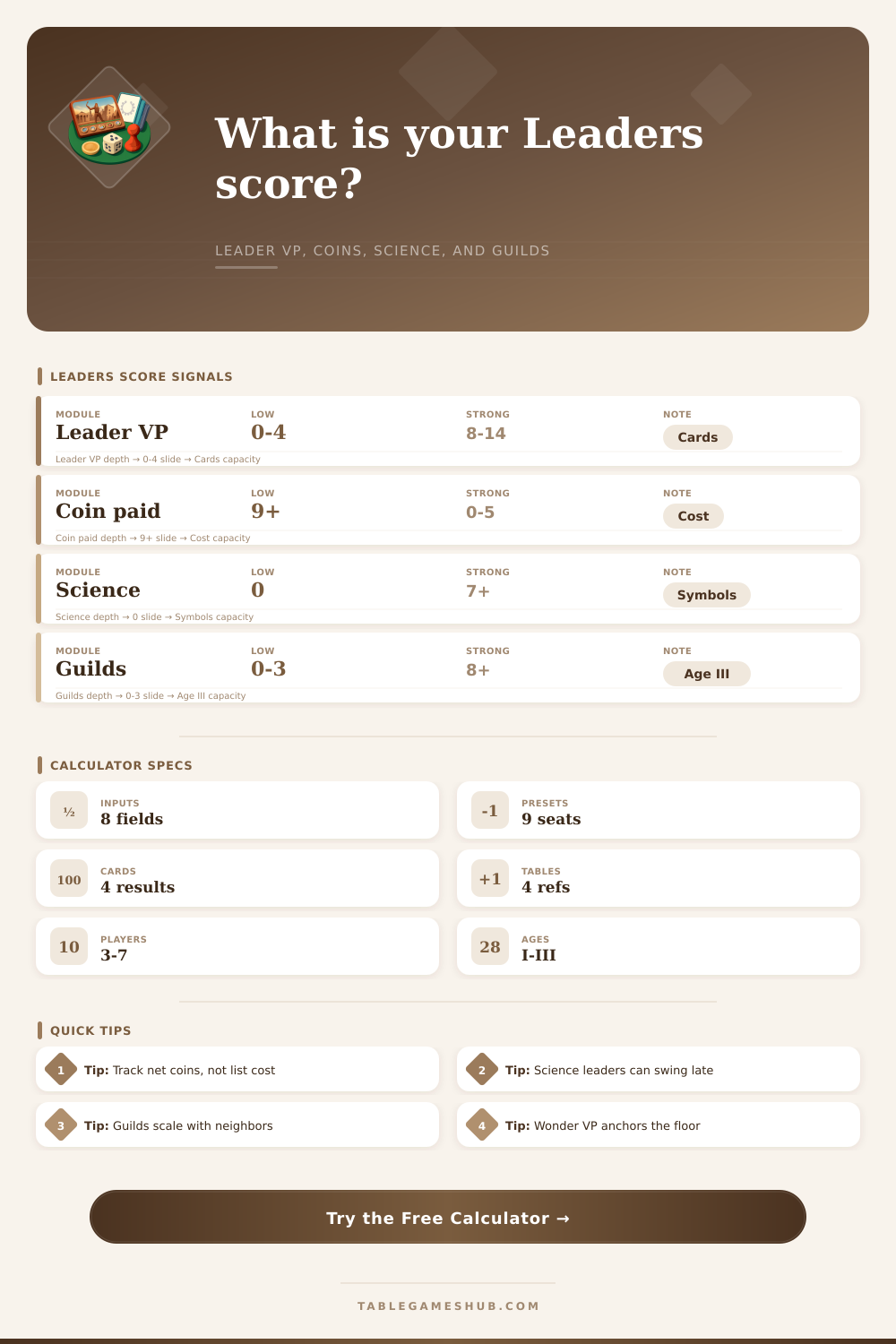
The guild system adds another layer of complexity which increases based on number of players. In a three player game, for instance, guilds rarely matter since there simply isn’t enough contact between neighbors to justify using the multiplier. However, at a six or seven player table, placing your board to get maximum adjacency bonuses can mean a difference of 15+ points and put a leader of a guild into the final scoring lead. The expected victory point bands for each number of players are shown in reference table on the page.
Playing tightly works different than playing widely, where the density of opportunity is totally different. These wonder stages are also like the solid floor below all that volatility. If your military defense falls to a Rhodes commander and your leader draft doesn’t go well, still: Those wonder points are yours.
The calculator treats them separately. It lets you know what percentage of your overall score is due to steady building (i.e., wonder) compared to the risky side (the Leaders phase). That’s important. You’ll know when to be more aggressive with your bids for pricey leaders when you’ve got a safety net, and when to play it safe.
But all too often, Leaders go down the path of poor coin management. At the end of the game, all those coins turn into victory points, and every coin spent on a leader is a point lost. And the calculator turns this spending into some amount of VP burden. The calculator helps you see if the leader’s benefit is actualy worth the cost. You have to ask yourself if what you think is a discount effect really saves any money at all, or if it just moves the cost to where your opponents gain civilian bonuses. This is the difference between being a good player and a great one.
You must know your masters. Leaders are an investment. They provide different returns for every player. There’s no “one-size-fits-all” approach here. Know your immediate needs for your engine. Know your end-game landscape. Keep one eye on what your neighbors is doing. Use this to predict where the value is and never view a single leader on its own. Start seeing the Leaders as part of a bigger story, which is your intended path to victory.
Maybe it’s an aggressive push into military. Maybe it’s a cautious build around science. Knowing your actualy net worth protects you from being caught flat-footed when that sweet-looking score turns out to be less than it appears. You should of not just need points; you need the right points at the right time.