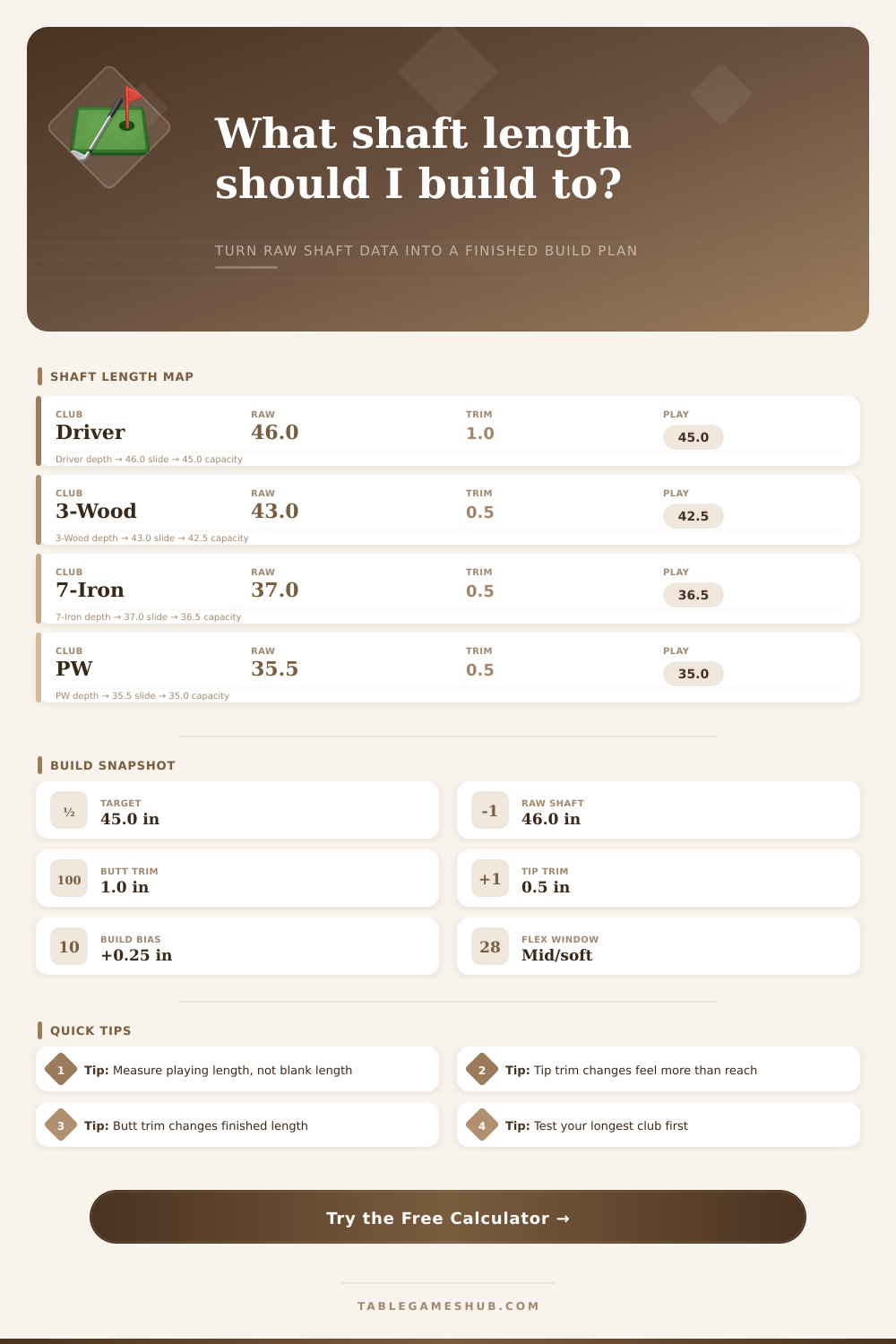
Golf Club Shaft Length Calculator for Trim Plans
Map raw shaft length, trim allowance, and finished play length into a cleaner build target.
| Club | Standard Play | Typical Tip Trim | Build Cue |
|---|---|---|---|
| Driver | 45.0 in | 0.5-1.0 in | Longest blank |
| Fairway wood | 42.0-43.0 in | 0.0-0.5 in | Launch window |
| Hybrid | 39.0-40.5 in | 0.0-0.5 in | Bridge club |
| Iron | 36.5-38.0 in | 0.0-0.5 in | Progression fit |
| Shaft style | Raw length note | Trim focus | Use case |
|---|---|---|---|
| Wood shaft | Longest blank | Tip first | Driver / fairway |
| Iron shaft | Shorter blank | Butt finish | Iron progression |
| Hybrid shaft | Mid blank | Light trim | Transition club |
| Wedge shaft | Shortest blank | Minimal cut | Control shots |
| Pattern | Finished length | Cut profile | Best fit note |
|---|---|---|---|
| Tour driver | 45.0 in | Low trim | Fast tempo |
| Balanced wood | 42.5 in | Moderate trim | Steady release |
| Control iron | 37.0 in | Butt finish | Compact posture |
| Gap wedge | 35.5 in | Minimal trim | Short-game touch |
This shaft length calculator turns raw blanks into a clear playing-length plan. Compare trim allowance, build bias, and finish length before you cut, then confirm the fitting window.
Golf shaft trimming are the process of adjusting a golf shaft so that the shaft feel best with a persons swing. A club may feel to flexible or to stiff due to the length of the shaft. A shaft must be trimmed to transform the raw shaft into a finished club.
The player must make the plan for the tip cuts and the butt trims to even create the necessary feel and length for the clubs. The trimming of a shaft begin with the tip trim. Raw shafts are longer than the clubs is supposed to be due to the adjustments that may be required of each club.
How to Trim a Golf Shaft
The tip trim cut the thin end of the club. This is used to even out the flexibility of the clubs and the way in which the clubs launch the ball. Once the tip trim is complete, the player can perform the butt trim.
This cut the thicker end of the club. This is used to even out the clubs to the desired length; the distance from the sole of the club to the end of the grip. If either of these steps are not performed in this order, a person may encounter balance issues with there clubs.
A persons posture will have an impact upon the trim of their clubs. For those with an upright posture, a longer shaft can be allowed. For those with more of a compact posture, clubs will have to be shorter so as to avoid standing up during impact.
A persons tempo can also have an impact upon the clubs. For those with more even tempos, a longer shaft can be provided. For those who have quick transitions from start to swing, clubs will have to be shorter to maintain control.
A person should of not rely upon the generic charts to determine club length and flexibility for there swing. Their motion is not the same then others. The weight of the clubs will also play a role in the length of the clubs that is made.
Clubs with heavier heads will require the shaft to be shorter to maintain swing weight. Swing weight is the feeling of the head weight of the club during the swing arc. If a club is using lighter grips or heavy adapters, the opposite will be true.
A person can use a build bias to provide some extra room for error. For instance, a person may want a longer club for distance with the balls or a shorter club for precision in there swing. Another method to determine the clubs length is the use of a mathematical fit score.
Some mistake can occur in the trimming of clubs. For instance, a person may measure the wrong part of the club. A person may measure the raw club instead of the playing length.
This will cause a decrease in the swing weight of the clubs. A common mistake with the tip trim is over-trimming the tips of the clubs to create a more stiff shaft. However, this will reduce the launch angle of woods clubs.
It is recommended that a person test the longest clubs first, such as drivers or fairway woods clubs. The mistakes that are made with these clubs will directy impact the remaining clubs in a set. Not all clubs will be trimmed in the same way.
Clubs such as drivers and fairway woods will require a focus on the tip trim. Iron clubs require a focus on the butt trim. Wedge clubs will require little trim as they require a high degree of predictability when swung.
A person will have to consider the different clubs that will be used together. For instance, a hybrid club will have to fit in the gap between woods and irons clubs. Each length or flexibility choice involve a trade-off.
A longer club may allow a person to swing faster but may also create dispersion in the balls that are hit. Shorter clubs allow for better club contact but may reduce the distance that the clubs travel. A person may use a counterbalanced system using a heavier grip to allow for longer clubs without fatigue.
Soft-stepping in irons will allow for a similar flexibility to long irons but with less trimming. A person will have to consider all of these factors and how they may impact clubs to determine the trim total for a shaft.