Sankore Score Calculator
Total a Sankore final score by converting each madrasa discipline's prestige into points from the shared library, with separate teaching, research, student, scholar, influence, and tower inputs.
Choose a sample end-game shape, then adjust every book shelf and prestige source to match your table before final scoring.
For each shelf, enter the final book counts. If book counts tie, set the tie winner using the dropdowns after resolving the physical shelf order at the table.
Shelf 1
Shelf 2
Shelf 3
Shelf 4
Shelf 5
Shelf 6
Enter prestige tokens, printed prestige, and end-game prestige sources by discipline. The calculator multiplies each discipline total by its library value.
Theology
Law
Mathematics
Astronomy
| Library side | Shelves used | Winning discipline | Second discipline | Tie handling |
|---|---|---|---|---|
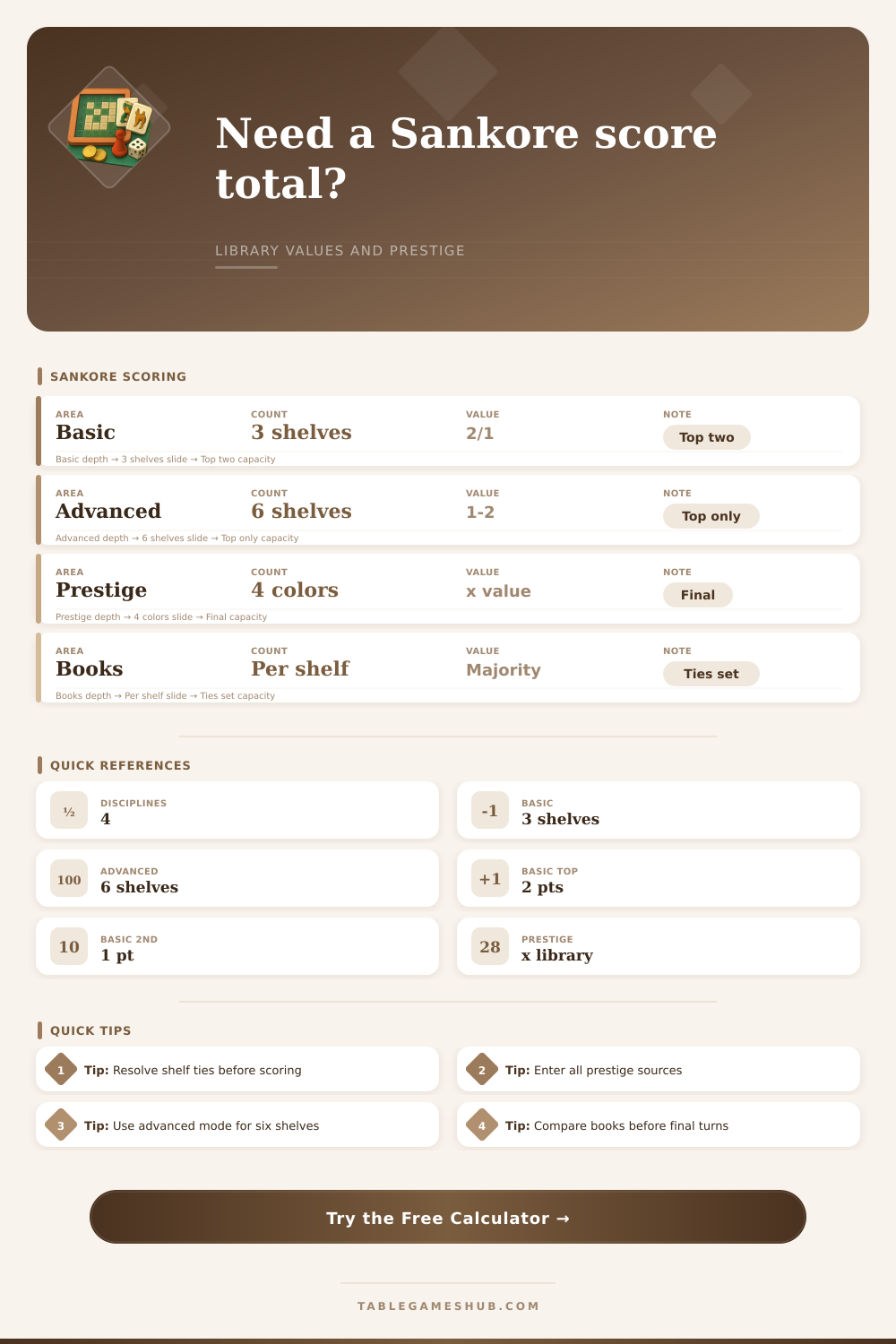
| Basic library | Shelves 1 to 3 | 2 value points per shelf | 1 value point per shelf | Use resolved shelf order for tied book counts |
| Advanced library | Shelves 1 to 6 | Each shelf gives its printed 1 or 2 value | No second-place value | Use the tie winner dropdown when counts tie |
| Zero books | Any shelf | No discipline scores from an empty shelf | No second-place value from an empty shelf | Leave all counts at 0 for a shelf that is not used |
| Final formula | All scoring shelves | Prestige tokens times matching value | Add all four disciplines | Then add neutral points and manual adjustment |
| Source field | What to include | Calculator treatment | Common check |
|---|---|---|---|
| Teaching prestige | Prestige gained while teaching a discipline or from taught class effects | Adds to that discipline's token count | Use the discipline printed on the prestige source |
| Research and cards | Objective, research, lesson, or card prestige icons | Adds before multiplication | Resolve any conditional card text first |
| Graduated students | Prestige printed on graduated student tiles and student rewards | Grouped by matching discipline | Count completed students only |
| Scholars and influence | Scholar bonuses, influence tokens, and majority prestige awards | Grouped by discipline color | Do not count blocked or covered icons twice |
| Tower or madrasa marks | Tower, wall, school, or madrasa board prestige marks | Grouped by discipline or entered as neutral if fixed | Use the final board state |
| Discipline | Board cue | Resource loop | Scoring cue |
|---|---|---|---|
| Theology | Mosques and manuscript networks | Often turns salt into books | Strong when theology books win multiple shelves |
| Law | Court, skills, and supported classes | Improves later teaching effects | Count scholar and influence rewards carefully |
| Mathematics | Walls, tower pressure, and madrasa construction | Can turn books into gold through board placement | Check tower or wall prestige marks at game end |
| Astronomy | Caravans, marketplaces, camps, and trade routes | Often turns gold into salt | Score astronomy prestige only if library value exists |
Library check: Score the library first, then multiply prestige. A large pile of prestige in a discipline can be worth little if its books lost the shelves.
Prestige check: Keep teaching, research, student, scholar, influence, and tower entries separated while counting, then allow the calculator to combine them by discipline.
Then you sit back down for that last go at Sankore and there’s a little fluttering in your heart because now you’re done with game. Books strewn all over the board, Prestige Tokens twisted up in knots and it feels like no one can possibly figure out what’s going on in their minds. That’s when most people lock up. As other players look on they fumble with their mental math, trying to perform addition and multiplication on the fly.
But it doesn’t need to be that way. Enter in your Prestige Totals and your Shelf Counts. The Calculator above deals with the difficult multiplication for you, turning potential nervousness into an easy-to-read victory points number.
How to Calculate Your Score in Sankore
Sankore’s core mechanic is really easy to describe, too easy, actualy, because if you don’t pay attention to detail, it can get really punishing mathematically. There are four disciplines: Astronomy, Mathematics, Law, and Theology. Books is collected in each discipline, and this decides whose books go up on the shelves. Then you collect prestige tokens in those disciplines as well.
Your prestige will score you points at the end of the game only if you’ve also won those specific shelf values. That connection is where most people mess up their scores. They’ll have a giant heap of prestige tokens but forget that without any books to put up on the shelves, all those tokens mean nothing. That’s why I force separation between the two with this tool; it makes you face that fact.
First, select the library board, then enter how many books there are of each discipline on each shelf. For a basic library, both the first and second top disciplines earns points per shelf (worth 2 and 1 point respectively). With the advanced expansion, only the top discipline earns points on each shelf, but it matters on all six shelves instead of just the top two. On the basic game, finishing second is still worth something. But on the advanced game, missing out by just one book drop that whole shelf to zero. The reference table included with the layout shows these rules so you can see how they apply to your own setup before you start calculating.
Then, you accumulate prestige and this is where people really start getting confused in how to calculate prestige. You don’t just count the prestige tokens sitting in your prestige pool. You have to add value from your scholar placements, your graduated student(s), research cards and teaching action(s). These are all broken down into their disciplinary categories so they can be added without double counting (for example, if you had a Law prestige token from a class you taught, put it under the Law discipline). If you had a Law prestige token from a class you taught, put it under the Law discipline). There’s even a place for any value adjustments outside of the primary disciplines like points from specific cards or other things with fixed values. Once everything is entered it gets multiplied at the end.
This system also has the added benefit of rewarding efficient play over pure volume. Leading in all categories isn’t necessary. Instead, you just need to lead in the categories where you have prestige waiting to be multiplied, which creates interesting tradeoffs throughout the game. Should I use my action to pick up a book and win a shelf? Or should I use my action to collect more prestige tokens?
Well, there is no one right answer to that question. It depends entirely based off your current state on the board and what actions your opponents are taking. Some will hoard prestige earlier in the game, saving themselves the ability to snag a shelf value late in the game. Others will methodically create their shelves, without paying attention to the number of prestige tokens they have until the game’s conclusion. Either strategy could of pay off if done properly.
Misreading tie-breakers is another common mistake; so is not remembering little sources of scores. For example: if you both has the same number of books on a shelf, the physical order on the shelf determines the winner. This is a tie-breaker based on how your books are arranged on the shelf. Because the calculator can’t view the state of your table, it lets you tell it who won in the case of ties. You tell it to choose the winner based off physical position first.
Then there are those smallish bits of prestige that students and scholars provide that folks forget in the heat of calculating big numbers. When you multiply these small differences times highly valued shelves, they add up fast.
Sankore is a balancing act. The best way to win is having both prestige AND books. Enough of each that your multipliers will count, since you need enough books to claim value and enough prestige to make those multipliers matter. These are two distinct resources that only combine at the game’s end.
Play some test matches and use the tool to see how many points you get while playing. This helps you learn the math so you can guess where you are in real matches without pulling out pen & paper. If you know what score you’re going to get then you can choose to be aggressive for one more point, or be conservative with what you have. It is worth more than any prestige token.
Finally: don’t freak out when you get to the last turn. Examine your tokens, examine your shelves, enter the information calmly, and let the math take care of itself. It’ll tell you if you made the right decisions or not; if you left points on the table, or whether your strategy actualy paid off. And either way, you walk away from the table knowing exactly what happened (and that’s the best teacher of all).