PARKS Score Calculator
Add a PARKS end-game total from visited park cards, photos, Year card personal bonus, First Hiker marker, table adjustments, and an audit of gear, canteens, trail resources, and season progress.
Load a sample hiker record, then replace the park card points and icons with your actual final tableau.
Enter each visited park card's printed victory points. Icon columns do not add points directly; they help audit Year card goals and tie-breaks.
| Park slot | Park card or note | VP | Forest | Mountain | Sun | Water | Wildlife | Season |
|---|---|---|---|---|---|---|---|---|
| Park 1 | ||||||||
| Park 2 | ||||||||
| Park 3 | ||||||||
| Park 4 | ||||||||
| Park 5 | ||||||||
| Park 6 | ||||||||
| Park 7 | ||||||||
| Park 8 | ||||||||
| Park 9 | ||||||||
| Park 10 | ||||||||
| Park 11 | ||||||||
| Park 12 |
Optional table score check. The active player total will be copied into the first score slot when you calculate.
| Rank | Player | Score | Tie-break Hint |
|---|
| Score line | Points | Audit detail | Scoring note |
|---|
| Score category | How to enter it | Point rule | Calculator handling |
|---|---|---|---|
| Visited parks | Enter each card's printed VP | Printed points on the park card | Summed from all non-empty park slots |
| Photos | Enter photo token count | 1 point per photo token | Photo tokens plus optional photo bonus field |
| Year card | Select 0, 2, 3, or custom | Personal bonus revealed at end game | Shown as its own score line |
| First Hiker marker | Check the marker box | 1 point for the player holding it | Included in bonus and marker total |
| Canteens and gear | Track counts in audit fields | Usually no base points | Only gear or expansion point field adds VP |
| Trail resources | Enter leftover tokens | Usually no base points | Reported as unscored inventory |
| Timing check | What to verify | Why it matters | Calculator field |
|---|---|---|---|
| End of Season 4 | All hikers reached Trail End | Game ends after the fourth season closes | Game progress |
| Final camera step | Camera holder had the photo chance | A missed final photo can change the score by 1 | Final camera/photo note |
| Reserved parks | Only visited park cards score | Reserved but unvisited parks do not add printed VP | Visited park card table |
| Year card reveal | Count icons and visited park conditions | Personal bonus is hidden until end scoring | Icon columns and Year result |
| Tie-break | Compare visited park card counts | Most visited parks breaks a tied score | Park count and comparison table |
| Icon or token | Used for | End score value | Common check |
|---|---|---|---|
| Forest | Park costs and Year goals | 0 by itself | Count icons from visited park cards |
| Mountain | Park costs and Year goals | 0 by itself | Count icons from visited park cards |
| Sunshine | Park costs, photos, canteens | 0 by itself | Leftover tokens are audit only |
| Water | Park costs, canteens, photos | 0 by itself | Filled canteens should be checked before scoring |
| Wildlife | Wild resource substitute | 0 by itself | Useful to explain a last park visit |
| Photo | Memory token | 1 point each | Count physical tokens, not camera ownership |
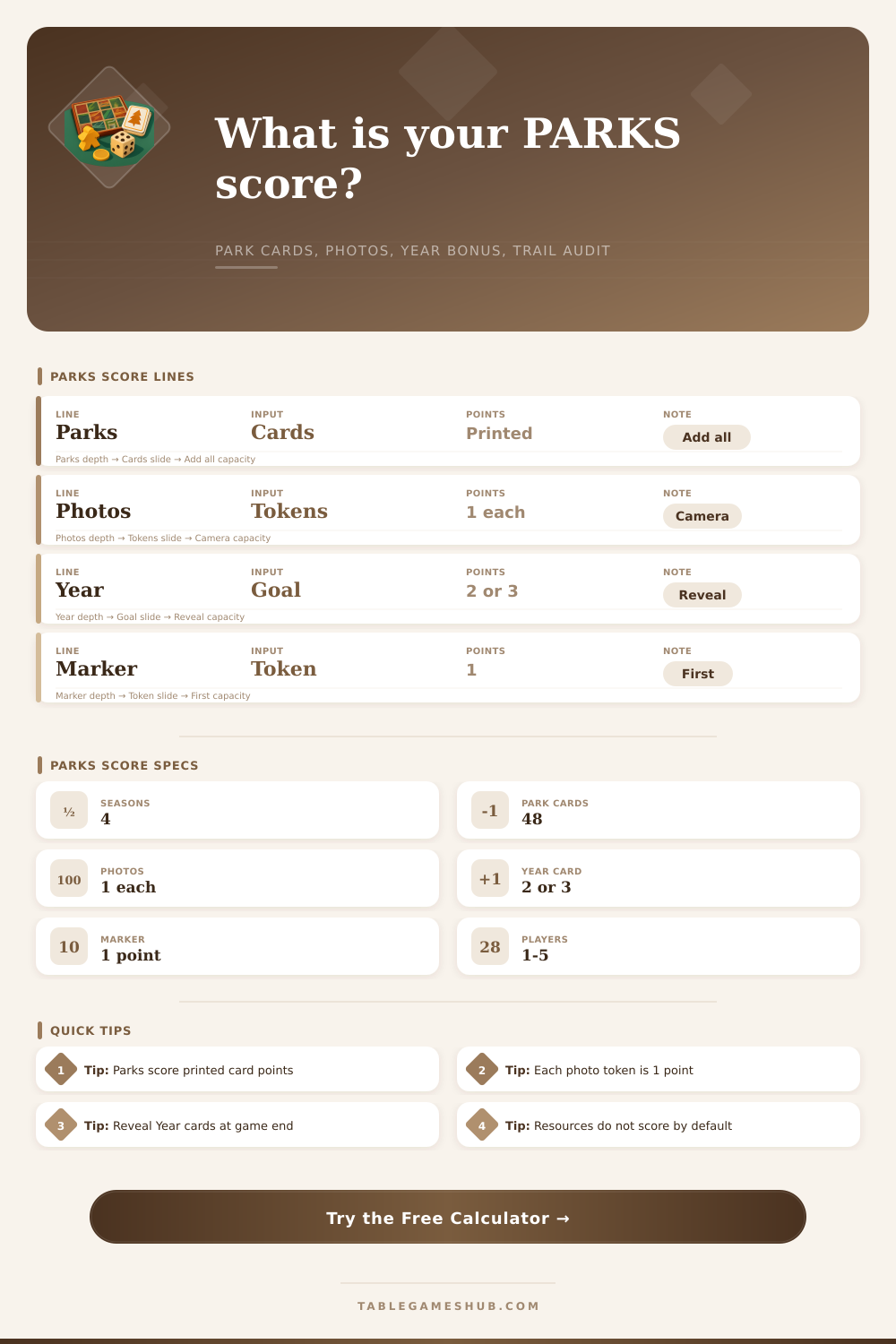
Final score order: Add visited park card points, then photos, then Year card personal bonus, then the First Hiker marker and any table-specific adjustment.
Reserved park check: Only park cards you actually visited belong in the park table. A reserved park is a plan, not end-game VP.
Canteen and gear audit: These are powerful during play but normally do not score by themselves, so keep their counts separate from victory points.
Tie-break check: If scores tie, compare the number of visited park cards before sharing the win or applying your table's house rule.
In PARKS, however, we count points, and there’s something satisfying about that. You know you’re right about your strategy. Now, by adding up numbers, you can see who’s good at playing their own game and who lucked out on the draw. It’s a little thing, but it’s what keeps tension alive, were they lucky? Or did they play the game they built for themselves? Now you can do better next time.
The vast majority of points are awarded based off the park cards you’ve visited and put down on your sheet. Looking longingly at a park card across the table or even reserving it doesn’t award you any victory points. Just the ones that is in play will contribute to your point total. This keeps things simple: you just write down what’s there, and then the calculator (above) does all the summing up for you. You don’t need to add up ten different number while your buddies debate over whether that’s a mountain or forest.
How to Count Points in PARKS
The steady baseline of photos adds another layer to the score. The catch is each photo is only worth a single point. Seems like an easy play to simply go hoard some token. But you need to spend those actions to get those photos, and those are actions you could use to go to more valuable parks or invest in better equipment. That’s where the game hinges. You’re always making the choice between getting points now vs having the potential for more later on down the line. Most people gravitate towards four or six photo because it seems productive. Others risk a big park visit to chase a tenth photo.
The secret variable is the Year card that you’re given at the beginning. Because it’s not revealed until the end of the last season, nobody else know what you’re working toward. Everybody could be scrapping for sun tokens, and you’ve got a stash of water tokens up your sleeve. Keeping this part of the game a secret makes it more dynamic and less likely that people will follow each other’s strategies too closely. The two or three points they give you at the end of the game can turn a race neck-and-neck.
To plan ahead, you have to look past what’s happening on the board and consider the overall story of your trek. Points don’t come from resources per se. Many beginners mistake collecting stuff for winning. At the end of the day, any extra forests, mountains, water, or sunshine tokens you might have lying around on your tray are simply a distraction. Sure, they got you where you needed to be, but they won’t take you home. Gear cards and canteens, too (unless an expansion rule specifies otherwise), is no different. Cleaning up all the extra items is part of the post-game ritual. It’s a reminder: it’s more efficient to travel light then it is to accumulate resources.
When the game ends, the person with the First Hiker marker gets one point. That may not seem like much; however, more often than not, the game is decided by a tie. The First Hiker marker will make all of the difference then, second place or first? You can also use it strategically throughout the game. It gives you the chance to go first in that round, allowing you to grab some good spots before someone else block them. It is a double whammy: it boosts your economy while playing and provides a points buffer at the game’s end.
After all markers, bonus points, photo points, and parks have been added up, if there is still a tie, the winner is determined by how many park cards they has in their collection. The more parks you visit on the trail, the more cards you will have. This incentivizes seeing multiple parks, even if it’s a small one vs. Just sitting on one giant score for the entire game. You might just hold onto a single massive park that could of been worth 100+ points throughout the game. It favors diversity and seeing things, not stagnating.
After this, you begin to view the table different when playing. Not only do you see other hikers’ movement, but you also get an idea of what they may be picking up for their own secret goals. Are they taking water tokens? Are they saving their moves for a photo opportunity? And the final score becomes nothing more than a representation of those invisible decisions that have been brought out into the open.
Next time you sit down to play, you’ll probably notice you think much less about “what move should I make?” and instead think about “how do I want my park sheet to look come the end of the fourth season?” That is the real essence of the game: it happens long before you touch a calculator.