🎲 Genesys Dice Probability Calculator
Build exact symbol odds for skill checks, opposed rolls, upgrades, and narrative specials.
Pool Build Echo
Symbol Math
Target Readout
Most Likely Roll Outcomes
| Rank | Net result | Chance | Flags |
|---|
| Build step | Rule | Formula | Example |
|---|---|---|---|
| Characteristic + skill | Higher number sets the base greens | Ability = max - min, yellow = min | 3 + 2 becomes 1 green, 2 yellow |
| Difficulty upgrades | Each upgrade swaps a purple for a red | Purple = base difficulty - upgrades | 2 purple with 1 upgrade becomes 1 red, 1 purple |
| Boost dice | Blue dice add luck and opportunity | Roll blue as situational positives | Good gear adds 1 blue |
| Setback dice | Black dice add small trouble | Roll black as situational negatives | Rain or clutter adds 1 black |
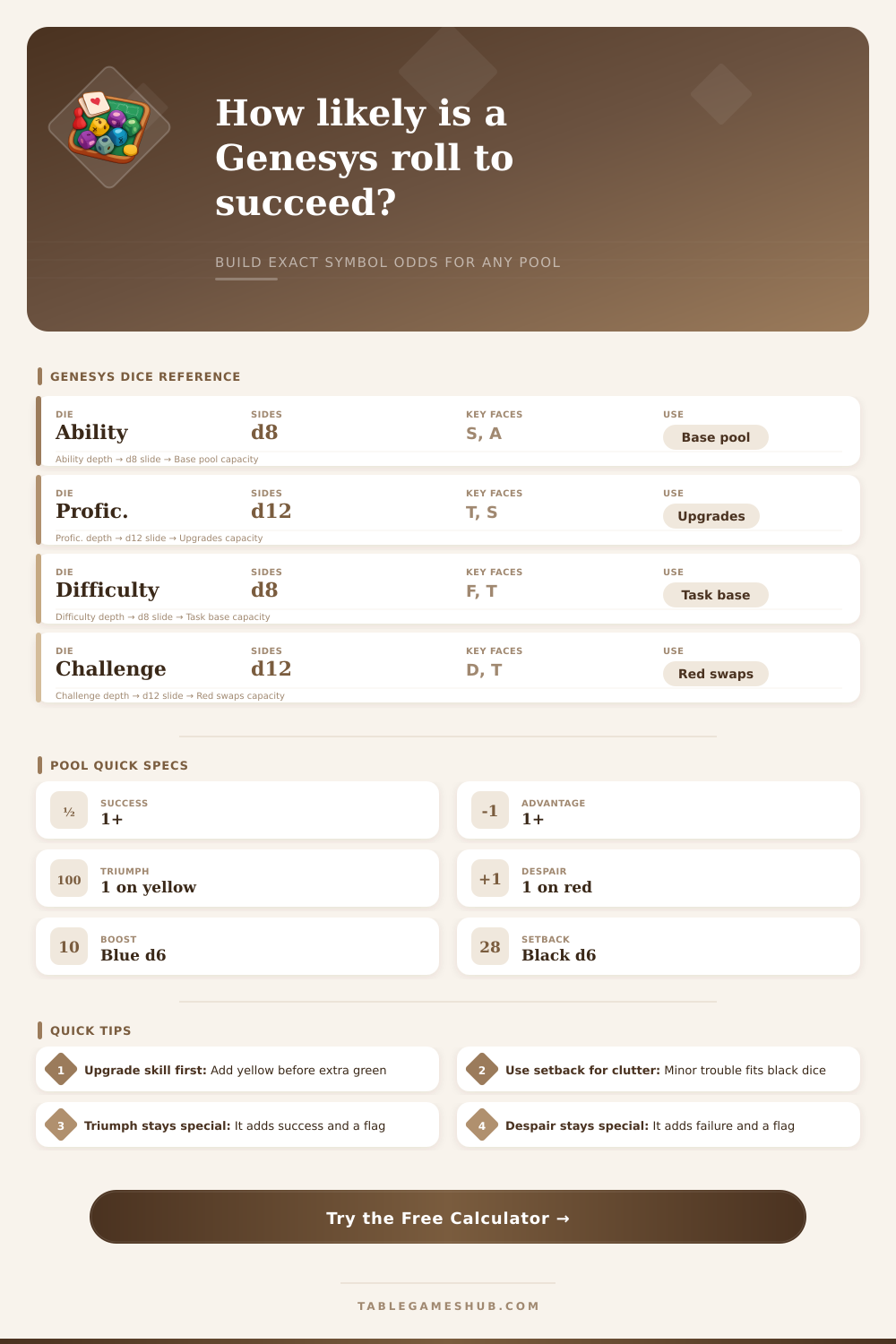
| Die | Sides | Face mix | Specials |
|---|---|---|---|
| Ability | d8 | blank, S, A, SA, AA, SS | Green core die |
| Proficiency | d12 | blank, S, SA, SS, AA, T | Only yellow dice can show triumph |
| Boost | d6 | blank, S, A, SA, AA | Fast positive swing |
| Setback | d6 | blank, F, T | Minor disruption |
| Difficulty | d8 | blank, F, T, FF, FT, TT | Purple task pressure |
| Challenge | d12 | blank, D, F, T, FF, TT, FT | Red upgrade die |
| Band | Purple dice | Red upgrades | Typical check |
|---|---|---|---|
| Easy | 1 | 0 | Routine task |
| Average | 2 | 0 | Normal check |
| Hard | 3 | 0-1 | Serious pressure |
| Daunting | 4 | 1-2 | Tough scene |
| Formidable | 5 | 2+ | Exceptional feat |
| Symbol | Cancels | Survives as | Notes |
|---|---|---|---|
| Success | Failure | Net success | If any remain, the check works |
| Advantage | Threat | Net advantage | Can matter even on a failed roll |
| Triumph | Nothing | Special success flag | Counts as success and an event |
| Despair | Nothing | Special failure flag | Counts as failure and an event |
Tip 1
Upgrade skill before stacking more green dice if you want triumph odds to rise faster than plain success odds.
Tip 2
Use setback for clutter and bad luck, then reserve extra difficulty or upgrades for the task itself.
The Genesys RPG uses a dice system that is different from everything else. Main mechanic deals with custom symbols on the dice, and every roll compares two separate pools; one for skill, the second for opposition The GM mentally forms the opposition pool from negative dice and tells the player about it, while the player prepares his pool from positive dice. Later you roll the whole pool together.
Two-axis task resolution independently is the main reason to play Genesys. The rest of the game is like a typical mid-core generic role-playing system, but such wild interpretations of rolls are great. Everything else bases on purchase of points for advantages.
How Genesys Dice Work
In Genesys two basic states control almost each dice roll: Characteristics and Skills. You form a pool from various dice according to aptitudes, weapons or tool qualties and skills. Pool has at least 2 dice until around 7.
Rule confines to maximum of 4 boost and 4 setback dice in one pool.
For probability best add or remove dice to or from the pool, rather than changing of existing dice. More dice always beat better dice. Here is a key lesson for character building and insight of checks.
Genesys is more complicated than simple dice systems. In a roll can happen until 5 from every symbol, so 11 possibilities for every symbol in pool, entirely 121 unique results, and it only gets wilder. With a bigger pool probabilities should move to accuracy.
When opposition is 2 purple dice and 2 setback, commonly you count what mix of yellow and green dice give 50, 75% success chance. In AnyDice terms, Genesys skills result in 12.5% chance for two advantages without successes. You testing shows that 2 advantages and 2 successes on one skill are impossible, but AnyDice points 1.56%, proving that tools can err.
There are probability calculators for dice pools, done specifically for FFG Star Wars and Genesys RPG. The key rule book itself has sections about probability thought behind the mechanics. Genesys puts mechanical clarity in the lead together with games like GURPS and Fate.