Newton Book Scoring Calculator
Estimate a Newton book engine by combining books collected, shelves completed, master cards, study track progress, travel bonuses, lesson icons, coins, and rounds remaining into one endgame score read.
| Books | Read | Planning Note |
|---|---|---|
| 0-6 | Light library | Use books as support, not the main score plan. |
| 7-12 | Working engine | One shelf completion can change the whole read. |
| 13-18 | Strong library | Master cards and study bonuses become efficient. |
| 19+ | Signature plan | Convert actions into endgame book multipliers. |
| Shelves | Bonus Shape | Best Timing |
|---|---|---|
| 0-1 | Loose books | Collect icons before overpaying for sets. |
| 2-3 | Stable set | Finish a nearby shelf if it costs one action. |
| 4-5 | High leverage | Book pickups usually beat small coin moves. |
| 6+ | Endgame ceiling | Protect the line and avoid stranded actions. |
| Signal | Why It Matters | Read |
|---|---|---|
| Study behind | Book score lacks track support | Push study before collecting extras. |
| Lesson dense | Actions can still compound | Spend lessons while rounds remain. |
| Master dense | Payoffs scale with books | Chase clean book or shelf triggers. |
| Coin rich | Last actions are flexible | Convert money into timing, not hoarding. |
| Preset | Score Driver | Best Use |
|---|---|---|
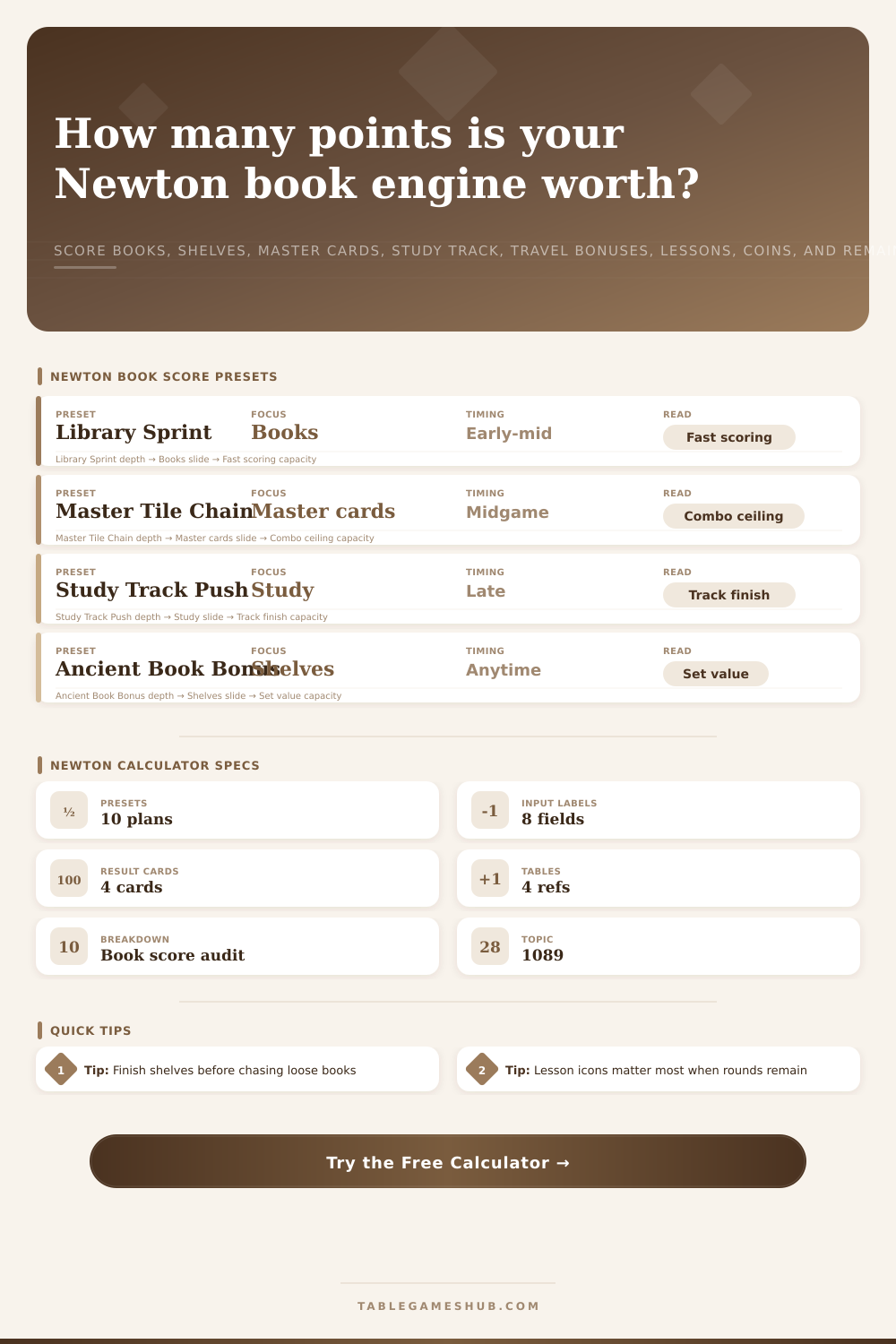
| Library Sprint | Book count | Early snowball or quick library burst. |
| Master Tile Chain | Master cards | When combos need one more book payoff. |
| Study Track Push | Track value | Late study action comparison. |
| Ancient Book Bonus | Shelf sets | Finish a shelf before the final scoring pass. |
Somewhere around Newton, you stop feeling good about the books on your shelves but bad about the scorecard underneath them. Your scholars is set up and your books are collected, but that total feels hollow because you have treated every tile as if they all weigh the same. It’s about more than just counting books; it’s about synergy, timing, and the balance between incomplete sets of loose icons, completed ones, and upcoming rounds.
The above calculator take the messy state of your board and distills it down to one number that projects what your engine is worth. How well you’re running or just spinning wheels. Resources are useless until converted to victory points. In Newton, players must gather resources and turn them into victory points.
How to Use the Calculator
“The shelving is the engine and the books themselves are the fuel. Having a stack of random books appear productive. However, if there are no completed sets, that potential energy remains unused scoring power. The reference tables demonstrates how much the value of book count changes based on being either a loose band or attached to a set.
Once a shelf is complete, it advances the study track(s) or master card bonus(es), multiplying the value within the shelf. This multiplication effect are missed by players and they overvalue their own position or undervalue the position of their opponents.
Keep your timing in mind. Lesson icons is great if there’s still time to burn ’em for more moves. But as you get into the final round and your moves start to run out, those lesson bonuses become less valuable. The calculator takes this into account, changing the weight of lessons based on how many rounds you’re playing out.
If you’re about to head into the third-to-last round, that lesson icon could be worthwhile since it’ll allow you to move tracks or pick up books one turn later (e.g., getting a critical piece of the puzzle). In the very last round? That icon won’t do anything. Seeing that change will help you avoid spending actions on things you shouldn’t… Instead going after set completions that yield high leverage.
Beyond that, there are the coin and travel bonus mechanics. Those can be underappreciated until late, but offer flexible ways to round out the ending play sequence. You can use coins to fill out a shelf by getting something into a space you needed or skipping around bottlenecks. There’s also travel bonuses which boost several scoring vectors at the same time. These are good choices for when you have an even mix of library and study stuff going on across your board.
The tool has various presets to model all this and let you see what kind of balance a purely library focused sprint might involve vs a more spread out, scholar style strategy.
One thing that’s easy to do: get too hung up on the value of one resource without thinking about how some other piece of your board might magnify its effect. A wildcard is a master card. These shift the game fast. Their value isn’t fixed; they level up based on how many books you have. That’s why an early-game master card can feel weak, until you start filling out those shelves, at which point it pays off like crazy.
The calculator breaks this lift out from the core book value and shows you exactly how much synergy adds to your overall score. No more blindly going down a low-percentage route when you know a higher-leverage combo is possible. For every action point, you’ll see what has the best return on investment.
To play Newton well, you need to think like an accountant, not a collector. Newton isn’t about collecting tiles; he’s about managing a portfolio of potential points that only become ready under certain conditions. Left loose, some books will never score, while others will expire before they’re put to use. Knowing what assets to hold for the endgame surge vs those to be liquidated can make the difference between a good game and a great one.
Audit your plan with the tool. Check your rate of completing shelves. Make sure you’re not lagging on study track because your library has outpaced it. When you shift from counting books to counting conversions, the math works in your favor. This isn’t a contest of who has the most tiles, but who makes them count when it matters.