Nertz Score Calculator
Total every Nertz round with cards played, cards left in each Nertz pile, call checks, round swings, running standings, and exact gaps to the target score.
1Preset Nertz Score Sheets
Choose a real table state, then adjust the player rows before calculating.
2Round Settings
3Player Score Lines
Round score = center cards played x point value - Nertz pile cards left x penalty + bonus - penalty. Mark the player who called Nertz, if any.
| Player | Previous score | Center cards played | Nertz pile left | Bonus points | Penalty points | Called Nertz? |
|---|---|---|---|---|---|---|
4Nertz Component Grid
5Reference Tables
| Score item | Standard value | Where counted | Calculator field |
|---|---|---|---|
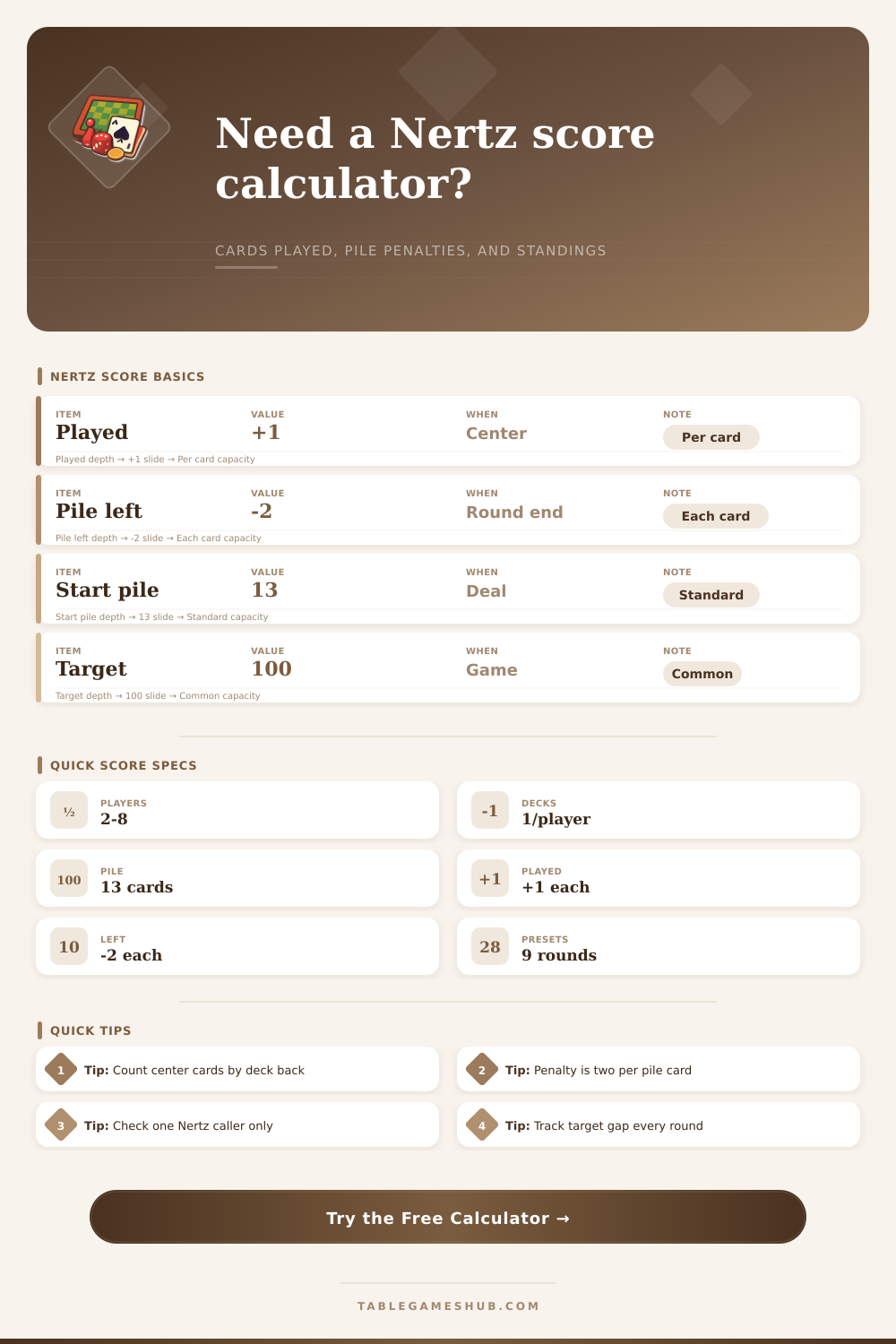
| Center card played | +1 point each | Shared center piles, sorted by deck back | Center cards played |
| Nertz pile card left | -2 points each | Each player's remaining Nertz pile | Nertz pile left |
| Round adjustment | House optional | Table audit, misdeal, duplicate count, or league note | Bonus or penalty points |
| Running score | Previous plus round | Score sheet after every round | Previous score |
| Table size | Decks needed | Score sorting method | Best use |
|---|---|---|---|
| 2 players | 2 unique decks | Quick two-back count | Teaching and head-to-head games |
| 3 to 4 players | 3 to 4 unique decks | Sort center piles by back color | Standard home table |
| 5 to 6 players | 5 to 6 unique decks | Use a scorekeeper for center cards | Fast family rounds |
| 7 to 8 players | 7 to 8 unique decks | Group by deck family, then verify | Large party tables |
| Round pattern | Typical played cards | Pile cards left | Score read |
|---|---|---|---|
| Clean Nertz call | 22 to 34 | 0 for caller | Strong positive round |
| Close chase | 16 to 28 | 1 to 5 | Small gain or break-even |
| Blocked table | 8 to 18 | 7 to 13 | Often negative |
| Teaching round | 6 to 16 | 6 to 13 | Use audit notes generously |
| Component | Standard count | Scoring risk | Sheet check |
|---|---|---|---|
| Player deck | 52 cards | Similar backs can mix | Confirm every deck is distinct |
| Nertz pile | 13 cards | Penalty count can be missed | Count before clearing table |
| Work piles | 4 piles | Not scored directly | Move only played center cards |
| Discard stream | Player managed | Not scored directly | Separate from center scoring piles |
6Scorekeeping Tips
Count before clearing. Sort all center cards by deck back first, then count each player's remaining Nertz pile. That keeps the +1 cards and -2 cards from getting mixed.
Audit the caller. In strict games, exactly one player should have called Nertz and should show 0 cards left in the Nertz pile. Use the penalty field for table-approved corrections.
Multi-decked card games heighten the table tension. Not only do you need to keep track of what’s in your hand, but you’ve got to account for three piles of cards and know whose is whose. Scoring becomes part of the game, not the afterthought it has been. It’s about the math. One wrong tally erases all those rounds of strategic stacking. Soon nobody trusts their headcount anymore they have to write things down. That is until you get tired or distracted.
Scoring is pretty straight-forward: Each time you move a card from your personal Nertz pile into any of the stacks in the center, you score a point. It is simple addition. Here’s where things get complicated: Any card sitting in your personal pile at the end of a round deducts two points from your total. So if you leave behind seven cards, that’s a fourteen-point penalty. Yikes! That’ll swing the leaderboard back and forth. You don’t want to be fussing with negative numbers.
How to Keep Score in Nertz
You just want to know what happened and how to do better next time, right? Let the calculator crunch that math for you while you go play the next deal.
The center piles are just a jumble of cards for most casual gamers. The trick is to sort by deck color and score accurately. If Nertz is called, you’ll need to visually group all of your already-played cards by their different back design before counting them. It becomes clear when someone has snuck one in there from another pile, you can’t double count! It organizes that chaotic center into nice, neat stacks. Once you’re in the groove, counting those stacks is quick. What you have remaining in each player personal stack are counted even quicker.
For those who want to check their house rules against something before dealing that first card, the reference table spells it all out. By default, this target score is typically a hundred points. It’s an arbitrary number that wouldn’t really matter except that it determines how fast the evening will play out. A lower target means less time to recover from a bad deal and fewer rounds. A higher target means consistency pays off more then luck.
Maybe you get lucky and get a good opening hand. Sure, you might blow up early, but where can you go after your Nertz pile is gone? At that point, it turns into a game about limiting losses, not making gains. That generally occurs at about halfway through when everyone has been running on fumes for some time now.
There is also a second level of mind game: who gets to call Nertz? There is only one, and they have to get rid of all their cards before doing so. Otherwise, everyone else keeps playing until someone makes a valid call. This means that everyone has eyes on you at the top table; it becomes a bottle neck. On some tables this is audited even more strictly, so players can’t be sure they didn’t play illegal moves while rushing to complete their hand. In those cases the calculator has an audit mode. That settles arguments while forcing a pause just long enough to verify the count. It pauses just long enough to confirm the number but not too long to let the spirit drain from the game.
But large games bring their own logistical nightmares that small tables will never experience. Six or eight players means six or eight different decks. Unless they all have unique backs, you’re already behind the eight ball before beginning play. Scoring turns into a detailed exercise in figuring out whose card was which. Playing with the same standard decks means ruined friendships and arguments. Because the complexity grows much faster with every player added to the table, the tool can support up to eight players. The more hands you play, the more mistakes there’ll be, the more disputes, and the more you’ll need a clear record of who won what.
Nertz isn’t a game of card strategy so much as it’s one of score discipline. You could play flawlessly all evening and still lose if you fail to remember to subtract your pile cards correctly at the end. If there’s anything that ends games, it’s the penalty for leaving cards on the table. It’s this knowledge that allows players to ease off in later rounds and focus on clearing their piles rather than building aggressively. They realize that the cleanest exit is always worth more than any big mid-round surge. Count the penalties with care and keep your center sorted by color. Let the math be your friend; the cards never lie. They’ll tell you who won all along.