🎯 Croquet Wicket Spacing Calculator
Scale wicket-to-wicket gaps, stake offsets, court units, margins, and coordinate tables for six-wicket and nine-wicket croquet setups.
| Measure | Result | Formula | Note |
|---|
| Point | X from left | Y from home | Next gap | Spacing note |
|---|
| Six-wicket item | Full-size measure | Scaled formula | Calculator use |
|---|---|---|---|
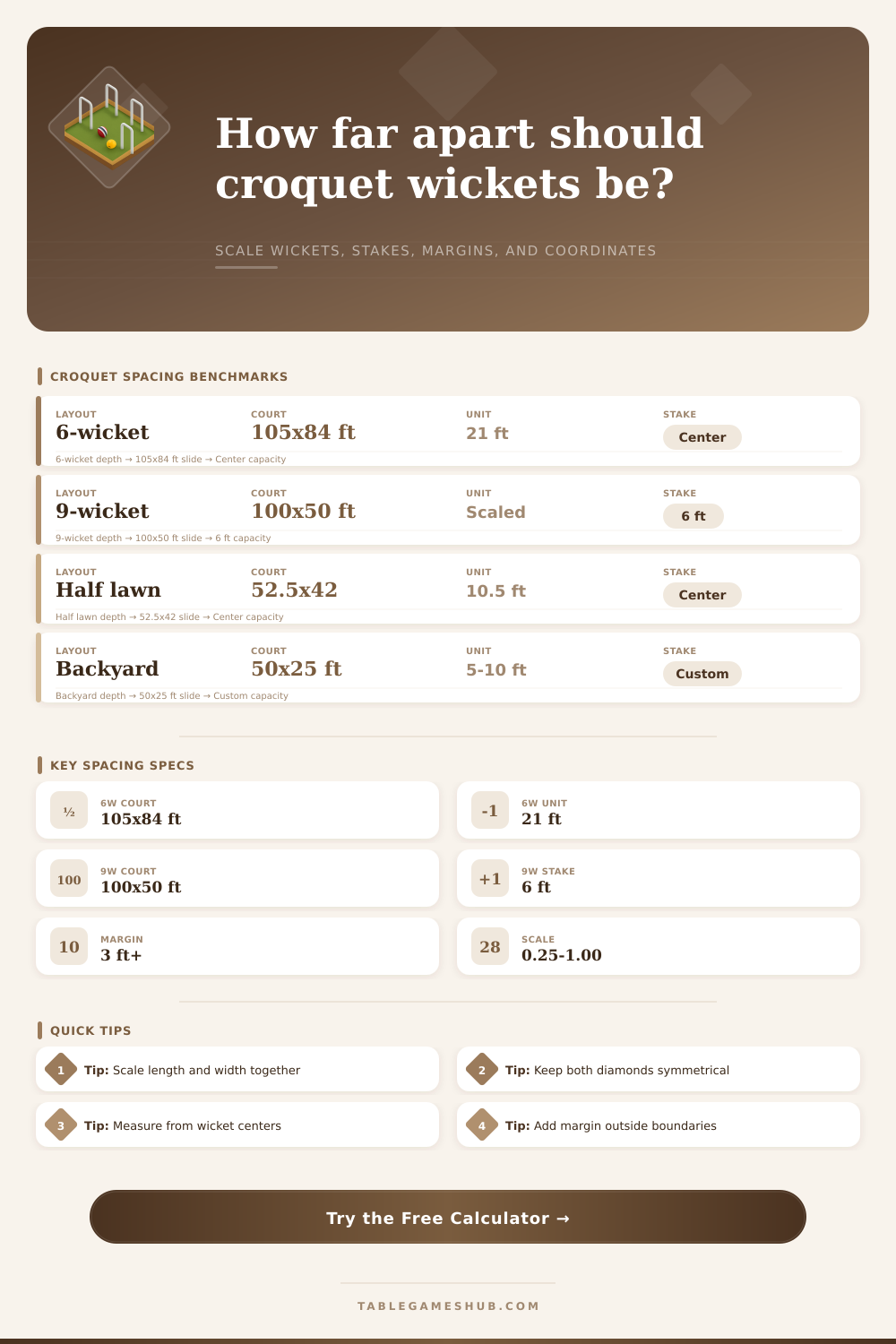
| Court rectangle | 105 ft x 84 ft | 5 units x 4 units | Scale factor and footprint |
| Center stake | Midpoint | width / 2, length / 2 | Coordinate anchor |
| Outer wicket offset | 21 ft from boundaries | 1 court unit | Corner wicket centers |
| Inner wicket offset | 21 ft from stake | 1 court unit | Rover and penult spacing |
| Nine-wicket item | Common measure | Scaled formula | Calculator use |
|---|---|---|---|
| Court rectangle | 100 ft x 50 ft | Length and width ratio | Backyard scale factor |
| End stakes | 6 ft from end | User stake offset | Home and turning stakes |
| Near wickets | 6 ft gaps | User near-stake gap | Wickets 1, 2, 8, and 9 |
| Double diamond | Symmetrical | 25%, 50%, 75% width | Middle wicket coordinates |
| Scale factor | Six-wicket unit | Nine-wicket court | Practical note |
|---|---|---|---|
| 1.00 | 21.0 ft | 100 ft x 50 ft | Full-size spacing |
| 0.75 | 15.8 ft | 75 ft x 37.5 ft | Large lawn spacing |
| 0.50 | 10.5 ft | 50 ft x 25 ft | Common backyard scale |
| 0.40 | 8.4 ft | 40 ft x 20 ft | Compact casual play |
Measure centers, not wire edges
Stake and wicket coordinates are center marks. Set a tape line first, mark centers, then press the wickets in square to the intended direction of play.
Scale before adding margin
Keep the playable court proportional, then add the boundary margin outside the rectangle so the calculated wicket spacing does not drift inward.
Calculate croquet wicket spacing from court size, stake offsets, scale factor, and boundary margins, then use the coordinate table to mark each wicket center consistently.
Croquet court spacing are important to the game of croquet because the spacing of the wickets will determine the games strategy. If the wickets are too close together, player will find it difficult to play the game. However, if the wickets are too far apart from one another, the games strategy will dissapear.
The distance between the wickets will dictate how far the players have to swing their mallet to hit the next wicket. Many people make mistake with the spacing of the croquet courts because they tend to treat the court as a simple rectangle. However, there is a specific proportion to the game that must be maintained, even with lawns that may be smaller than the size needed for a regulation croquet court.
How to Set Up a Croquet Court
A six-wicket version of croquet may use a five-by-four rectangle as the playing area, while a nine-wicket version of croquet may use a double diamond arrangement of croquet wickets that are placed between two stakes. In either case, players should establish the rectangle that will be used first, and then the wickets will naturaly fit into the rectangle. The calculator will handle the math behind establishing the correct spacing for the wickets.
Another important variable in establishing a croquet court is the boundary margin. These margins provide the players with the room to stand while playing croquet. A three-foot strip of lawn around the outside of the croquet court will allow the players to stand without crowding the lawn around the wickets.
The three-foot boundary also keep the balls from rolling into fences or flower beds. Creating boundary margins that are too narrow, however, will make it more difficult for the players to hit the outermost wickets with their mallets. The croquet court calculator will allow users to establish the boundary margins while ensuring that the internal distances between the wickets are still accurate to one another.
Another decision is the placement of the stakes for the croquet court. For a six-wicket game, the stake will be placed at the geometric middle of the croquet court. For a nine-wicket game, however, the two end stakes will be placed a set distance from the short boundaries of the lawn, with the wickets position near those two stakes.
The offset of the stakes can be adjusted to change the length of the endgame of the game. Additionally, the lateral offset allow the player to shift the entire croquet court to one side of the lawn if there is some obstacle to the center of the lawn, such as a tree or slope. A coordinate table will provide the measurements for the croquet court markings.
The measurements should be taken from the home-left corner of the lawn, as this will ensure that all of the croquet wickets are properly place. The gaps indicated between the coordinates will indicate the playing distances for each area of the lawn. These playing distances are important to ensure that the lawn is workable; the gaps should be at least five feet in size, but not much larger than twenty-one feet in size.
The scale factor for the lawn will determine whether the croquet court is scaled to represent a standard game of croquet. A scale factor that remains above two-thirds of the full size of a croquet court will ensure that the angle of the lawn and the pacing of the game remain the same as the standard game. However, using a scale factor that is smaller than two-thirds will change the game to a casual game in which chance plays a more larger role then placement of the wickets.
The croquet court calculator will show the scale factor to the user, allowing them to make a determination of whether or not the croquet court is large enough to be marked according to the games specifications. Common mistakes include measuring the wrong measurement for the croquet court. For instance, some people stretch their tape measurement to the outside of the wickets rather than the center of the wickets.
Additionally, they may also neglect the proportional requirement of the game; the length of the lawn with the wickets should not decrease at a faster rate than the width of the lawn. Another problem that may exist on real lawns are obstacles like slopes and roots of trees. A croquet court calculator will not be able to see these obstacle, but it will allow the users to understand how to adjust the wickets accordingly.
If the obstacles permit, only a single wicket can be moved a few inch. Otherwise, the best option is to scale the croquet court smaller at the beginning of setting it up on the lawn. Once the wickets are appropriately placed at even distances from one another, players will have the best possible chance to play a strategy game of croquet.