Merv Caravan Calculator
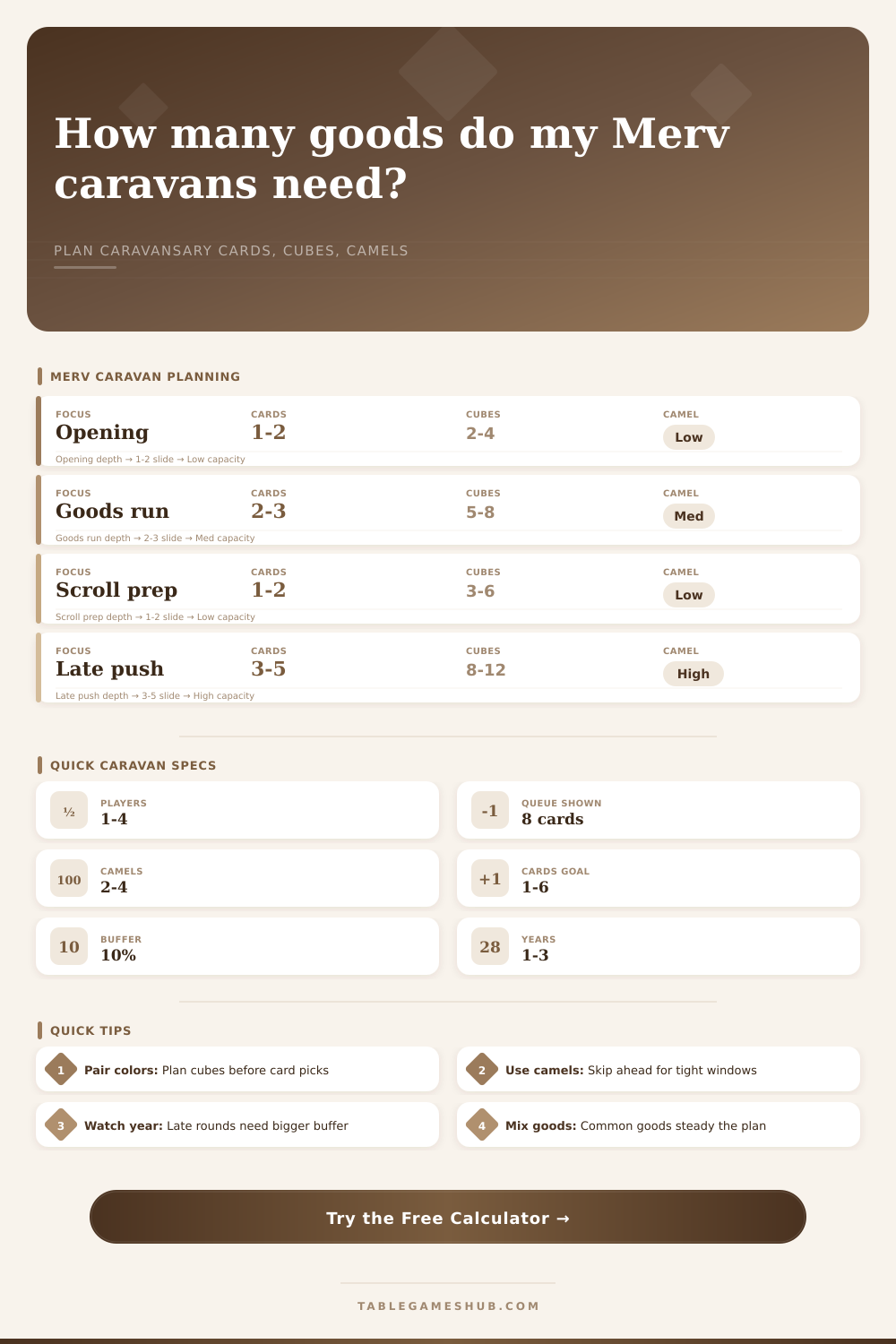
Plan caravansary card goals, goods pressure, resource cubes, camel skips, and round timing for Merv: The Heart of the Silk Road.
| Table State | Cards Targeted | Suggested Camels | Resource Buffer |
|---|---|---|---|
| Solo planning lane | 1-2 cards | 1-2 camels | 5% if colors are flexible |
| Two-player open queue | 2-3 cards | 1-2 camels | 10% for matching colors |
| Three-player contested queue | 3-4 cards | 2-3 camels | 10-15% for lost timing |
| Four-player crowded queue | 3-5 cards | 3-4 camels | 15-20% for priority fights |
| Caravan Focus | Cube Demand | Wild Cube Value | Best Use Window |
|---|---|---|---|
| Spice tempo | Medium and color-specific | High for card matching | When queue has duplicate spice types |
| Common goods | Low to medium | Moderate for smoothing | When engines need steady tokens |
| Luxury goods | High and less forgiving | Very high for final turns | When stored goods already cover basics |
| Scroll support | Medium with timing risk | High if library plans are tight | Before committing library conversions |
| Wall support | Medium but opportunity-heavy | Moderate for recovery | Before Mongol pressure peaks |
| Players | Queue Feel | Planning Risk | Caravan Note |
|---|---|---|---|
| 1 player | More controllable | Lower denial risk | Use camels to set tempo, not just rescue turns. |
| 2 players | Readable but reactive | Moderate denial risk | Track opponent route before counting a card as safe. |
| 3 players | Cards rotate quickly | High timing risk | Keep one flexible good or white cube when possible. |
| 4 players | Highly contested | Very high timing risk | Plan a backup card in the same color family. |
| Primary Route | Caravan Role | Resource Warning | Good Backup |
|---|---|---|---|
| Palace follow-up | Build card count for later conversion | Do not empty all favor support cubes | One common good keeps route flexible |
| Library scroll push | Fill missing cube colors before scroll spend | White cubes are especially valuable | Accept a smaller card claim if colors align |
| Mosque tempo | Support action timing without overcommitting | Camel skips can be more important than quantity | Use balanced goods to avoid a dead turn |
| Wall defense | Recover goods after spending on protection | Late turns punish exact cube counts | Hold at least one wild cube if possible |
The market has opened. The wind stirs dust off the streets and you’re standing at crossroads of the Silk Road. Engines mingle with opportunity at inn in Merv, where poor timing is nothing short of an insult to your person. Do you have the goods? Check. Do you have the cubes? Check. But do you realy have the route? That’s a question that stays with a lot of player.
With the number crunching done for you by the calculator above (just enter your current year and player count), it spare you from fumbling around with conversions and coefficients, all so you can get down to business. It is not card-counting per se, but it is about knowing how much those cards will cost you in terms of opportunity.
Why You Need a Plan
Let’s start with pressure. Pressure is the first thing to know. In a solo game, you’re tending your own garden (the queue) and choosing the flowers you want. But in a four-player game, you’re in a battle for the flowers. The queue is a battlefield where cards dissapears off the screen before you can even read what they say.
The tool responds by adjusting its recommended card choices accordingly. If you choose a full table, it’ll bump up required number of camels and give you more of a buffer for resources. Chances are, your dream card won’t be there anymore. So you have a backup plan. It probably involves holding onto some extra wild cubes to pair with a weaker card, or using camels to skip ahead to the next round.
The rate at which the queue spins around when three or four players is hunting for the same resource colors is significantly faster then most people think. And that leads us to color. Twenty resource cubes sounds like a lot, until you only have blue ones, when cards on the table require green and red.
The calculator wants each type of good, common and luxurius, separate because they plays different roles. Common goods sustain your engine; they are the beating heart of your plan. Luxury goods spike your output. They win games, and they is unpredictable. Without a backup plan, chasing after luxuries can leave you with a dead turn. In Merv, that’s a death sentence.
You see the danger in the planner’s output. The low score isn’t a sign of failure; it’s a sign of fragility. It is a signal that you need to be careful not to get stalled for a single turn of the queue and lose everything you’ve worked so hard to build up.
Let’s talk about timing again. Remember that year one is build year. You’re allowed to be slow here. Wait an extra round if you have to, miss a single card, no big deal. But year three isn’t like that. The board’s crowded with mongols and their pressure are ratcheting up. Everything you do has consequences.
That’s why the calculator raises its required buffer over time. When the margins are tight, you need more wiggle room. A ten percent buffer is plenty in year one. You may need twenty or more in year three to keep your head above water amidst the madness.
It sounds negative, but it’s not, this is being pragmatic. Look at the reference table on the page. It spells it out: as the table state shift, so does the recommended camel reserve amount. It is a little thing, sure, but it is important.
But don’t dismiss those crazy cubes either. A good caravan plan is built based off white cubes. Those white cubes act like glue, letting you pick up a card you might be missing from your inventory. The tool will account for those when calculating your readiness score. It will ding you if you’re running low on wild cubes and hoping for a high-color-pressure strategy. It’ll tell you that you have stretched yourself too thin.
The tool will tell you sometimes taking the second-best card that fits in your hand is the best thing to do. You should of not reached for the best card. That’s where people miss it. They want that perfect card, so they end up with nothing.
Remember: it’s not the reward, but the wait to get there that matters. Plan for the wait, not just for the goal at the end. Hold space for your scattered color. Before you commit your workers, the tool shows you these connections. It turns vague worry into real numbers. Instead of wondering if you have enough, you know what you’re missing.
Your turn is short; the Silk Road is long. Make sure your plan lasts the distance.