Mahjong Tenpai Calculator
Count riichi mahjong shanten, waits, wait shapes, visible copies, live tiles, draw windows, and ukeire from compact tile notation.
| Notation | Tile Group | Allowed Digits | Counting Note |
|---|---|---|---|
| m | Manzu characters | 1 through 9, plus 0 as red 5 | 0m is counted as 5m for copies and waits. |
| p | Pinzu circles | 1 through 9, plus 0 as red 5 | 0p is counted as 5p for copies and waits. |
| s | Souzu bamboo | 1 through 9, plus 0 as red 5 | 0s is counted as 5s for copies and waits. |
| z | Honors | 1 through 7 only | 1z to 4z are winds; 5z to 7z are dragons. |
| Wait Type | Block Pattern | Raw Copies Before Visibility | Calculator Label |
|---|---|---|---|
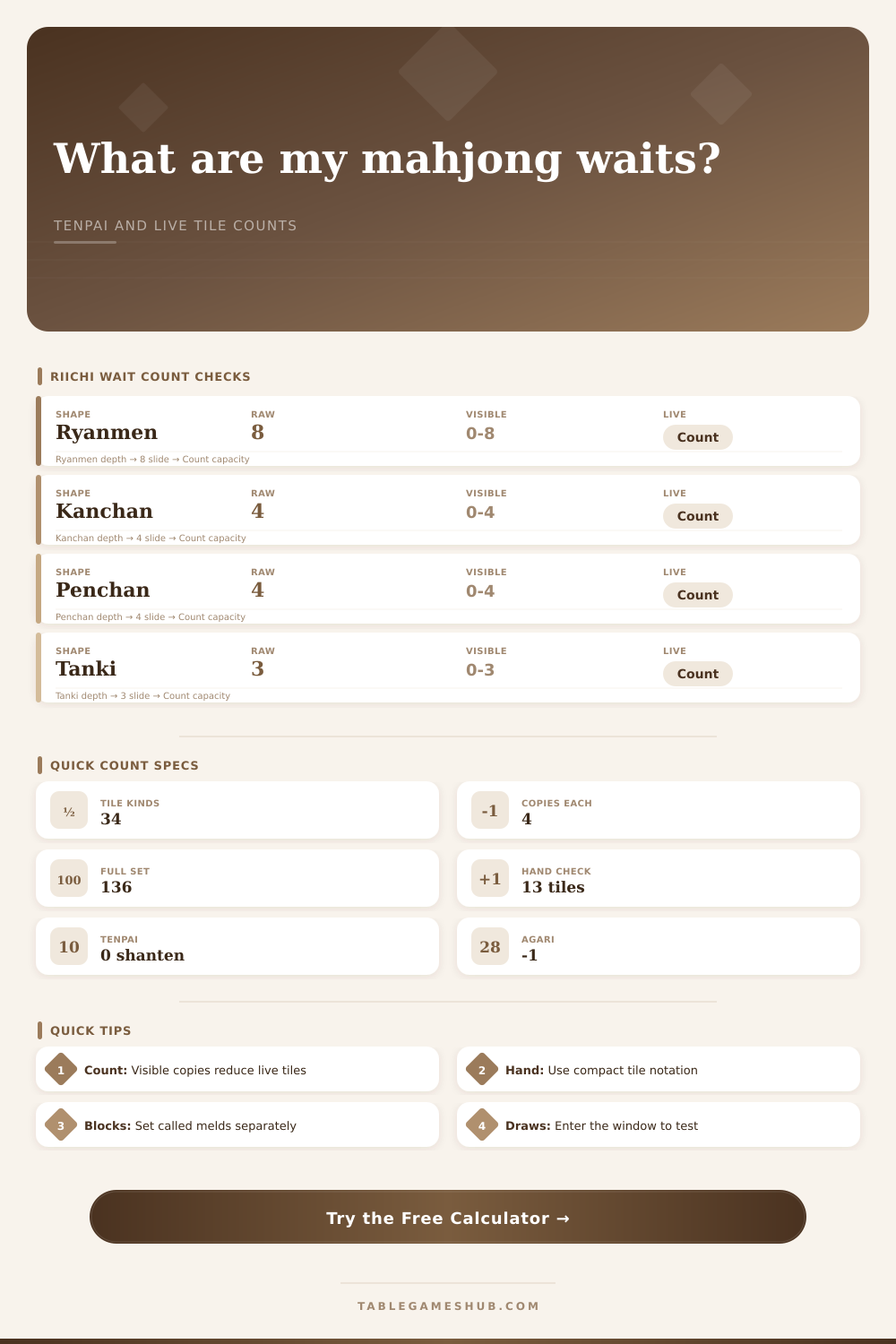
| Ryanmen | Open-ended sequence side, such as 45 waiting 3 or 6 | Up to 8 across two tile kinds | Two-sided |
| Kanchan | Inside sequence gap, such as 46 waiting 5 | Up to 4 for one tile kind | Closed |
| Penchan | Edge sequence gap, such as 12 waiting 3 or 89 waiting 7 | Up to 4 for one tile kind | Edge |
| Tanki | Single tile becoming the pair | Up to 3 when one copy is in hand | Pair |
| Shanpon | Two pairs where either tile can form a triplet | Up to 4 total across two pairs | Double pair |
| Special | Seven pairs or thirteen orphans completion | Depends on held and visible copies | Special family |
| Count Step | Formula | Example | Output Affected |
|---|---|---|---|
| Own copies | Copies already inside the working hand | Hand has 2p once | Reduces available 2p copies |
| Visible copies | Discards, exposed melds, indicators, dead marks | Visible field has 22p | Subtracts two more 2p copies |
| Live copies | 4 minus own copies minus visible copies | 4 - 1 - 2 = 1 | Feeds each wait line |
| Total ukeire | Sum of live copies across winning waits | 2p live 1 plus 5p live 3 | Feeds ukeire and draw chance |
| Family | Complete Shape | Tenpai Marker | Scope In This Calculator |
|---|---|---|---|
| Standard | Four complete blocks plus one pair | 0 shanten | Sequences, triplets, pair, and fixed meld blocks |
| Seven pairs | Seven different pairs | 0 shanten | Closed hand only; fixed melds disable this family |
| Thirteen orphans | All terminals and honors plus one duplicate | 0 shanten | Closed hand only; fixed melds disable this family |
| Complete hand | Winning shape after adding a tile | -1 shanten | Used to detect the listed waits from the current hand |
Two-sided
Often has two distinct tile kinds before visibility is subtracted. Ukeire is the live sum of both kinds.
Closed
Uses a single middle tile kind to complete a sequence. Ukeire is capped by that one tile kind.
Edge
Uses a 3 on 12 or a 7 on 89. It counts like one tile kind before visible copies are removed.
Pair
Uses a single tile to form the pair, or one of two pair tiles to form the last triplet.
I sit at the table with 13 tiles and I sense this hand is close to being a winner. But I don’t know what tile I am looking for. The calculator will shows me precisely what I’m looking for and how many of those tiles exist in the wall. This lets me focus on reading my opponents rather than doing the math myself.
The first thing is that you must understand shanten. It’s the number of tiles required to reach a winning position. If your hand is at 0 shanten (tenpai) then you’re one tile short of being in winning position. The calculator will check lowest shanten for standard rules, seven pairs, and thirteen orphans. So if a hand appears to be two shanten away on standard, it may actualy only be one away as seven pairs. That alters the play. Your hand becomes an offensive rather than defensive one. No more remembering all the patterns (just let the tool check several for you).
How to Use the Mahjong Calculator
Next up is counting live tiles, or ukeire. Each tile have four copies, though not all are in view. That’s where this calculator comes in: It will count up all the tiles and then display the number that are out of sight. From there you can see how many remaining tiles is still winnable. This is why knowing your wait shape isn’t as important than knowing what’s actualy visible. You may be waiting for a two-sided wait, which on paper would give you eight tiles, but your opponent could of thrown away three of those tiles already. You’ve got another. So now you’re only down to four. Your odds just went from eight to four. Knowing what’s visible is more important than knowing your wait shape.
The tool also lets you plug in your own discards, which effectively simulates what is happening during a game. So if your opponent throws down a five of circles, you type it into the displayed field. It recalculates your live tiles and adjusts the probability of each wait. That reflects how you have to think at higher levels of play. You are not just keeping track of the number of tiles, but also estimating the size of the opportunity pool that’s left. There are even reference tables for wait types (closed kanchan waits, open ended ryanmen waits). The calculator display how they decrease given actual situations.
It calculates compound probability. With a draw window set, it will show you the probability of drawing your wait in X number of turns. That allows you to assess risk vs. Reward. Do you toss safe? Or do you go for broke and try to win? A few things change that equation: How thin is the wall? How many uke do you have? Is the chance really worth taking? Maybe you’ve got some rare hand shape going on. But if there’s no live tiles left, what does it matter how high those points are? Give it the data, let it tell you. Then you make the call.
Mahjong is both a game of calculated risk and a game of hidden information. It’s more about timing than simply having a full hand (tenpai). With this calculator, the live tiles, wait, and shanten are counted for you. This allows you to concentrate on the human parts of the game. While you still must sense the flow and read the discard, you don’t have to worry about missing your next tile. Let the calculator do the math, and make that decision on when to strike.