Mahjong Probability Calculator
Model live wall odds, useful tile hits, and completion windows for common waits.
This calculator uses exact no-replacement draw math. It treats the live wall as an urn of remaining tiles after dead-wall reserve, visible copies, and any buffered turns.
Live wall math
The wall is trimmed before odds are computed. That keeps the draw pool honest when a hand has already revealed a lot of tiles.
live wall = total wall - dead wall - visible tiles
Useful tile math
Useful tiles are the copies that can still advance the target shape. Seen copies are removed from the useful pool before the probability step.
useful copies = original useful copies - seen useful copies
Completion window
The chance shown below is the exact probability of seeing at least the required number of useful hits inside the buffered draw window.
P(x >= k) = sum of hypergeometric outcomes
Preset: Riichi Dora Chase. Live values update as soon as you pick a scenario.
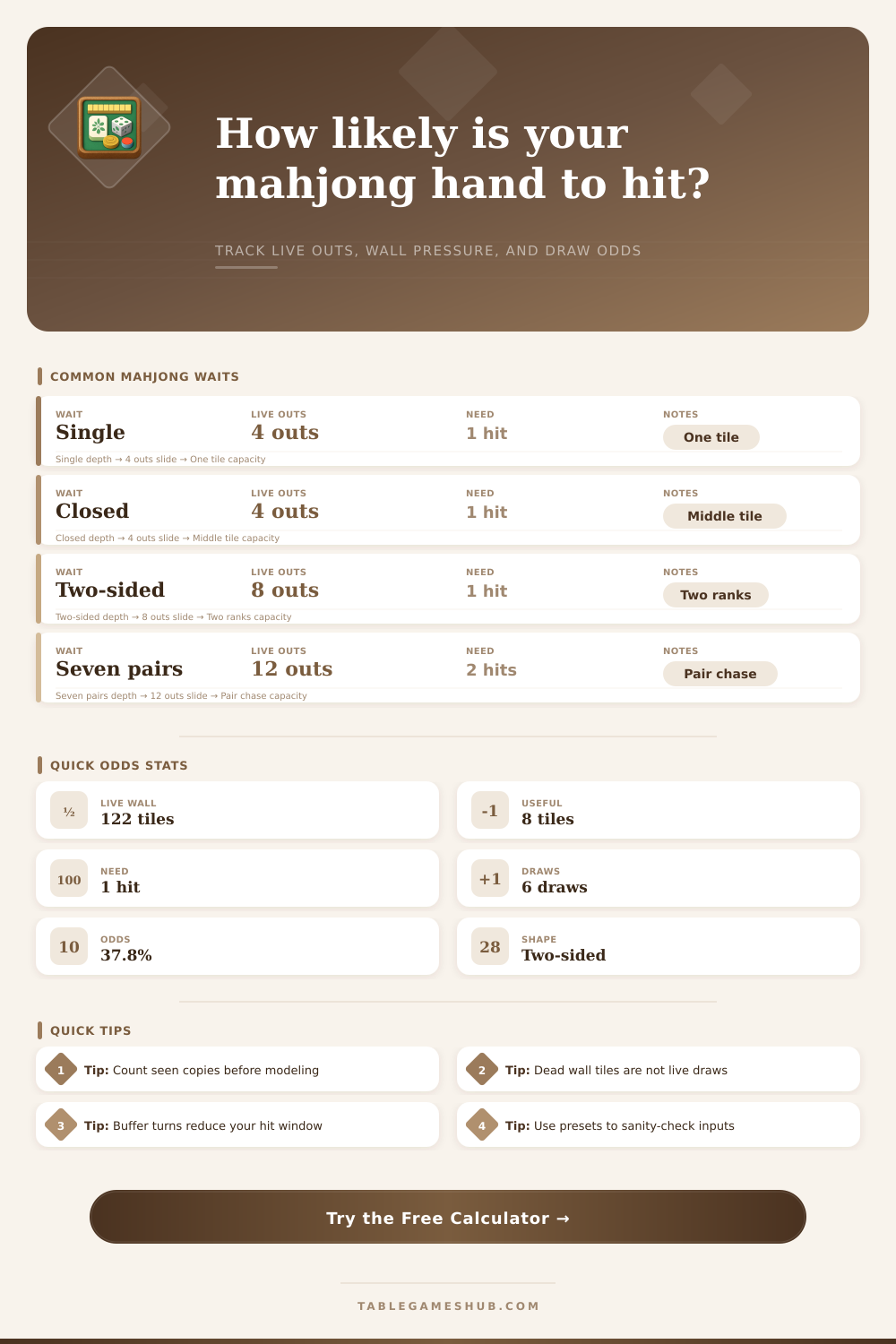
These tables keep the calculator grounded in practical tile-set counts, wall pressure, and table setup ranges.
Use this mahjong probability calculator to measure live outs, wall pressure, and completion odds for common waits. Compare presets, adjust visibility, and test draw windows fast.
In mahjong, probability plays a part in many situations. Unlike games like chess, go or shogi, it is a game with incomplete information. Because of that players have to guess results and chances for reach tenpai.
They also estimate chances for improve the state of their hand. This includes lower tenpai-level or expand uke-ire, so the value of useful tiles. Players really work to complete their hand.
How Chance Works in Mahjong
Game has 136 tiles. A wall is made up of four identical copies of every type. Like this arrange itself 34 different tiles.
Some estimate a full mahjong-set in 144 tiles. When a game starts, every player receives four tiles. Neither any order of draws matters.
Chance win do not depend on that, whether you are the first or last to draw.
Mahjong strongly base on reading of other players’ discards. That helps to understand what they want with their hands. Later stays only luck to use those discards and the tiles.
Mahjong have many rounds with many choices, what makes it depend on chance. The random element is like that in card games like poker. Here the deck mix and deal tiles face down.
Always probability and chance causes the winning hand.
Prize of a round relates to the amount of doubles that allows your combination. Some call them tai or fan. Randomly formed hand from 14 tiles have around one from 330 000 chances be a valid mahjong-hand.
That qualifies for tenhō or chiihō. Probability of 1/11 000 are not that low for average players during long time. Building the 13 Orphans, you little can choose discards.
Ultimately some maybe will dump every tile from the wall. That expands chance that other player has a pair of it. It likewise can help the player on the right with the same tiles.
Various styles exist for mahjong. Between them are American, Chinese Classical, Chinese Official, HK Old Style, HK New Style, Japanese Classical, Japanese Modern, Korean, Riichi Competition, Taiwanese, and World Series. Some uses automatic tables for Chinese or Japanese mahjong.
Those variants can add flower tiles and set in 136, 140 or 144 tiles.