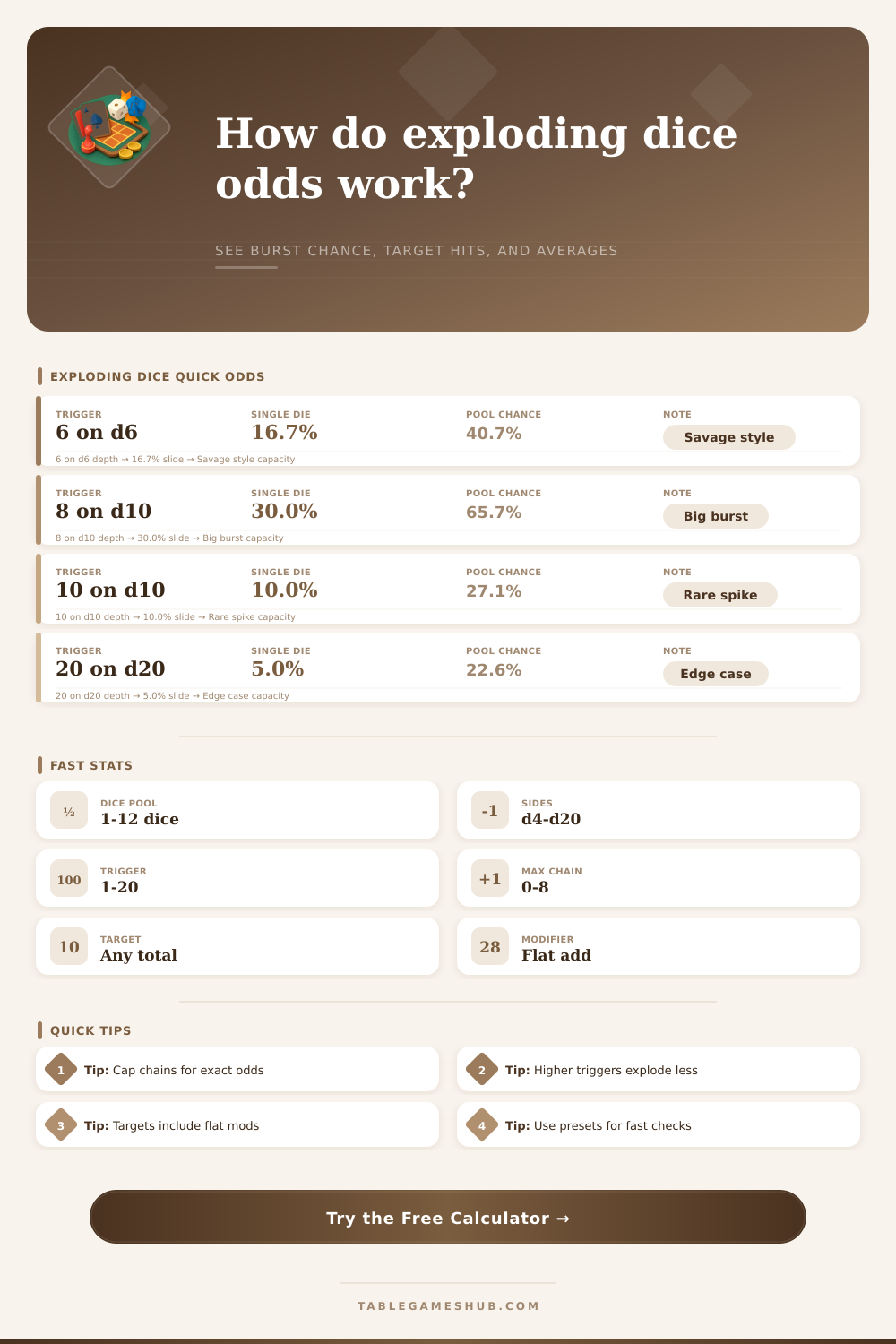
🎲 Exploding Dice Probability Calculator
Compare burst odds, target hits, and chain averages from any exploding die pool.
Use a max depth so exact odds stay fast and readable.
Lower explode values raise burst odds and expected totals.
Bursting dice are a tabletop mechanic, where the player rolls again when it shows the highest value. The new result simply adds to the total. This can happen many times one after another.
The player keeps to add the values, until he no longer rolls the maximum. For instance, if the die first shows 6 and later 1, the total is 7. But if the second time was again 6, it would burst more.
How Bursting Dice Work and Change Averages
You describes this chain by means of a moving model, where the last roll must not be an explosive value.
The mechanic of bursting dice increases the result in a certain grade. For normal die roll the expectation is (n + 1)/2. A good way outline the impact of bursting dice are, that it goes upward the expecting value.
At d4 the average grows from 2.5 to 3.33, so in 33 percentages. Rather, at d20 from 10.5 to 11.05 only 5 percentages. Basically, big dice benefit more than little, when exploding play role.
Here the reason: although they burst less commonly, they give higher numbers.
Is unlikely effect, called the target number paradox. It comes from that, that dice with few sides burst more easily. Take for example the d4!
It can not reach 4, 8 or 12. Because each 4 burst, and roll under 4 ends the chain. The chance surpass 8 with bursting d4 are 6.25 percentages.
That doubles almost the probability at bursting d6. Exactly 8 result is entirely impossible with bursting d4.
For multiple dice the expectation simply multiplies the individual value according to the amount of dice. At 3d6 you takes the result for n=6 and triple it. In systems as Deadlands the player chooses the highest value from the pool.
If he rolls 3d6 and receive 2, 4 and 6+2, the total is 8, because that is the maximum. Character with 6 dice could have 1, 1, 3, 4, 6, 6. The two 6s burst to extra 2 and 5.
Like this happened three successes from the 4, 6 and 6.