Left Right Center Probability Calculator
Estimate LCR dice outcomes, survival risk, expected turns, center pot movement, and the chip flow around your table.
| Lost Chips | Probability | Chips After Roll | Survival Call |
|---|
| Dice Rolled | Any Center | All Dots | Any Pass Left/Right | Expected Center |
|---|
| Flow | Dice Source | Formula | Expected Chips |
|---|
| Scenario | Faces | Per-Die Loss Chance | Best Use |
|---|---|---|---|
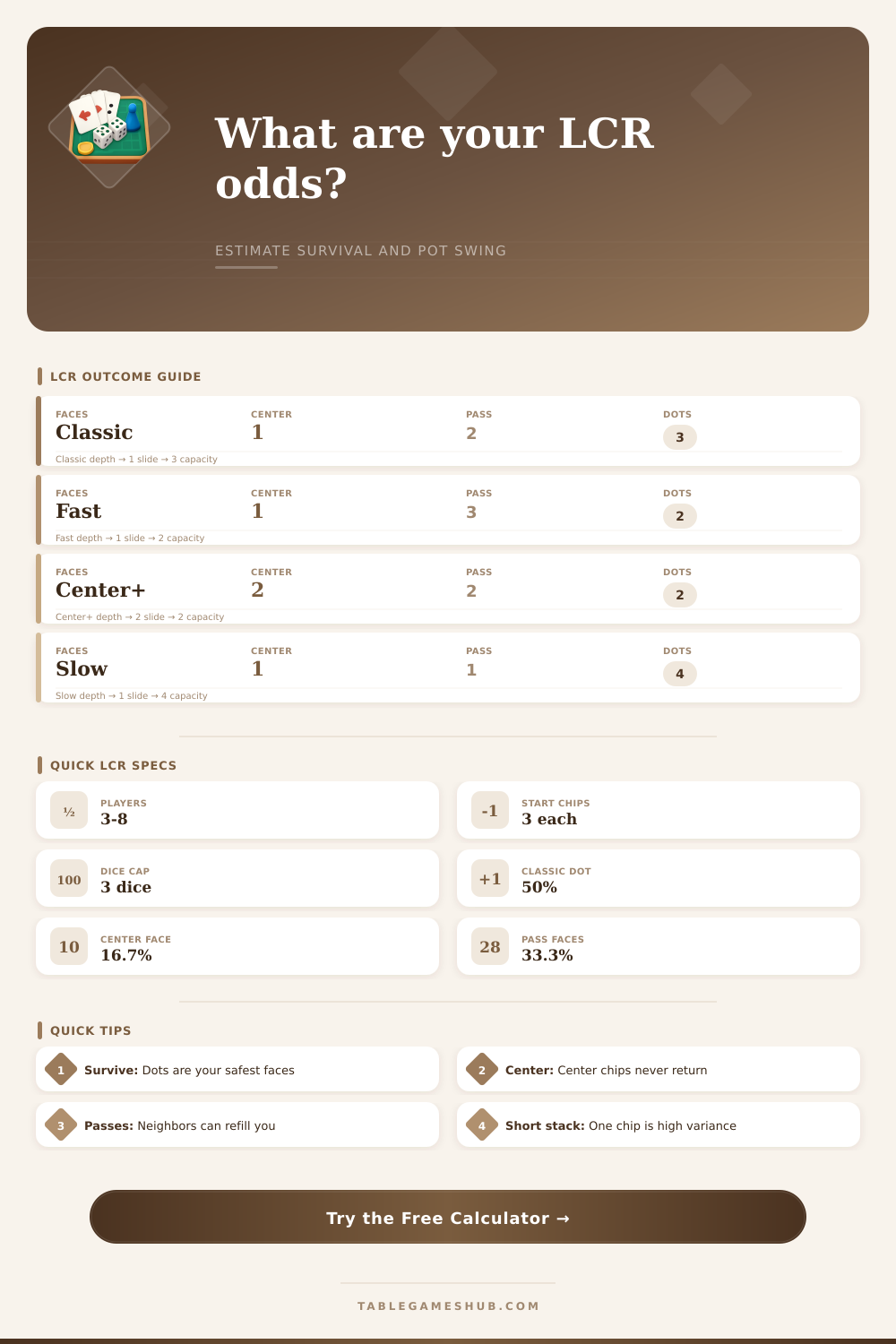
| Classic LCR | 1 L, 1 R, 1 C, 3 dots | 50.0% | Standard family game |
| Fast pass game | 2 L, 1 R, 1 C, 2 dots | 66.7% | Shorter rounds |
| Center heavy | 1 L, 1 R, 2 C, 2 dots | 66.7% | Bigger center pot |
| Dots heavy | 1 L, 0 R, 1 C, 4 dots | 33.3% | Longer survival |
Left Right Center is a game that uses rolling of the dice to move chip from the players to the center of the game. Left Right Center involve chips, dice, and players. The chips are moved according to the roll of the dice.
For instance, one roll of the dice can move a chip to the center of the game, another roll of the dice can move a chip to a neighbor of the player who roll the dice, or the player who rolled the dice can keep the chips that they holds. The chips that end up in the center of the game are removed from the game. Thus, as the game is played, the total number of chips in the game will decrease over time.
How Left Right Center Works
The faces of the dice that are rolled determine the movement of the chips. For instance, some of the dice may have faces that are labeled with “left”, others that are labeled “right”, others that are labeled “center”, and others that are labeled with “dots”. If a player rolls a face that has “left” in the center of the face, the player must send a chip to the neighbor to the left of the player.
If a player rolls a “right” face, the player must send a chip to the neighbor to the right of the player. If a player rolls a “center” face, the player must place one of their chip in the center of the game. Finally, if a player rolls a face that has “dots” in the center of the face, then no chips are sent between player.
The different types of faces of the dice help to create the pace at which the game of Left Right Center is played. For instance, if there are more “center” faces on the dice than other types of face, the chips will leave the game more rapidly. Additionally, if there are more “dots” faces on the dice than other types of faces, the game will last longer overall; the more “dots” faces that are rolled, the fewer chips that will be sent between players.
The person can understand the mathematical probabilities of the game by utilizing a calculator. The calculator allow the person to enter the number of chips that they hold, the number of players in the game, and the types of faces of the dice into the calculator. The calculator can then output information about the survival odds of the players and the movement of the chips.
For instance, the calculator can calculate the survival chance of a player that has a stack of three chips, or the survival chance of a player that has only a single chip. In each case, it is more likely that the player with only one chip will be eliminated from the game than the player that has a stack of six chips. The neighbors of the players are crucial to the survival of the players.
Each player has a neighbor to the left and to the right of themselves. Thus, the player to the left of the player can send them a chip, or the player to the right of the player can also send them a chip. For instance, if the player to the left of the player rolls a “right” face, the player will send them a chip.
Additionally, if the player to the right of the player rolls a “left” face, that player will also send a chip to the player. Thus, each player has the potential for a “refill” of chips from their neighbor. The more chips that their neighbor has, the more likely that their neighbor will roll a die that sends them a chip.
Thus, players with few chips will roll fewer dice than players with many chip. A calculator can calculate the “round-net” number of chips for each player, which is a representation of whether or not each player will gain or lose chips in that round of play. The center of the game is where the chips that are sent to the center are removed from the game.
Thus, as the number of chips that are sent to the center increases, the total number of chips that are available to the players decreases. The game can calculate the number of chips that the center will collect each round, and this value can help to each player to understand how long the game will last. For instance, if the dice have many “center” faces, then the center will collect chips at a rapid rate from the players, and the game will end quick.
The player can use the calculator to test different scenarios that can occur during the game of Left Right Center. For instance, the player can utilize the “horizon setting” on the calculator to calculate what will happen to the player if they maintain the same number of chips in several rounds. This calculation is helpful for players that may not receive any chips from their neighbors immediately after they lose some of their chips.
The “expected turns” number on the calculator will calculate how many turns a player can roll before they run out of chips, assuming that their neighbors will not send any chips to them during this time. This number is a way of calculating the risk that a player is taking with the number of chips that they have at the beginning of the game. The rules for Left Right Center can be changed in a variety of ways, which will change the mathematics of the game.
For instance, if the game uses extra “center” faces on the dice, there will be more turns for chips to be moved to the center of the game, and the game will end more quickly. Additionally, if the game uses extra “left” and “right” faces on the dice, there will be more turns for the chips to move between players, and the players will have more chips in the game for longer periods of time. Many players make mistake when they play the game of Left Right Center.
For instance, players may not understand that it is safer to have a large number of chips than it is to have a small number of chips. A player that has six chips will be able to better handle bad rolls of the dice than a player that only has one chip. Additionally, players may often ignore the chips that their neighbors have.
They should never ignore their neighbors and the chips that they have in their possession, as these are the only chips that players can recieve during the game of Left Right Center. A calculator is a helpful tool to avoid such mistakes during the game.