🎯 Ladder Ball Distance Calculator
Set ladder spacing, throw line distance, player division, scaled backyard fit, diagonal clearance, and bola arc allowance for ladder toss layouts.
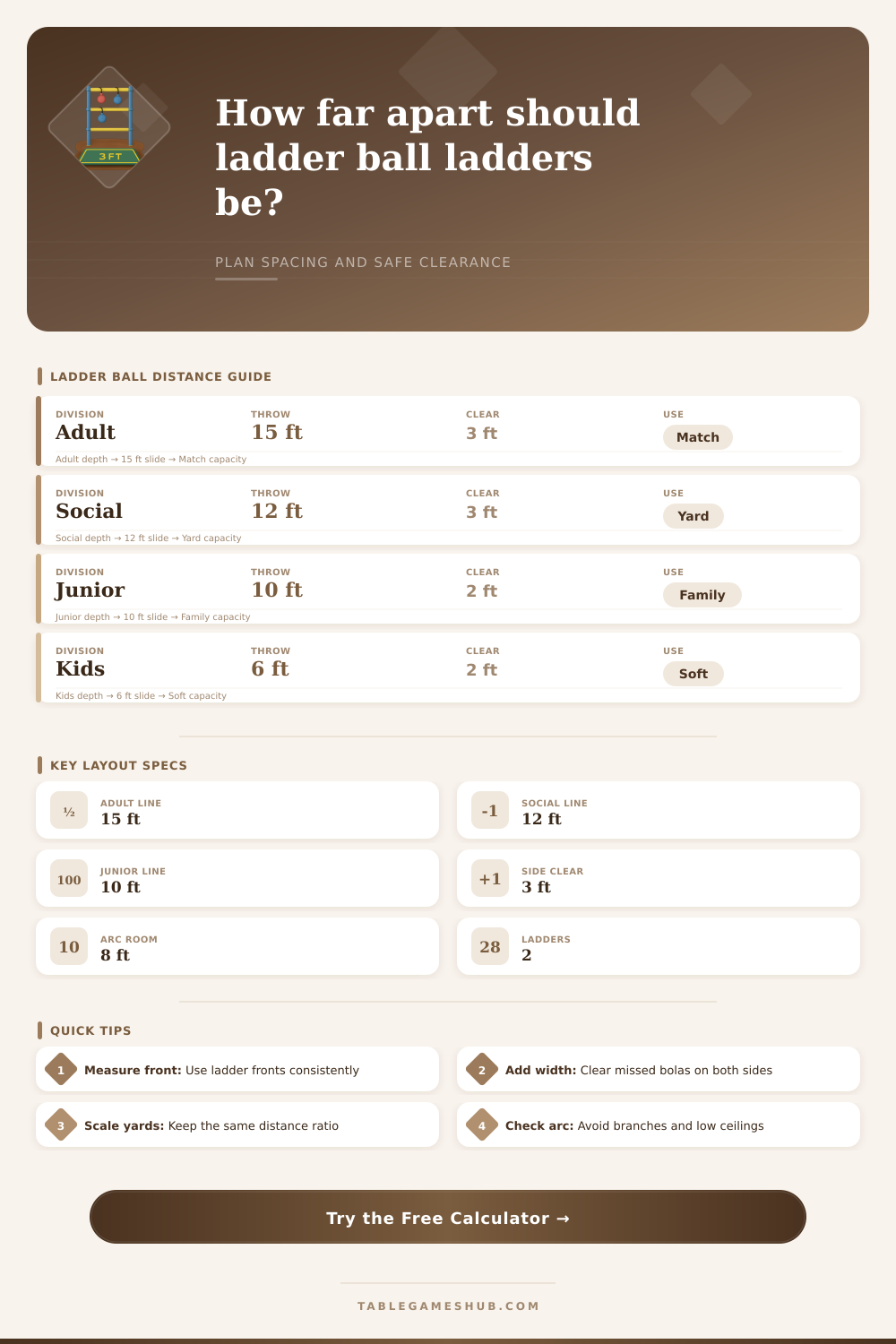
| Player Division | Suggested Throw Line | Typical Players | Best Use |
|---|---|---|---|
| Adult or regulation style | 15 ft to ladder front | 2 to 4 players | Full lawn and match-style play |
| Social backyard | 12 ft to ladder front | 2 to 8 players | Casual games with mixed skill levels |
| Junior or mixed ages | 10 ft to ladder front | 2 to 6 players | Families, younger throwers, shorter yards |
| Kids soft-bola lane | 6 to 8 ft to ladder front | 2 to 6 players | Soft sets, indoor practice, first games |
| Layout Area | Adult Target | Backyard Minimum | Calculator Use |
|---|---|---|---|
| Throw distance | 15 ft | 8 to 12 ft | Main result and ladder spacing |
| Behind line clearance | 3 to 4 ft each end | 2 ft each end | Safe footprint length |
| Side clearance | 3 ft each side | 2 ft each side | Safe footprint width |
| Bola arc allowance | 8 to 10 ft open height | 7 ft for soft throws | Overhead clearance note |
| Reference Choice | What You Measure | Center Adjustment | When Useful |
|---|---|---|---|
| Ladder front | Line to front edge | Add half ladder depth | Fast yard marking and most common setup |
| Ladder center | Line to target center | No adjustment | Consistent target geometry |
| Ladder back | Line to back edge | Subtract half ladder depth | When rear base edge is easiest to mark |
| Scaled lane | Available space first | Reduce throw line only | Compact patios and narrow side yards |
| Preset Layout | Throw Line | Approx Footprint | Clearance Focus |
|---|---|---|---|
| Adult match | 15 ft | 23 ft by 8 ft | Full line depth and side misses |
| Social yard | 12 ft | 18 ft by 8 ft | Shorter throws with adult ladders |
| Junior family | 10 ft | 15 ft by 7 ft | Mixed ages and smoother rotation |
| Two-lane party | 12 ft | 18 ft by 18 ft | Gap between lanes and diagonal space |
Tip 1: Pick one reference edge
Measure every throw line to the same ladder point, such as the front edge, so both sides of the lane play evenly.
Tip 2: Check diagonals after scaling
A compact lane can fit lengthwise but still feel cramped if the diagonal corner-to-corner path crosses furniture, trees, or walls.
Ladder ball is a backyard game that require careful measurement of the space in a yard to set up correctly. Several factors affect how ladder ball is played in the yard, including the distance between the ladders, the position of the throw lines, and the amount of space on the sides of the ladders. Too short a distance between the ladders create a rushed game, while too long a distance can make the players lose interest in the game.
A calculator can help determine the correct measurements for ladder ball in any yard, removing the guesswork of where to place the lines in the grass. The distance from the throw lines to the front of the ladder is a measurement that many people will have to adjust to fit the size of the yard. Using the standard measurement, the throw line is fifteen foot from the front of the ladder.
How to Measure Your Yard for Ladder Ball
This distance allows the bola to travel far enough to feel good about the throw. The distance can be shortened for young players or small yards. Using a longer distance can encourage players to focus on the skill of throwing the bola and getting the shot to land away from the ladder.
The calculator will help show what different distances the throw lines can be to accommodate the length of the yard. The size of the ladder will take up space in the yard. Furthermore, there will be space needed behind the throw lines and beside the ladders.
The calculator will account for the size of the ladder and allow space for the players to stand beside the ladders. The side space will help prevent the missed bolas from rolling into flower bed or under furnitures in the yard. Additionally, players will have a place to stand so as to avoid crowding the next player who will be throwing the bolas.
In yards with limited space for the ladders, the ladder calculator can show whether two lane of ladder ball will fit or if only one lane of ladder ball is needed with more space on each side of the ladder. Reference points for measuring the yard for ladder ball can make or will not make a difference in how the ladder ball game is played. Many people will choose to measure the distance from the front edge of the ladder.
Using this distance will help ensure that the game is even on each side of the ladder. Using a string or tape measure will mark the distance on the ground. Measuring to the center of the ladder or the back edge of the ladder will change the distance that is thrown and may make the game too challenging or too easy for the players.
The ladder calculator will show the distances to help people understand the impact of the different reference points. Only one reference point should be chosen and use on each side of the ladder; otherwise, the game will be uneven. The number of players that will use the ladder and the style of the ladder ball game can create an impact on the layout of the game.
Four players can play on one lane of the ladder with three feet of clearance behind each throw line. Eight players may require a second lane for the players to stand and wait their turn to throw the bolas. The calculator will account for the number of players.
The total footprint of the ladder ball game can help to determine if it will be a relaxed ladder ball game or if players will step on each other’s toes in the yard. The diagonal distance of the ladder ball footprint can help if there are trees or fences that may interfere with the players’ throws. In some backyards, the available space may not have room for a ladder ball game to be twenty-four feet in length.
In these cases, the calculator can be used to create a scaled-down version of the ladder ball game. The distances that will be used for the game will be altered to accommodate the yard size, but the ratios of the distances will be preserved. Single lanes of ladder ball can be used if there is not enough space on each side of the ladder for the players to stand.
The minimum open height above the ladder ball game lane that the calculator will ask for people’s yards will affect the game. Eight feet of open space will be sufficient for most players to throw the bolas. Seven feet will be enough space for children or players using foam bolas.
If the open height in the yard is too low, there will be limitations to the types of throws that the players can make. People should ensure that the height allows the bolas to travel without hitting any branches from the trees in the yard. Mistakes are easily made when people only measure the throw lines and do not consider the rest of the footprint that ladder ball games take up in yards.
People may measure out the distance to the throw lines and the ladders when they set up the game. However, once they have set up the ladder ball game, they may realize that there is no space for the players to stand. Additionally, they may use a different reference point on one side of the ladder than the other, which will make for an even game.
Using the calculator will prevent these mistakes from being made when setting up the ladder ball game. Using the calculator will help people to think through the entire area that ladder ball games take up in yards. Given all the factors that affect ladder ball game designations for yards, the calculator will make it clear to people what the footprint of the game will be and whether or not it will fit in the yard.
The calculator will provide people with the clarity they need for the ladder ball game to work for the yard and for the people who will be playing.