Kubb Baton Distance Calculator
Estimate the straight and diagonal throw distance from your baseline position to a kubb or king, including field scale, target row, lateral offset, and safe overthrow margin.
This tool is for baton throwing distance and aiming geometry. It uses field size only as the coordinate scale, so it stays focused on the path from the player to the target rather than laying out a pitch.
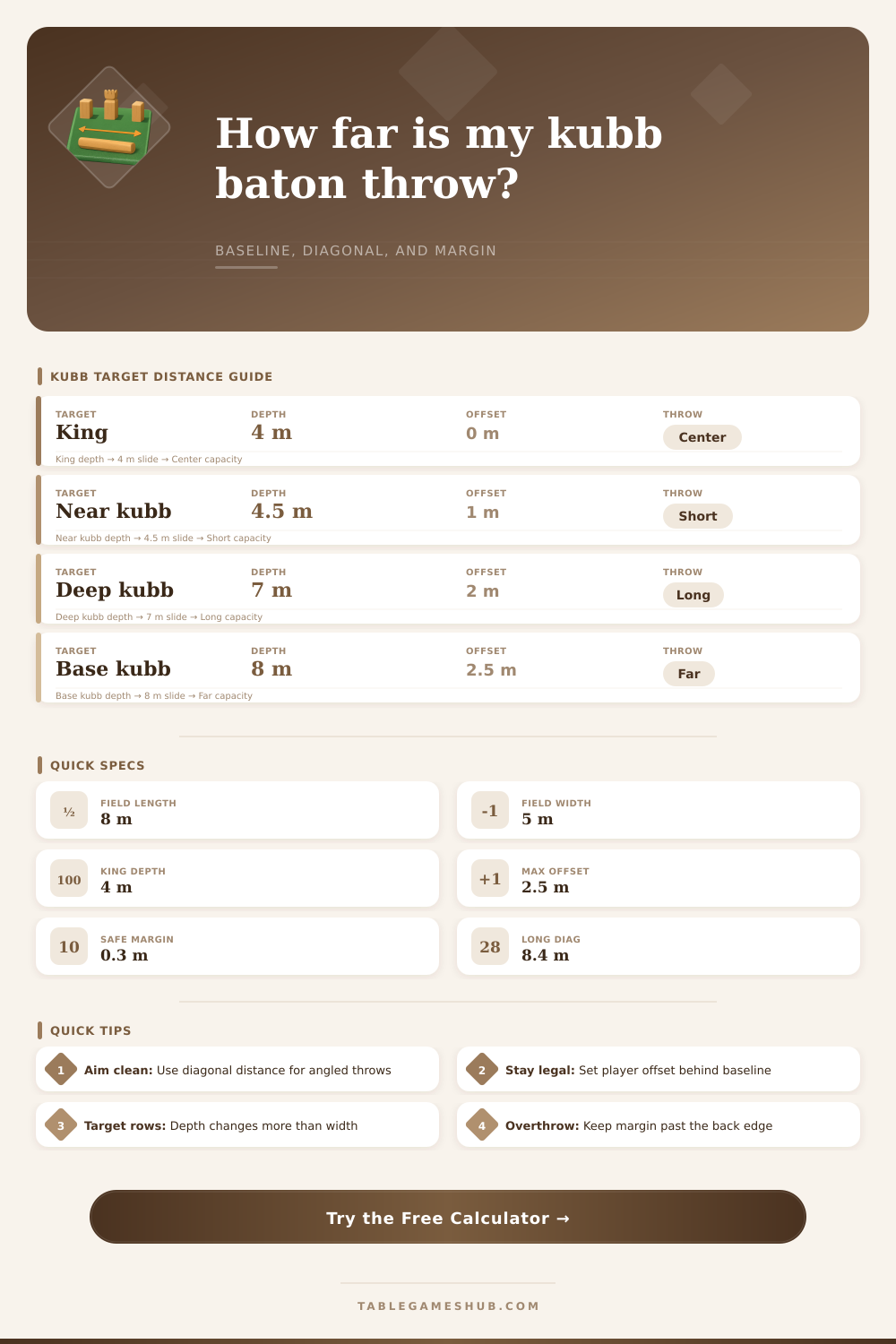
| Target Row | Standard Depth | Typical Offset | Distance Use |
|---|---|---|---|
| King row | 4 m from baseline | 0 m center | Center-line baton control and warm-up calibration. |
| Near field kubb | 4.2 to 4.8 m | 0.5 to 1.5 m | Short field throws after kubbs are tossed in. |
| Mid field cluster | 5.4 to 6.2 m | 0.5 to 2 m | Common angled throws that need diagonal adjustment. |
| Opponent baseline | 8 m standard | 0 to 2.5 m | Longest regular kubb targets from your baseline. |
| Field Scale | Length | Width | Half-Field King |
|---|---|---|---|
| Standard adult | 8 m | 5 m | 4 m from either baseline |
| Compact casual | 7 m | 4.5 m | 3.5 m from either baseline |
| Junior practice | 6 m | 4 m | 3 m from either baseline |
| Small yard drill | 5 m | 3 m | 2.5 m from either baseline |
| Side Difference | Depth | Diagonal Effect | Practical Note |
|---|---|---|---|
| 0 m | 4 m | No added distance | Use straight baseline distance. |
| 1 m | 6 m | About 0.08 m added | Small but noticeable on touch throws. |
| 2 m | 8 m | About 0.25 m added | Plan a slightly longer release. |
| 3 m | 8 m | About 0.54 m added | Large cross-field angle changes feel. |
| Overthrow Margin | Use Case | Risk Level | Adjustment |
|---|---|---|---|
| 0.1 m | Precise king or close kubb | Tight | Reduce release power and aim low. |
| 0.3 m | General backyard play | Balanced | Good default cushion for most throws. |
| 0.5 m | Deep field kubbs | Forgiving | Allows more roll or bounce past center. |
| 0.8 m | Far baseline row | Loose | Useful only when space beyond target is clear. |
If the target is far left or right of your throwing hand position, the diagonal path is the number that best matches the baton flight you need.
King throws usually need a smaller cushion than deep kubb throws, because too much carry can turn a clean line into a risky miss.
Calculating the distance for a baton throw in a game of kubb is an necessary task. The actual distance that is thrown is rarely the straight line between the field depth and the target. A person can envision the distance between themselves and the target, but the actual distance that must be covered is more long due to the angled position of the target.
Should the target be offset to the left or the right of the field depth, the baton will have to travel a longer distance then the distance from the field to the target. It is important for the individual to account for this distance to ensure the baton does not fall short of the target. An individual can perform a calculation on the throw to calculate the distance that the baton will travel.
How to Calculate the Kubb Baton Throw Distance
This mathematical result will provide the distance that the baton should travel to reach the target. Using this calculator eliminate the need for an individual to calculate the distance in there mind. The calculator accounts for the accuracy that an individual will have when throwing the baton.
An individual must decide on a margin for error in the throw. The calculator will account for the depth of the field to the target and the distance laterally from the thrower to the target. The total of these two distances will be the distance that the baton will have to travel to reach the target.
The size of the field is a necessity in calculating the distance that the baton will travel. The size of the field for adults is eight meters in one dimension and five meters in the other. However, fields can be larger or smaller.
The depth from the field to the king is half the size of the field. After each round, the positions of the kubbs will change. The kubbs is not always in the center of the field.
Therefore, the distance that must be calculated is the diagonal of the field from the thrower to the kubb. The further that the target is offset from the depth of the field, the longer the distance that the baton will have to cover. An overthrow margin is a necessity when throwing a baton for kubb.
The space behind the target is limited. Therefore, an individual must set a margin for the baton to travel behind the target. If the margin is too small, the baton may leave the field of play.
If the margin is too large, the individual may not have control over where the baton lands. This calculator allows for the individual to set a margin to the target to allow the baton to over-throw the target. An accuracy buffer is a necessity with each throw.
An individual may have inconsistencies in their throwing of the baton. The accuracy buffer will account for these inconsistencies and ensure that the calculated distance to the target is the distance that one should of have to throw the baton to reach the target. The size of the field can impact the game of kubb.
If the field is small, any lateral offset from the field depth will have a more significant impact on the angle of the throw. If an individual is on a small field, they may throw the baton too hard to cover the distance to the target. However, throwing the baton too hard on a small field will cause the baton to skip past the target.
An individual can use the calculator to adjust the length of the field to calculate the apropriate amount of power that should be used on a small field. The calculator cannot account for environmental and physical factors. For example, the calculator cannot account for the effect that the wind may have on the baton while it is in flight.
However, the calculator will provide an individual with the calculated distance that the baton should travel. Using this distance, an individual can determine whether any missed target throws were due to the distance or the effect of the wind on the baton. The calculator can be used in advance for each game to prepare for each throw of the baton.
The field size is important for the players. Its difficult to play without a proper field. Youll need to make sure the field is level.
A person should of checked the ground. If the ground is uneven, the baton might not behave naturaly. Make sure you’re checking the dimensions.
The players’s equipment should be ready. Don’t forget to check the kubbs size too. The length of the field affects the game more than alot of people realize.
The moddern way to play involves using this calculator. It is more easy than doing it by hand. Most people dont like the math part of the game, but its necessary.
If you dont use the calculator, you might miss. The accuracy of the throw depend on the distance. You’re going to need a good strategy.
The field dimensions is very important. The size of field should be checked. An individual should of practiced more.
The distance was calculated by the player. The wind will affect the flight of the baton. The player will throw the baton with power.
The target is located at the end. Use the tool to help you. The distance is longer than expected.
The calculation is easy. The math is not hard. The player must focus.
The game is fun. The rules is simple. The field is large.
The baton is heavy. The target is small. The wind is blowing.
The distance is far. The player is ready. The game begins.
The player throws. The baton flies. The target is hit.
The game is over. The winner is happy. The loser is sad.
The game was good. The distance was right. The player was fast.
The wind was light. The field was flat. The baton was straight.
The target was hit. The player won. The game is finished.