🏆 Swiss Pairing Calculator
Estimate Swiss rounds, score-group load, byes, no-repeat pressure, and table waves before pairing the next round.
| Band | Players | Pairing Load | Likely Action |
|---|
| Entrants | Minimum Swiss Rounds | Opening Matches | Planning Note |
|---|---|---|---|
| 5-8 | 3 | 2-4 | Common pod or small club night |
| 9-16 | 4 | 4-8 | Clean local Swiss range |
| 17-32 | 5 | 8-16 | Needs tighter score tracking |
| 33-64 | 6 | 16-32 | Use software or a pairing sheet |
| 65-128 | 7 | 32-64 | Large event with many score bands |
| Pairing Method | Core Sort | Pairing Pattern | Best Fit |
|---|---|---|---|
| Dutch score group | Score, seed | Top half vs bottom half | Chess-style rated events |
| Adjacent Monrad | Score, rank | 1 vs 2, 3 vs 4 | Simple club events |
| Random within score | Score only | Shuffle eligible players | Casual card events |
| Accelerated Swiss | Score plus boost | Separates leaders sooner | Large strong fields |
| Scoring Model | Win | Draw | Used For |
|---|---|---|---|
| Chess 1 / 0.5 / 0 | 1 | 0.5 | Chess, go adaptations |
| Match points 3 / 1 / 0 | 3 | 1 | Trading-card tournaments |
| Win-loss only | 1 | 0 | Miniatures and elimination cuts |
| Board-game VP Swiss | Table rank | Variable | Multiplayer ranking events |
| Constraint | Calculator Input | Effect | Organizer Check |
|---|---|---|---|
| Odd field | Active players | Adds one bye | Lowest eligible score is safest |
| Repeat opponent | Known repeat blocks | Raises pairing pressure | Swap before moving score groups |
| Color or side | Pressure percent | May alter ideal pairing | Avoid same side streaks |
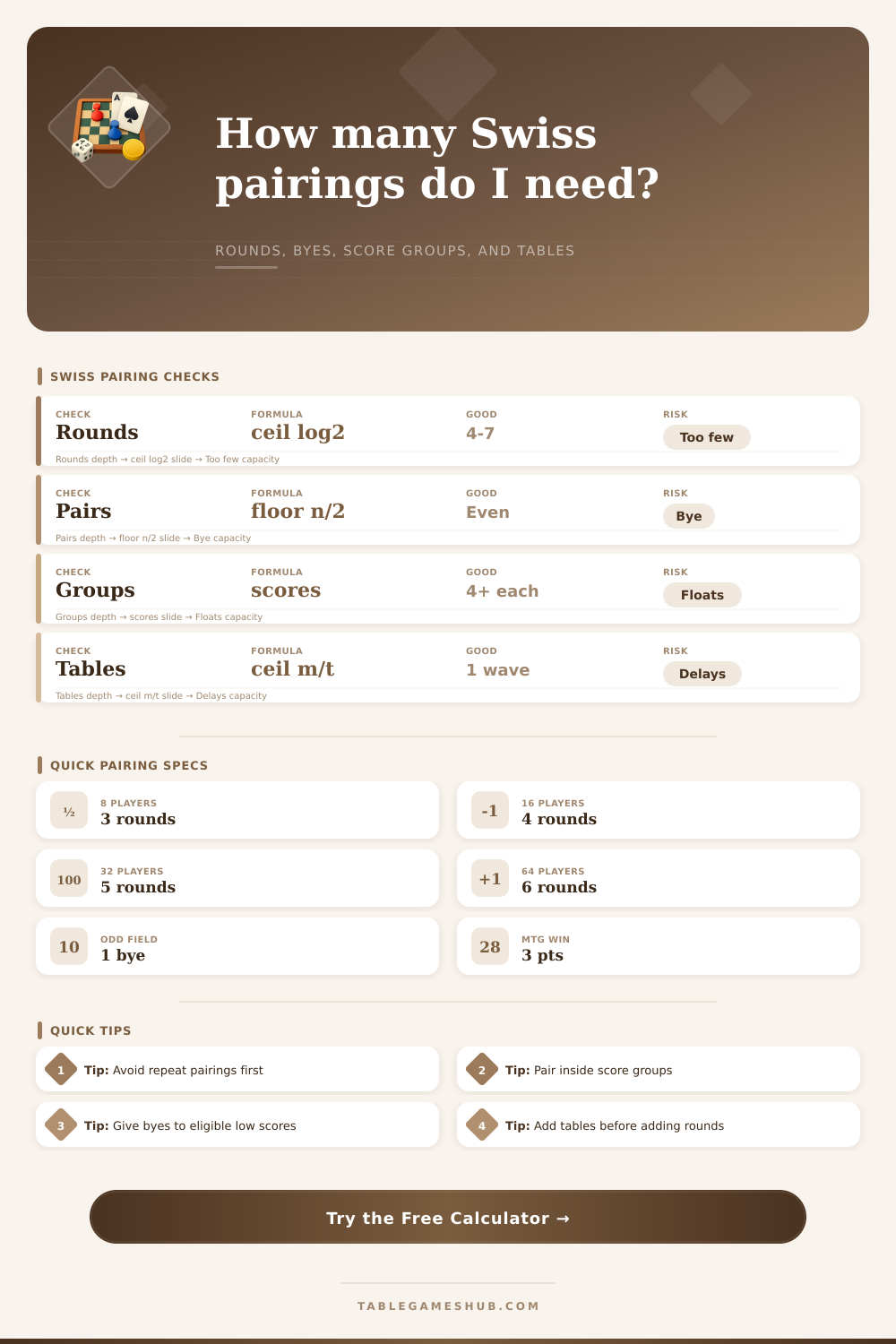
| Limited tables | Tables available | Adds waves and time | Keep one wave when possible |
Protect the no-repeat rule first
Swiss pairings are most credible when repeat opponents are blocked before color, side, or seed preferences are optimized.
Watch small score groups late
When average score-group size drops below four players, expect floaters and double-check byes before posting the round.
Tournament directors are not only tasked with running a game but they must also manage complicated logistics. A clock refuses to stop ticking; judges need coffee breaks; and players wants to sit together. This is where the Swiss pairing system comes into play. All player stay in the tournament, none get eliminated early and everyone keeps playing.
The theory is elegant, but reality is messy. One must weigh scores, prevent rematches, and keep players from waiting at tables while others completes their rounds. It’s a simple idea… Pair people up based off relative performance; move winners forward and losers backward. It naturaly sorts players by their skill level.
Why You Need to Plan Your Tournament Carefully
That said, it all goes pear-shaped in Round 2. People who had two draws or one bad loss starts to scatter across score ranges into odd clumps. At that point, math replace instinct as planning method. How many players is still alive? Which scoring system are right for you? Can you fit all those tables into a single-wave matches? Do you need to stagger match times?
When you enter the constraints (i.e. “I’m playing with X players in Y fields”), it uses field size to estimate how many rounds you actualy need. Instead of taking 4x as long to play with twice as many players, it take just one additional round. The more rounds there are, the more tired everyone get and the higher their drop-out rate becomes. “I’m playing with X players in Y fields”), it uses the size of each field and logs the number of rounds needed. Instead of taking 4x as long to play with twice as many players, it takes just one additional round. Because the more rounds, the more tired everyone gets and the higher their drop-out rate.
A chess open with 64 players should of take about six or seven rounds to properly sort field; a Magic: The Gathering draft pod with eight player can get away with three. One of the harder inputs is setting the score spread profile. A very narrow cluster occurs in draw-heavy tournaments like high-level chess, where many player might end up with same score after two rounds. That restricts your pairings and adds stress on avoiding repeats. Loss and win-only tournaments tend to separate quickly, leading to wide score gaps.
Our tool helps adjust its predictions based off those conditions so that you can get a sense ahead of time how well your pairings will work out different than having to shove people across group lines. I’ve seen organizers miss this till they start hearing back from players upset about being paired against someone much better then them.
Tournament success also hinges heavily on table availability. What looks perfect on paper doesn’t translate well to real-world applications if there isn’t enough space to run all matches at one time. Not having enough boards mean running multiple waves, increasing your setup time and frustrating players stuck in line. The round calculator can be a reality check before finalizing your schedule, as it will estimate how long each round take depending on the number of tables and match lengths. For instance, if the tool tells you it’ll take two waves for the third round, then think about cutting down number of scheduled rounds or adding more tables.
Byes in odd fields cause admin headaches. If done right, byes is given to the lowest scoring players eligible for one; otherwise, they can inflate rank unfairly. The tool highlights required byes and lets you know if you’ve missed one in mid round. It also monitors no repeat pressure, which increase when the field gets smaller and choices dwindle. This is a warning flag. A high percentage here means you are going to have to bend pairing rules just to keep moving forward.
In the end, Swiss pairings walk a tightrope of feasibility and fairness. Sometimes you can’t have every round be perfectly matched for seed, color, or repeat free. Give and take is part of the deal. Good organizers recognize these concessions up front instead of wrestling with them at crunch time during the event. Develop your rules clearly and explain them ahead of time. Make sure you can use tools to run through your draw beforehand. This way, once the door opens, all that’s left is for players to play.
Problems aren’t lacking in a good tournament. The organizer sees and manages them so players can spend their time playing the game instead of packing up.