Klaberjass Score Calculator
Total a Klaberjass deal from card points, accepted melds, bela, last trick, maker status, bete transfer, and race-to-target totals.
Pick a common scoring shape, then adjust the hand details for your table.
| Side | Card points | 20 melds | 50 melds | Bela | Tricks won |
|---|---|---|---|---|---|
| Maker Took the deal |
|||||
| Defender Opposed maker |
| Rank | Trump value | Non-trump value | Scoring note |
|---|---|---|---|
| Jack | 20 | 2 | Highest trump, ordinary non-trump value elsewhere. |
| Nine | 14 | 0 | Second trump, no card points outside trumps. |
| Ace | 11 | 11 | Highest natural non-trump card. |
| Ten | 10 | 10 | Ranks below ace in plain suits. |
| King | 4 | 4 | Counts toward bela only with queen of trumps. |
| Queen | 3 | 3 | Counts toward bela only with king of trumps. |
| Eight / Seven | 0 | 0 | May win or follow rules, but add no card points. |
| Item | Points | Input field | Calculator handling |
|---|---|---|---|
| Sequence of 3 | 20 | 20 melds | Multiplies count by 20 for that side. |
| Sequence of 4 or more | 50 | 50 melds | Multiplies count by 50 for that side. |
| Bela / marriage | 20 | Bela selector | Added even when a side wins no tricks. |
| Last trick | 10 | Last trick winner | Added to the selected side after card points. |
| No tricks won | Varies | Tricks won | Sequence melds are suppressed; bela remains. |
| Comparison | Maker scores | Defender scores | Practical effect |
|---|---|---|---|
| Maker total is higher | Maker own deal total | Defender own deal total | Contract succeeds; both write their points. |
| Maker total is lower | 0 | Both deal totals combined | Bete: defender receives the whole deal swing. |
| Totals are tied, classic | 0 | Defender own deal total | Maker does not satisfy the contract. |
| Totals are tied, friendly | Maker own deal total | Defender own deal total | Optional house rule for casual score sheets. |
| Preset | Card split | Bonus shape | Expected result |
|---|---|---|---|
| Clean Maker Win | 84 / 68 | Maker last trick | Both sides score own totals. |
| Bete Swing | 57 / 95 | Defender last trick | Defender collects combined deal. |
| Tie Loss | 76 / 76 | No melds | Classic tie blocks maker score. |
| Bela Rescue | 70 / 82 | Maker bela and last trick | Maker edges ahead by bonuses. |
| Fifty Sequence | 64 / 88 | Maker 50 plus bela | Meld turns a weak trick count. |
| No-Trick Maker | 0 / 152 | Maker claimed sequence | Sequence ignored, defender sweeps. |
Audit before awarding: In a completed two-player deal, maker card points plus defender card points should total 152 before the 10-point last trick is added.
Separate deal total from award: A maker can have a combined deal score, but still receive 0 if the defender ties or beats that total under classic scoring.
It’s hard math. When you sit down to play Klaberjass it doesn’t take long before it gets confusing. Two players competes against each other with a total of thirty-two cards. One hand might have seven high value cards, but those are worth nothing unless they’re played into winning tricks. The following hand could be twelve sequences…but then you lose every single trick because your opponent has high trumps.
This is where casual games breaks down: keeping up with the swings. Trying to do math in your head while waiting for the next hand, adding up card points, melds, and penalties, is where people loses track. Take away this friction with a score calculator that lets you get back to the thing itself: playing.
Why You Need a Klaberjass Score Calculator
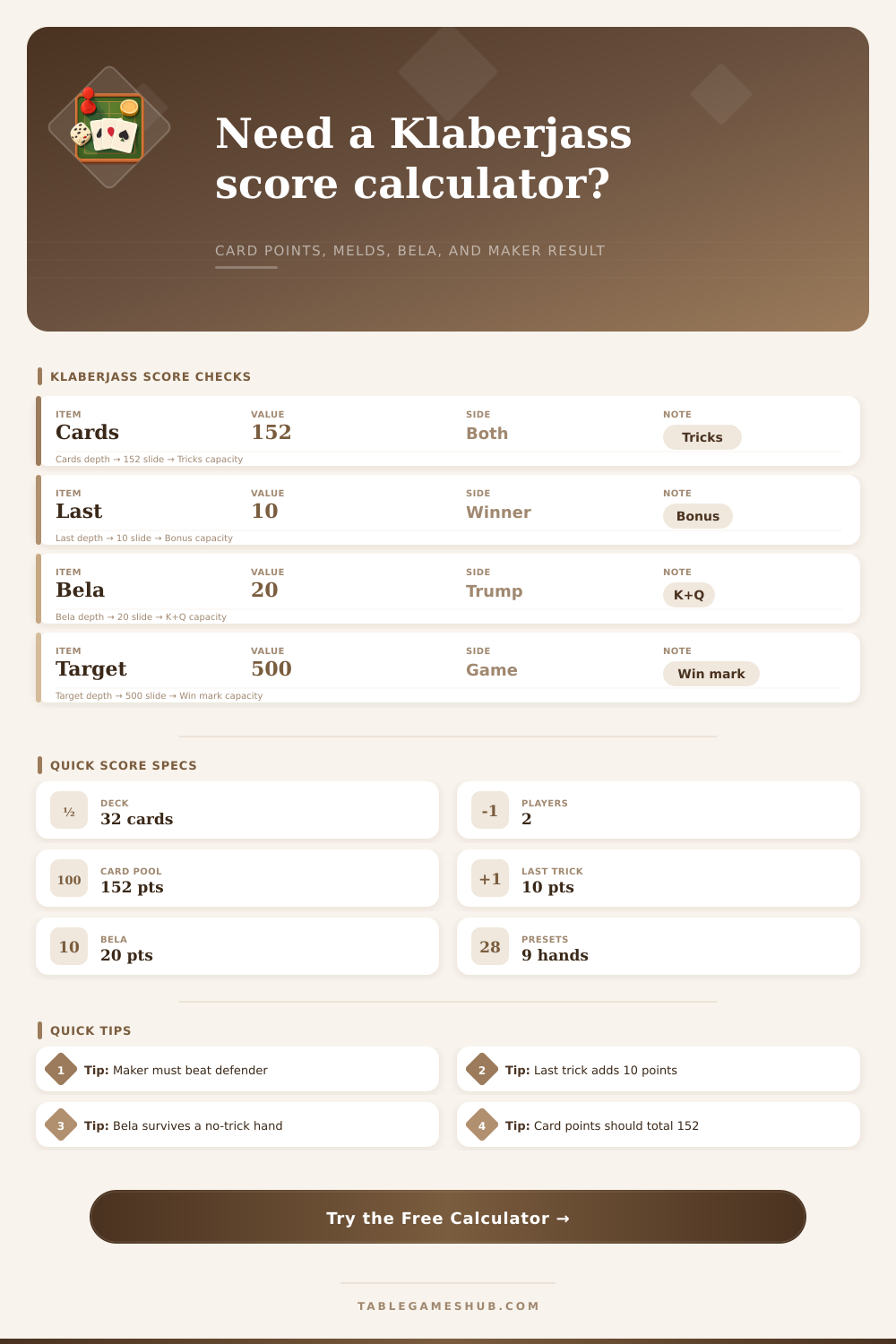
One hundred fifty-two points comprise the card point pool used in all forms of Klaberjass, before any bonuses is added on. These points gets divided between you and your opponent according to the number of tricks won by each player. By default, the card counter will calculate base points for you. Simply input the amount of points your team scored and computer will ensure that your total matches its own. If there’s no match, it’ll alert you, since there should be thirty-two cards in a round of Klaberjass, every single one needs to be accounted for. That way, a simple math mistake doesn’t cause scores to go off-the-rails at some future point during the game. No need to redo a hand because of poor addition.
Special bonuses add extra interest to melds above and beyond simple card point value. Getting a run of three cards of the same suit will net you twenty points while four cards jumps up to fifty. If you play your cards right, those multipliers can transforms a weak hand into a winner. You can enter how many runs you had into the tool, which applies the proper multiplier to your total count.
Then there’s the bela bonus, which rewards you with a twenty-point bonus if you hold both the Queen and King of trumps, regardless of how few tricks you might have won. Even in a disastrous hand, that can make a difference different than it having no value at all.
Klaberjass differs from other trick taking games in another way: the make/defend dynamic. In order for the maker to earn their points, they has to win by more than the defender. Under traditional rules, if the defender wins more tricks, or even ties, then the maker earns no points. Bete is the name of the penalty the defender earns if this occurs, which is usually sum of both players’ tricks. These swings are huge, turning what was a small lead into a blowout in seconds flat. By adjusting each player’s total with these bets and comparing the resulting scores, the calculator figures out who won and how much they scored. It will report whether maker has made or broken contract and adjust the running game score to match.
By default, it plays to 500 points (some groups play up to 501), which you can modify by changing the setting to suit whatever is common at your house. From there it’s up to you; do you risk it with a crazy bid? Or do you go safe? It displays how far off the goal you are at any given moment so you know exactly what to expect as the game progresses. And it will remember past scores just in case you’ve been playing for a while and don’t quite recall who’s winning. This is important because a Klaberjass match between two evenly-matched player could easily drag on for hours.
It’s a detailed game, taking into account not just card values, but the interaction between those values and various bonuses. It pays to know the score, literaly! However, included tools make it easy while keeping the strategy that makes it more than just simple number crunching. Count the cards, work out your melds, yes, but leave the math to the machine. It frees up the gameplay so it’s more about strategy and less about management, letting the game flow.
When the scorekeeping is clean, all that’s left on the table is the tension that draws friends back for another hand. That’s what keeps ’em coming.