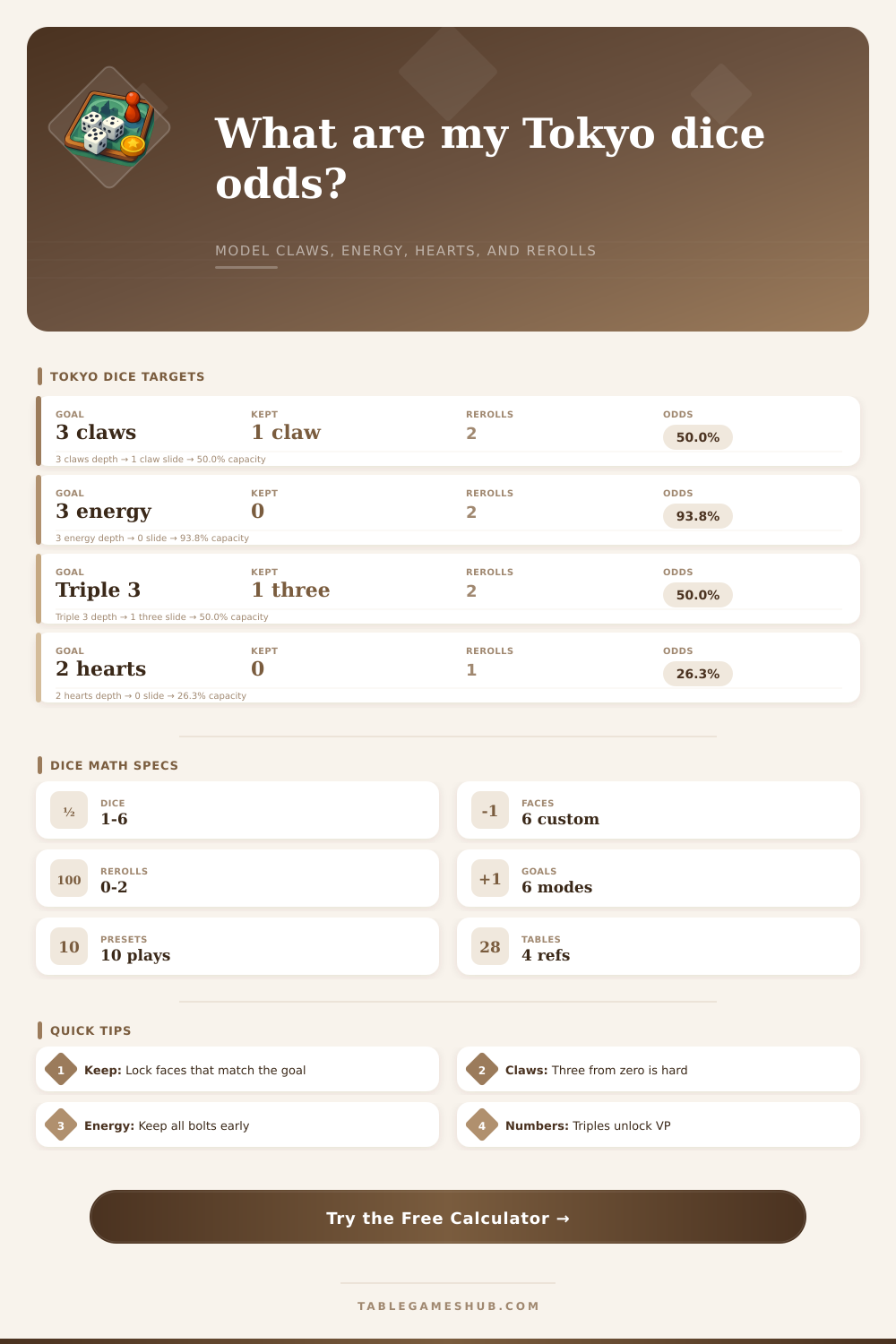
King of Tokyo Dice Probability Calculator
Calculate exact odds for six custom King of Tokyo dice, held faces, claws, energy, hearts, number scoring, and one or two optimal rerolls.
| Face | Calculator name | Single die chance | Common target use |
|---|---|---|---|
| 1 | 1 face | 16.7% | Score 1 VP for three 1s, plus 1 VP per extra 1 |
| 2 | 2 face | 16.7% | Score 2 VP for three 2s, plus 1 VP per extra 2 |
| 3 | 3 face | 16.7% | Score 3 VP for three 3s, plus 1 VP per extra 3 |
| Claw | Claw | 16.7% | One damage per claw before card effects |
| Energy | Energy | 16.7% | One energy cube per energy face |
| Heart | Heart | 16.7% | One healing face when outside Tokyo |
| Final number set | VP scored | Why it matters | Calculator check |
|---|---|---|---|
| Three 1s | 1 VP | Lowest scoring triple, but extras still add 1 VP each | Number VP threshold |
| Three 2s | 2 VP | Middle triple; four 2s becomes 3 VP | Number VP threshold |
| Three 3s | 3 VP | Best base number score; four 3s becomes 4 VP | Number VP threshold |
| No triple | 0 VP | Pairs and singles do not score number points | Exact distribution |
| Turn stage | Rerolls input | What is modeled | Typical use |
|---|---|---|---|
| Fresh turn | 2 | Roll free dice, then optimize two more rerolls | Before any dice are committed |
| After first roll | 1 | Held dice stay locked, free dice get one reroll path | Deciding what to keep after roll one |
| Final roll | 0 | Roll only the free dice once and score the final state | Last chance checks |
| Locked result | 0 with 6 kept | No dice remain free, so the probability is already 0% or 100% | Auditing a completed roll |
| Preset | Held dice | Goal | Useful result card |
|---|---|---|---|
| Fresh Roll, 3+ Claws | None | Reach at least 3 claws with two rerolls | Selected goal |
| Energy Hunt From Zero | None | Reach at least 3 energy over a full turn | Target face |
| Keep 1 Three | One 3 face | Complete triple 3 scoring | Number VP |
| Mixed Turn | One claw and one energy | Hit claw, energy, and number minimums together | Mixed threshold |
In the game King of Tokyo, the player roll six dice to determine the options for that turn. The situation of the monster determine the value of each die that comes up on the monster’s dice. For example, an monster with three energy will need energy, but a monster outside of Tokyo with no hearts and with one reroll remaining will have different needs for that turn.
Thus, the monster player will have different decisions about which dice to keep and which to reroll in each situation. While some players base these decisions on intuition, such intuition isnt a reliable way to make these choices if the dice do not land on the desired face. There are only a few simple variable to the game, including the number of rerolls that the monster player has.
How to Use the Monster Dice Roll Calculator
If the player has two rerolls, there are three chances to roll the desired number on the dice. If, however, the player only has one reroll, there are only two chances to roll the desired number. Finally, with no rerolls the player has for that turn, the roll with the monster’s dice are final.
A simple calculator can tell the probability of the desired rolls for the monster player by entering the number of dice that are to be kept and the number of rerolls that is left for that turn. The calculator will provide the best dice to be keep for the monster player’s current turn with the desired goal. For those who choose to keep the dice during their turn, such choices are a safe move.
Yet, by keeping the dice the monster player must choose from during their turn, they may not have as many opportunity to collect certain types of dice later during the turn. The calculator can help the monster player understand the probability of rolling certain types of dice, such as claws, and also the probability of losing other types of combinations of dice that could of potentially been collected during the turn. These types of odds help the monster player to decide whether the early turn decision to keep some of the monster’s dice is a good idea or whether they would be better off rerolling to acquire other types of dice.
The monster player’s monster requires energy. Thus, the player will have different needs for energy when the monster has three energy compared to when the monster is outside of Tokyo with no hearts and one reroll remaining. For instance, one bolt face is useful when the monster starts the turn, but three bolt faces will allow the monster to make one purchase during the game.
The probability of rolling three energy dice for a monster with only one energy depend on the player’s choice to reroll some of the monster’s dice. Yet, the math for hearts is similar to that of energy except for the fact that hearts are only useful for healing the monster when it is outside of Tokyo. Thus, hearts will appear on the monster’s dice while inside of Tokyo but will fail to provide healing during those same turns.
Beyond the requirement of energy for each monster is the need of monster players to roll number combinations to earn as many victory point as possible for the game. To score number combinations, monster players must roll three of the same number on their monster’s dice. For instance, if a monster rolls three threes, the monster earns three victory points, plus one additional point for every additional three that are rolled.
Yet, if the monster rolls three ones, the monster earns one point, and additional points for each additional one that is rolled. While many monster players do not value rolling low number, victory points are earned from these rolls. A calculator can determine the probability that a monster will roll a specific number on the dice.
Another challenge for monster players is when they have multiple goal for their turn. For example, if the monster player needs two claws, two energy, and one number combination, the probability of rolling each combination individually is decent. Yet, the probability of rolling each of these during the same turn is low.
A monster player can enter these goals into a monster dice roll calculator that will determine if the monster player’s choices for the turn are helping or hurting the achievement of there goals. In these situations, it may be better for a monster player to give up trying to meet all goals and to instead focus the monster’s remaining dice on one or two goals. Monster players may make mistake during their turns.
For instance, monster players may treat each turn of the monster’s dice the same. Yet, with two rerolls for a monster player, they have more opportunities to reroll their dice to acquire the types of dice that will most benefit their monster during that turn. Yet, with zero rerolls, there are no opportunities to reroll their monster’s dice to collect others.
Thus, the monster roll calculator can adjust the number of rerolls that will be used during the turn. Another mistake that monster players may make is to not consider the monster’s position on the game board when they roll for hearts. Hearts are useful for monster players when the monster is outside of Tokyo.
Yet, if the monster is inside of Tokyo, the hearts are not useful to the monster unless they have the proper card for those outcomes. The location setting in the monster dice roll calculator will help the monster player to understand the value of the monsters hearts. Beyond the monster dice roll calculator are reference tables and rules for number scoring.
These tables help monster players understand the relationship between the number of rerolls that they have left for the turn and the various stages of the turn. The tables can be referred to while making decisions about the monster turn and while adjusting the variables in the monster dice roll calculator. Thus, the use of the monster dice roll calculator can help monster players to stop relying on their mental math skills and to base their decisions about the monster’s turn on the probability calculations of the turn.