Horseshoe Stake Distance Calculator
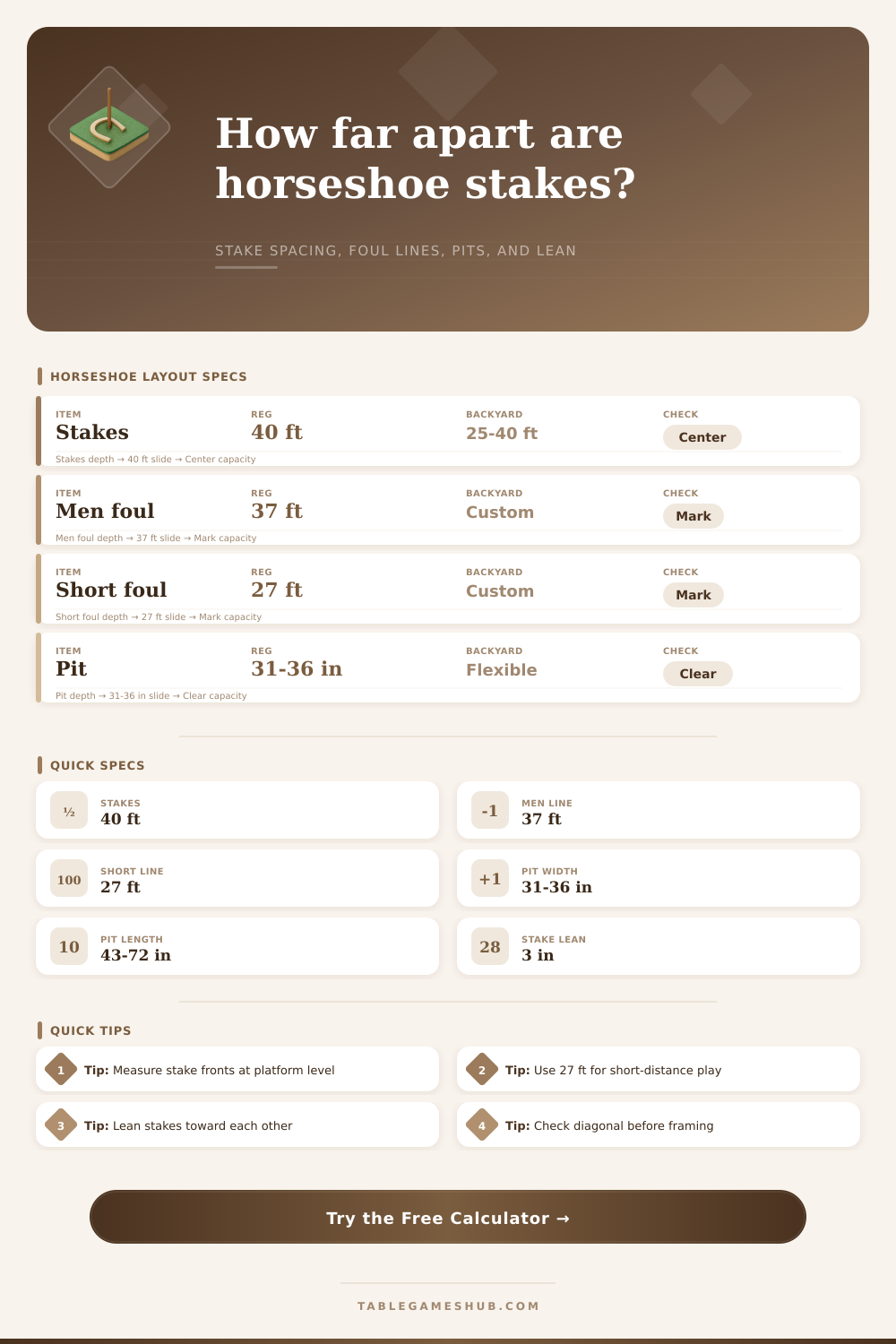
Calculate stake-to-stake spacing, 27 ft and 37 ft foul lines, pit length and width, stake lean angle, court footprint, and diagonal layout checks for regulation or backyard horseshoe courts.
| Player division | Foul line from opposite stake | Release setback on 40 ft court | Calculator setting |
|---|---|---|---|
| Open men | 37 ft | 3 ft before near stake | Open men / senior men |
| Senior men | 37 ft | 3 ft before near stake | Open men / senior men |
| Open women | 27 ft | 13 ft before near stake | Women |
| Juniors / youth | 27 ft | 13 ft before near stake | Junior / youth |
| Elder men option | 27 ft | 13 ft before near stake | Elder men |
| Item | Regulation reference | Calculator input | Layout effect |
|---|---|---|---|
| Stake spacing | 40 ft between stake fronts | Stake-to-stake distance | Sets main court length and foul-line math |
| Pit inside length | 43 to 72 in | Pit inside length | Determines front/back pit margin around stake |
| Pit inside width | 31 to 36 in | Pit inside width | Must leave room for shoes in count near the stake |
| Pitcher box | 72 x 72 in | Pitcher box / lane width | Frames platforms and pit in one square end box |
| Stake lean | 3 in toward opposite stake | Stake lean and height | Converts lean into a practical angle check |
| Layout | Stake spacing | Foul lines | Best use |
|---|---|---|---|
| Regulation / league | 40 ft | 37 ft and 27 ft marked | Practice for sanctioned or serious play |
| Club court | 40 ft | 37 ft, 27 ft, and 20 ft midpoint | Multiple divisions using the same court |
| Backyard full-distance | 40 ft | Use agreed player lines | Casual play that still matches stake spacing |
| Backyard short | 25 to 35 ft | Custom, clearly marked | Small lawns, mixed ages, first-time players |
| Tight patio | 20 to 30 ft | Custom | Recreation only, not regulation comparison |
| Check | What to measure | Good result | Fix when off |
|---|---|---|---|
| Stake centerline | Side-to-side offset between stakes | 0 to 1 in for a clean court | Shift one stake before framing pits |
| Actual tape distance | Diagonal from stake front to stake front | Matches target stake distance | Re-square line before adding pit material |
| Court footprint | Corner-to-corner of total layout | Both diagonals match | Move frame corners until diagonals agree |
| Pitching lane | Width at each end box | Same width at both pits | Snap a centerline and rebuild side marks |
To set up a horseshoe pits, a person must take precise measurement to ensure that the game is to be fair for everyone who plays. Without correctly measure the distance between the stakes, the game cant be played according to the rules of horseshoes. The geometry of a horseshoe pit determine the quality of the game, so players must pay careful attention to this initial aspect of setting up a horseshoe pit.
The first step in setting up a horseshoe pit are to measure the distance between the stakes. A person should measure the distance from the front of one stake to the front of the opposite stake at the level of the platform. Measuring from the center of the pit will produce incorrect measurement.
How to Set Up a Horseshoe Pit
A calculator will assist players in determine the correct distance between the stakes. If the stakes are not spaced accurate, the foul lines will be placed inaccurately. The second step in setting up a horseshoe pit is to place the foul lines.
The player will not measure the foul lines from the stake a person is standing near. The foul lines will be measured from the front of the opposite stake. For a men’s game, the foul line will be placed at a specific distance in front of the near stake.
For childrens games, the distance between the foul line and the stake can be shorter. However, it is essential to measure the foul line from the opposite stake. Using a tool to calculate the distance of the foul line will assist in placing the foul line at the exact right position so that there is no debate regarding the placement of the foul line.
The third step in setting up a horseshoe pit is to ensure that the stakes has the correct lean. The stakes should not be perfectly vertical; they will cause the horseshoe to bounce off the stake. There should be a slight lean of the stake towards the opposite stake.
This lean will allow for the horseshoe to land on the stake at a betterer angle. The angle of the lean of the stake can be calculated from the height of the stake. Calculating this angle will ensure that the stake does not look crooked when view from the sides.
The fourth step in setting up a horseshoe pit is to dig the pit. The dimensions of the horseshoe pit must be considered before digging the pit. The dimensions will determine how easy or difficult it will be for the players to retrieve the horseshoes from the pit.
If the horseshoe pit is too narrow or too short, the player will experience difficulty retrieving the horshoe from the pit. The length and the width of the horseshoe pit must be determined before digging the pit. The fifth step in setting up a horseshoe pit is to perform a diagonal measurement of the stakes.
Even if the distance between the stakes is correct, the stakes might not be dug in the same centerline of the horseshoe pit. Using a tape measure, determine the distance from the front of one stake to the opposite diagonal corner of the horseshoe pit. This diagonal check will determine whether or not the horseshoe pit is a true rectangle or a skew parallelogram.
If the stakes are skewed, the player will be throw the horseshoe at a diagonal. This can make it difficult for the player to aim at the target. Finally, a person must consider the space in which the horseshoe pit will be built.
Depending on the size of the space, the stake distance and foul lines will need to be adjusted. For example, the distance between the stakes can be adjusted to fit the size of a small yard. However, proportions of the horseshoe pit should be preserved when setting it up in a small area.
A successful horseshoe pit will be a consistent horseshoe pit. If the stakes are square, if the stake lean is correct, if the foul lines are correctly place, then a horseshoe pit is ready for players to enjoy the game.