Hearts Jack of Diamonds Calculator
Score a Hearts hand with the J♦ bonus, compare house-rule floors, test moon interaction, and see how the result changes the scorepad.
Choose a realistic J♦ table state, then adjust the scorepad, card holders, and house rules.
| Seat | Before | Hand | After |
|---|---|---|---|
| You | 38 | -6 | 32 |
| Left | 41 | 3 | 44 |
| Across | 52 | 3 | 55 |
| Right | 47 | 3 | 50 |
| Rule | J♦ value | Floor | Best use |
|---|---|---|---|
| Bonus | -10 | Allows negative | Omnibus-style scoring |
| Floor zero | -10 | Min 0 | Tables that avoid negative hands |
| Reverse | +10 | No floor | Reverse Hearts variants |
| Ignored | 0 | No effect | Classic Hearts comparison |
| Audit | Needs | J♦ effect | Result |
|---|---|---|---|
| Classic | 13 hearts + Q♠ | Separate | Moon branch can post |
| With jack | All 15 counters | Must hold J♦ | Blocks if jack escaped |
| Forced on | Manual table call | Ignored by branch | Applies selected moon rule |
| Forced off | No override | Normal hand math | Useful for partial runs |
| Mode | First load | Use when | Risk read |
|---|---|---|---|
| Even | All opponents | Unknown trick piles | Neutral estimate |
| Seat focus | Chosen opponent | Known capture pile | Sharper scorepad |
| Leader | Lowest score | Leader took hearts | Narrows the gap |
| Trailer | Highest score | Trailer absorbed points | May end the game |
Separate the bonus from the moon call
Record who captured J♦ before applying any moon override. That keeps house-rule disputes from hiding inside a single manual adjustment.
Confirm negative-hand policy
A hand with only J♦ can be -10 at some tables and 0 at others. The floor setting changes both the hand score and the projected rank.
This calculator scores a four-seat Hearts scorepad using standard 13 hearts, Q♠ penalty math, and optional J♦ house rules. It estimates opponent hearts when exact trick piles are not entered.
When the Hearts round finally winds down, there’s a combination of calculation and dread as you look at pile of tricks left over. One person will wind up with Queen of Spades; someone else may snag Jack of Diamonds. In traditional Hearts play, that Jack is simply a card. But under many house rules, it act as a wild card and shifts your position. Counting hearts isn’t enough, you also need to understand the bonus structure that’s playing out in that game. The calculator above does the math for you.
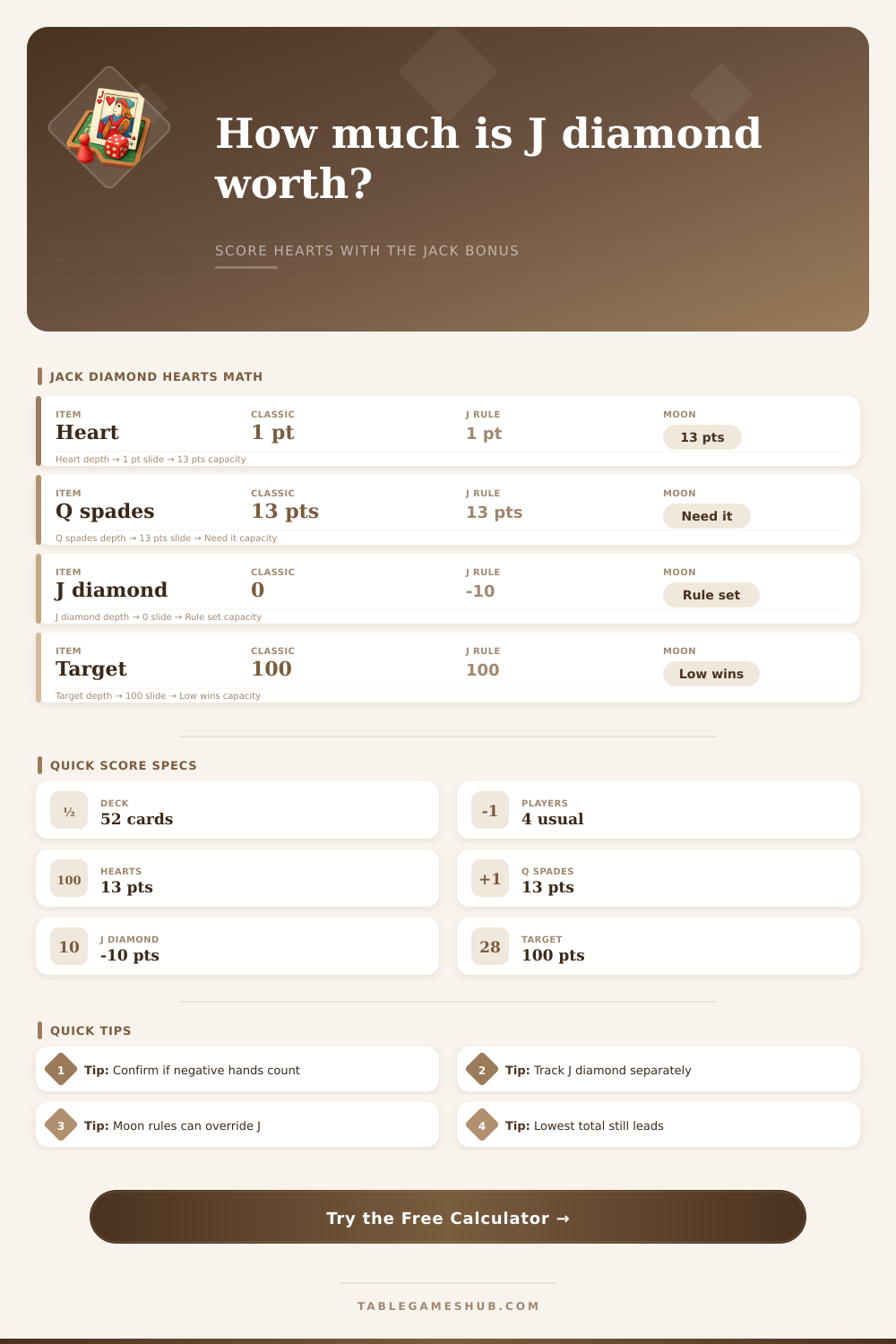
What do all those numbers mean? That’s where understanding how these variants changed within family gatherings comes into play. Most of us learn Hearts in a very straightforward way. The queen of spades equals thirteen points; each heart equal one penalty point; the jack of diamonds usually does nothing. Your goal is to stay under one hundred.
Understanding Hearts Scoring Rules
Then someone shows up playing by the omnibus style rules, and now that jack is worth negative ten points on its own. If you can collect enough hearts to make a terrible hand but then throw down the jack, you actualy reduce your score for the round, which is kind of like getting some redemption. And it completely shifts the psychology of the game. Now instead of just taking safe hands, you’re actively trying to hunt down the bonus card even when your other cards is terrible.
The problem is that each group are different. In some tables, taking the jack and no hearts mean you’re down ten points on your hand score. In others, there’s a floor of zero, which means that same jack cancels out any small penalties youve taken. It sounds like a small difference. But towards the tail-end of a game, it becomes a big one.
With a negative score, you have a bigger hole to climb out of and more leeway for error in the next round or two. A zero floor tightens the pack. You don’t get a credit balance from holding the bonus card, sure, but it also force you to be careful with your other cards.
Additionally, there is the issue of “shooting the moon,” where one person end up with all of the penalty cards. Depending on rules in your local area, this scores twenty-six points against all other players, or removes twenty-six points from the shooter’s score. Your table may have some variation regarding whether the Jack of Diamonds counts toward a moon, so the calculator provides the ability to choose which audit requirement your group uses. Some will insist that you must shoot the Jack of Diamonds as well as the thirteen hearts and the Queen of Spades. If that’s the case, then having the Jack won’t be a bonus anymore; instead, it’ll become part of the necessary plan to win the game. And if you miss out on it by as much as one card, what should of been a sure thing now turns into a normal penalty round.
That’s what happens in a card game: the pressure fluctuates over time. When you’re far below 100 points and haven’t hit triple digits yet, it’s okay to gamble a little and go for that jack bonus. But once you’ve narrowed down the field and its neck-and-neck, each point becomes critical to your survival. And that’s where the tool really shines; it displays how many points you’ll be ahead (or behind) based on how much you score now. If your opponent is getting within striking distance and you haven’t won the round yet, the tool will show you visually. You’ll see that “you’re not the leader anymore” rather than seeing a raw point number. Because sometimes fifty-two looks like safety but then you look across and your opponent has forty-five points … and they just collected three hearts. No, you aren’t ahead; you’re clinging to life.
Knowing how to play your hand depends as much on reading the table other players’ hands) than the actual cards in front of you. For example, if you see the player on your left aggressively bidding for low points, they might be setting up a moon attempt. They could be attempting a moon, and want you to catch it. Do they take several penalties but not the jack? They probably don’t have the strict audit rule going. Patterns let you know when to play safe (fold), and when to reach for the bonus. Your basic math provides the foundation; intuition adds the color between the lines that algorithms can never see.
Ultimately, Hearts is a game of controlled chaos. You can’t make someone play the card you want them to, but you can mitigate the damage if they choose to do so. It might be a ten-point loss you’re working toward. Or it could be that you just don’t want the Queen in your hand. Either way, the result is the same: stay aware and stay low. Never think you have the Jack covered until he’s in your tricks. The aggression vs. A survival mentality is the difference between good and great players.