Hand and Foot Meld Calculator
Total opening meld points, card values, clean and dirty book bonuses, red threes, deadwood, and go-out readiness for a Hand and Foot round.
Formula breakdown
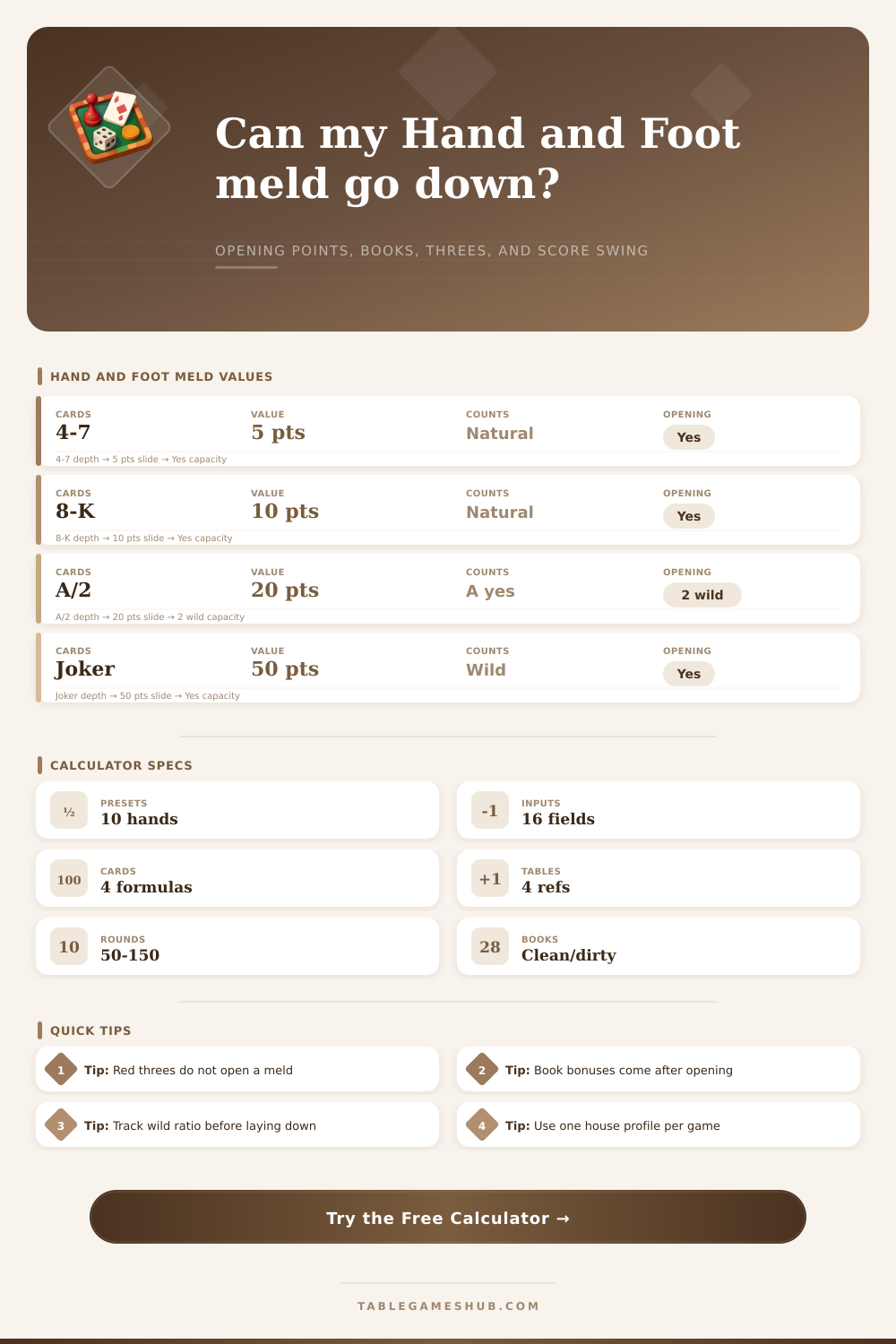
| Card group | Point value | Opening meld use | Calculator field |
|---|---|---|---|
| Natural 4, 5, 6, 7 | 5 points each | Counts toward the minimum when actually melded | Natural 4-7 cards |
| Natural 8, 9, 10, J, Q, K | 10 points each | Counts toward the minimum when actually melded | Natural 8-K cards |
| Aces | 20 points each | Counts as natural cards in the opening total | Aces in meld |
| Twos and jokers | 20 and 50 points | Count as wild cards, subject to your meld-ratio rule | Twos / Jokers |
| Round setting | Minimum | Example efficient open | Notes |
|---|---|---|---|
| Round 1 | 50 points | Two aces + two fives | Small natural melds often clear this threshold. |
| Round 2 | 90 points | Joker + ace + two kings | Wild-heavy opens should still pass your ratio rule. |
| Round 3 | 120 points | Joker + two aces + three tens | Red threes and book bonuses are not included. |
| Round 4+ | 150 points | Two jokers + ace + three kings | Custom fields support stricter local tables. |
| Book or bonus | Common score | Opening meld? | Calculator use |
|---|---|---|---|
| Clean book | 500 bonus points | No bonus points toward opening | Score projection and go-out readiness |
| Dirty book | 300 bonus points | No bonus points toward opening | Score projection and go-out readiness |
| Wild book | House-rule value | No bonus points toward opening | Optional field, default 1500 |
| Going out | Often 100 points | No | Add only for the team ending the hand |
| Profile | Clean books needed | Dirty books needed | Best use |
|---|---|---|---|
| 1 clean + 1 dirty | 1 | 1 | Common casual finish check |
| 2 clean + 2 dirty | 2 | 2 | Club or family tables that require more books |
| 3 clean + 4 dirty | 3 | 4 | Long partnership games with many decks |
| No requirement check | 0 | 0 | Score-only review or nonstandard rules |
When someone sets their book down on the table, everyone gets quiet. That’s how addicting Hand and Foot is. It forces you to build up your points in secret yet try to get rid of your card. Meanwhile, you pretend that your hand doesn’t have any deadwood. It’s a mathematical pressure cooker with hidden intentions at play.
Because the math gets complicated fast, most people don’t do well at it. Bonus books, wilds, natural cards and penalty threes all compete for your attention. Trying to keep track of your mental ledger is no easy feat while keeping a poker face.
How to Play Hand and Foot Better
Mastering this game is more about managing point exposure than just doing the math, though. That’s why the calculator above breaks it into opening meld requirements and end-of-round scoring. That’s because most of us gets tripped up at both steps. First, you’re trying to determine whether or not you have sufficient points to go down. Second, those aren’t necessarily the same point that will indicate how well you are doing overall.
Getting a clean book nets five hundred bonus points. It doesn’t apply toward your starting meld requirement. Why does this matter? A player could hold a bunch of high-value cards and still be stuck in hand for ten turn.
In early rounds, how do naturals compare with wilds? Fours through sevens count for only five apiece. Those low card aren’t efficient openers. To clear the fifty-point bar in Round One, you’d need ten of these cards. Meanwhile, one joker by itself count for fifty points. The urge will be to hang onto the jokers until you can make a book from some naturals. Holding wilds for too long increases your deadwood risk at the end of the round. You might play it safe, only to be hit with a huge penalty because you couldn’t get rid of that high-value card before time ran out.
By adjusting these wild ratios, it allow you to visualize the trade-off of holding wilds versus naturals for deadwood risk. Some tables will be more strict/lenient. Some tables ask for less wilds vs naturals for a dirty meld while others have more. Some groups plays with no more than 3 wilds allowed per book.
You should know if your hand is up to par BEFORE you go down so you don’t get penalized! Enter in the number of cards you hold and instantly find out if you’re playing it safe or not. It accounts for the bonus points for having dirty vs. Clean books too. Now you can tell if it’s worth it to go down based off a score prediction instead of a simple pass/fail.
Finally, there are the red threes which add a layer of complexity that will trip up new players. Depending upon how you play, they’re either penalties or bonuses. By default, they usually counts against your opponents if they remain on the table. However, should you find yourself unable to go down (or unmelded threes result in some sort of penalty under your house rules), then these cards can turn into a liability. There are options in the calculator for various ways to handle red threes. That way, you can model how you play with your particular group.
House rules get really wild and one table may treat them as straight bonuses while another reverses the score. A big part of the game is “deadwood.” Until the last few minutes, you think you have a good hand then see that you’re holding four cards which don’t go together (e.g., three aces plus a two). Each card is worth forty points. Suddenly what was going to be a winner becomes a loser pretty fast.
Being able to track your possible deadwood allows you to make an educated choice about whether to throw away a weakish card in the hopes of doing better next round, or keep it around because you might need it another time. It makes you weigh short-term gains against long-term possibilities. Hand and Foot is a game of minimizing your losses and maximizing your gains. To do this, it is less about luck and more about managing point exposure.
You should of known that! Practice gives you knowledge. Knowledge enables you to make educated guesses instead of guesswork. Your numbers give you information so you can take chances; they’re not blind gambles. Don’t play to win, play to have your score reflect winning. Next time you get to go when the table gets quiet, you’ll know exactly how it got quiet and what’s coming next.