Golf Card Game Score Calculator
Total Golf card game hole scores, cancellations, wild cards, knock penalties, running match totals, pace against par, and projected finish for 4-card, 6-card, 9-card, and 10-card tables.
1Preset Score Sheets
Load a real table state, then edit the card points and cancellation credits for your house rules.
2Match Settings
3Player Hole Scores
Hole score = raw grid points - canceled pair value - canceled column value + wild adjustment + manual penalty. Failed knock penalty is applied after comparing low hole.
| Player | Previous total | Raw grid points | Pair cancel credit | Column cancel credit | Wild adjustment | Manual penalty | Knocked? |
|---|---|---|---|---|---|---|---|
| Rank | Player | Base hole | Knock adj. | Hole score | Match total | Gap |
|---|
4Golf Card Game Component Grid
5Reference Tables
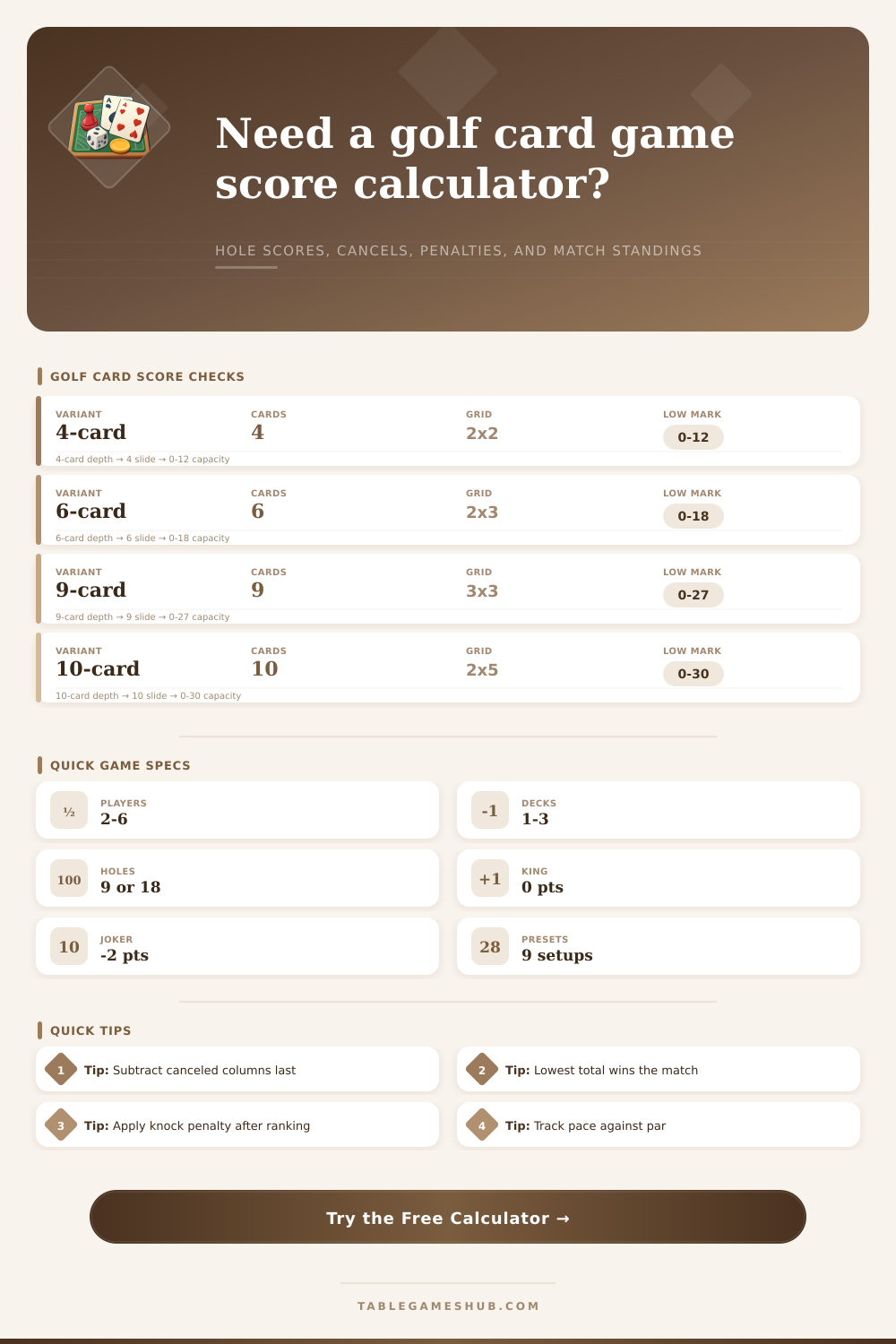
| Variant | Layout | Usual deck count | Typical low hole |
|---|---|---|---|
| 4-card Golf | 2 by 2 grid | 1 deck for 2-4 players | 0 to 8 points |
| 6-card Golf | 2 by 3 grid | 1-2 decks for 2-5 players | 0 to 12 points |
| 9-card Golf | 3 by 3 grid | 2 decks for 3-5 players | 3 to 18 points |
| 10-card Golf | 2 by 5 grid | 2-3 decks for 4-6 players | 5 to 22 points |
| Card or event | Common value | Calculator input | Scoring note |
|---|---|---|---|
| Ace | 1 point | Raw grid points | Count before cancellation credits. |
| 2 through 10 | Face value | Raw grid points | Add visible and revealed final cards. |
| Jack or Queen | 10 points | Raw grid points | Some tables set queens to 12. |
| King | 0 points | Raw grid points | Low card unless a house rule changes it. |
| Joker | -2 points | Wild adjustment | Use only when jokers are included. |
| Cancellation type | Where used | Credit entered | Best check |
|---|---|---|---|
| Pair cancellation | Rows or matched ranks | Total points removed | Enter the value of the canceled cards. |
| Column cancellation | 6-card, 9-card, 10-card grids | Column points removed | Verify every card in the column matches. |
| King column | House variants | Usually 0 credit | Do not subtract a column already worth zero. |
| Negative card lane | Joker tables | Manual if needed | Keep negative cards in raw or wild, not both. |
| Preset style | Players | Holes | What it tests |
|---|---|---|---|
| Family 6-card | 4 | 9 | Normal column cancellation and one knock. |
| Joker swing | 4 | 9 | Negative wild cards and low totals. |
| Risky knock | 5 | 9 | Failed knock penalty after score ranking. |
| Six-player | 6 | 18 | Three-deck table and wider standings gaps. |
6Scorekeeping Tips
Cancellation audit: enter raw grid points first, then subtract only the value that truly disappears from matching pairs or columns. That keeps king columns and joker cards from being double counted.
Knock timing: compare every base hole score before adding a failed knock penalty. The knocker is safe only when tied for, or holding, the lowest hole under your house rule.
On the last hole of a round of Golf card game (and we do mean Golf), a particular kind of panic sets in. There are two decks, six friends, and a mental math problem that would more aptly appear on a calculus test. Who knocked? Did someone knock back? And what about those penalties and wild cards and cancellations? You’ve got to sort all this out quickly because before the snacks run out, you want to know who won.
Usually, the mess comes when you try to judge the room’s mood while juggling everything in your head. That’s not fun; that’s an argument waiting to happen. While it sounds simple, I mean, how hard can it be? It is actualy surprisingly tricky when playing. You’re trying to get your score as low as possible (using kings helps since they’re free points). And you don’t want any face card. Because face cards will hurt you badly.
How to Keep Score in Golf Card Game
What makes this game so tense is that everything is unknown. You have no idea what those cards are until you flip them over… so do you risk it? Or do you keep your cards in case something else better comes along? That’s where the math calculator starts. It does all the number crunching for you, so you don’t have to spend brain power doing math. Just thinking strategically.
The point of this isn’t to memorize various variations on the scoring rules; instead, I think it’s more helpful to understand how scoring works and then how each variation can impact your average per hole. For example, one group may cancel out all pairs within columns (across the whole grid), but not within rows; another may do the opposite. These decisions has a major impact on your overall scores. Play a game with super-aggressive cancellation rules, and your scores are going to be wildly different then if you were using a normal conservative setup.
To account for those kinds of changes, the tool lets you state exactly what qualifies as a credit before finishing rankings. That means no more “but our table plays it differently”, the bane of many fun tournaments.
Perhaps most misunderstood about Golf is the knock mechanism. People think knocking is always safe, but in fact it’s risky. You can knock on a hole and end up with a worse number than someone else, meaning you suffer a penalty for knocking. That penalty can be big enough to win or lose the match. To do so, many groups wait until they know the raw low score. So one player may well have had the better hand, only to shoot themselves in the foot by knocking at the wrong time. It all hinges on understanding the order of operations… Not hard to screw up when things is getting exciting.
The nature of the gameplay changes greatly depending off the size of the grid. A four-card game plays fast and is fairly forgiving. It’s often used as a party filler or a quick warm up. Since there are fewer lanes and fewer cards, the scoring has less variance, and there are fewer card to keep track of. Meanwhile, a ten-card grid introduces more hidden variables and larger potential swings. There are bigger swings in points and more hidden variables in play. More lanes mean more opportunities to pull a bad card which makes every decision feel heavier. As you can see from the reference table on the page, the size of the grid works with the number of decks to provide unique pacing experiences for your group.
Another strategy element beginner might miss is wild cards. Depending on the implementation, kings typically count toward your score but don’t hurt you since they’re essentially stand-ins. If jokers are part of the deck, they may be worth negative points. That means a player can intentionaly drop their score into the negative on any given hole. Suddenly it’s not about avoiding face cards and tens anymore; it becomes a game of going after the joker. The points calculator takes this into account by differentiating between raw points in the grid and the value of the wildcard. That way the baseline score is correct without factoring in the modifiers.
At the end of the day, however, Golf is all about taking risks and reading the discard pile more effectively than your competitors. This is a game of partial information that relies more heavily on gut guesses than strict probabilities. You can read ahead slightly by tracking the history of cards already played. For example, if there are three queens in the previous two holes, it’s much less likely one will be drawn. The scorekeeper handles the boring bits; counting up and down for you, so you can concentrate on picking out those small clues.
What once was an unstructured melee becomes a carefully planned contest, one in which ability triumphs over math mistakes. That’s what makes playing Golf so great. The simple act of exchanging cards with your grandpa, mom or kids makes it accessible for anyone.
That’s when things get complicated. As you explore more complex strategies and score rules, that’s when it gets interesting. If you can outsource the math part to another device, you’re keeping the human element intact. Planning, chatting and laughing are desired parts of any game. Calculating whether or not you forgot to remove the canceled column? You should of done that earlier. Keeping scores clean means keeping winners clean. There’s no need to remind everyone how to work an algebra problem. It lets everyone know who won, agreeably, and keeps the fun at the center of the experience where it belongs.