Russian Railroads Calculator
Score the Trans-Siberian, St. Petersburg, and Kiev lines, then audit locomotives, industry, engineers, route multipliers, medals, and final bonus cards in one rail-yard worksheet.
🚂Railroad Presets
📝Game State and Score Marker
Use the score marker for points already awarded during earlier scoring rounds. The route calculator projects the current scoring pass, while end scoring fields handle medals, engineers, cards, and manual table corrections.
🛤Trans-Siberian Track
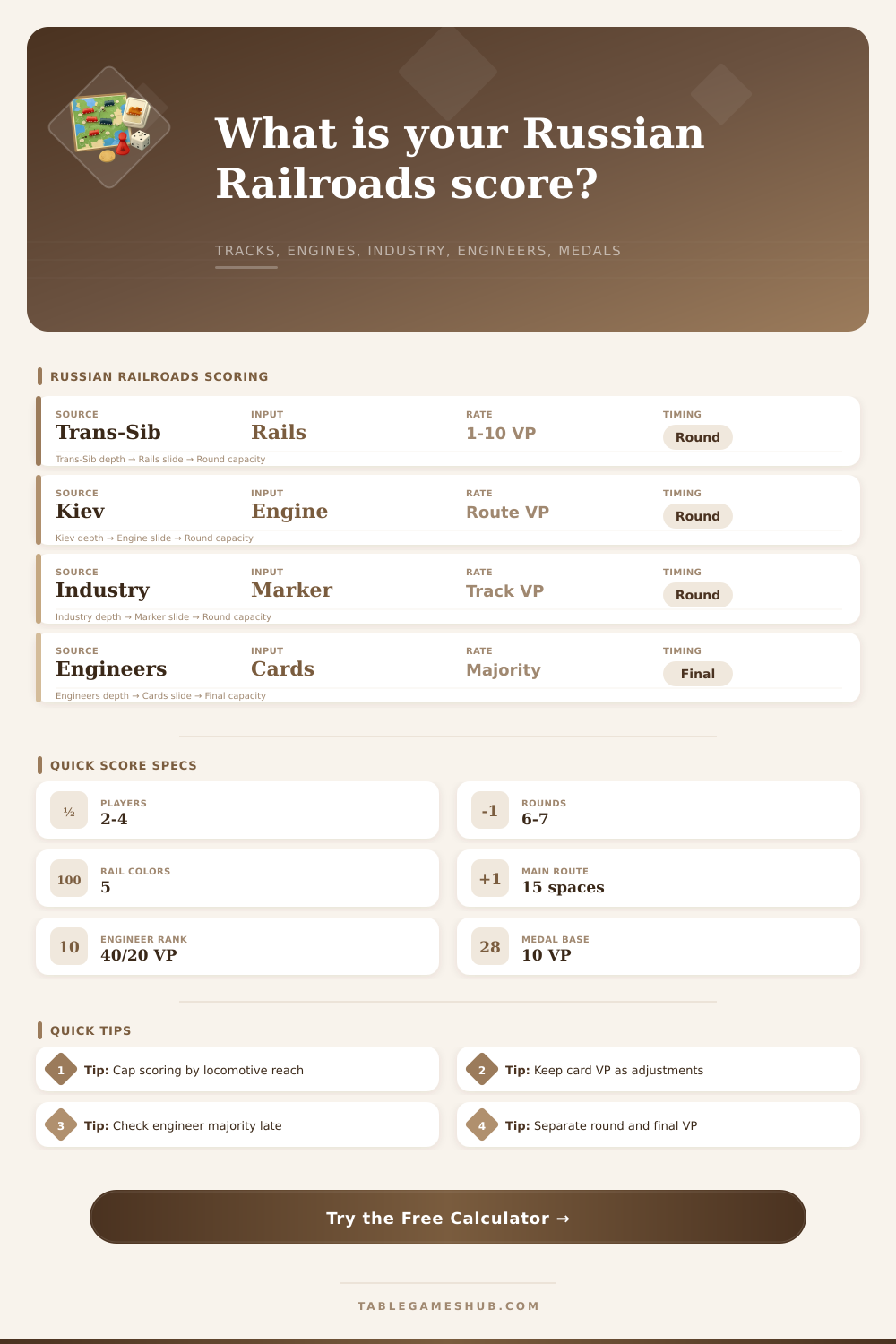
Enter each rail marker position and cap it with the Trans-Siberian locomotive. The calculator scores visible rail strength using black 1, gray 2, brown 4, natural 7, and white 10 VP per active position, then applies route tokens and manual adjustments.
🏙St. Petersburg and Kiev Tracks
🏭Industry, Factories, and Engines
👷Engineers, Multipliers, Medals, and Final Scoring
🧮Live Scoring Grid
Main-line rail strength after engine reach, route multiplier, and bonus VP.
Short route projection from black and gray rails, capped by locomotive reach.
Kiev route scoring with endpoint medal or special route reward included.
Industry marker, factories, and engine conversion values.
Majority rank plus printed engineer card and action scoring.
Medals collected times entered medal value; adjust for expansions as needed.
Shows the active white rail distance after the Trans-Siberian engine cap.
Flags route positions beyond locomotive reach and unusual final settings.
📚Reference Tables
| Rail color | Value used | Best line | Audit note |
|---|---|---|---|
| Black | 1 VP | All routes | Early scoring base |
| Gray | 2 VP | All routes | Mid-route upgrade |
| Brown | 4 VP | Trans-Sib | Large main-line jump |
| Natural | 7 VP | Trans-Sib | Late route pressure |
| White | 10 VP | Trans-Sib | High-value finish |
| Line | Typical reach | Calculator fields | Watch for |
|---|---|---|---|
| Trans-Siberian | 15 spaces | 5 rail colors | Engine cap |
| St. Petersburg | 9 spaces | Black/gray/bonus | Short-line timing |
| Kiev | 9 spaces | Black/medal/mult | Endpoint medal |
| Industry | 30 steps | Position/rate | Factory rewards |
| Final source | Input field | Default formula | Timing |
|---|---|---|---|
| Engineers | Majority rank | 40/20 VP | Final |
| Medals | Medal count | Count x value | Final |
| Bonus cards | End card VP | Manual total | Final |
| Factories | Factory VP | Manual total | During/end |
| Preset | Focus | Route style | Risk |
|---|---|---|---|
| Kiev Sprint | Fast medal | Kiev reach | Low industry |
| White Rail | High rail VP | Trans-Sib | Needs engine |
| Industry | Factories | Mixed routes | Engineer race |
| Engineer Majority | Final VP | Stable scoring | Card timing |
💡Scoring Tips
You may have heard about Trans-Siberian Railway: the epic journey through endless distance and imperial hubris. Actualy, its construction was a hard slog of politics, resources, and logistics. Board games like Russian Railroads does a great job representing the struggle between pushing rails outwards and upgrading engine responsible for pulling them along.
You can easily find yourself absorbed in the tactile process of laying down track and forget that the track itself serve no purpose if there’s nothing to haul on top. That’s why a scoring calculator isn’t just helpful for ensuring you hit the right number, it also helps keep you honest about whether or not your plan make sense.
How to Play Russian Railroads Better
There are three different routes: the short ones from Kiev and St. Petersburg, as well as the long one through Siberia on the Trans-Siberian line. Each one have a different locomotive cap. So if your locomotive doesn’t reach ten spaces, then laying down those additional rail markers won’t increase your score. The game’s calculator figures out the math for you, so it caps what you could get depending on how strong your engine is.
That stops people who commonly start off investing too much into building rail too quickly while neglecting engine upgrades. Both things need to be going at once. If you’ve got rails but no powerful loco, you’re investing for potential that will never materialise.
The engineering and industrial aspect isn’t just about the tracks themselves, however; it’s also about the factories that activate on those routes. Industrial markers are solid money-makers and move along their path. But they has to be timed to match when factories activate. Majority control by engineers is largely where real leverage comes from, not because you’re going to win the game based solely off them, but because of potential 40-point difference if you lose majority status after having a small point lead mid-game. That can completely flip your fortunes: a win becomes a tie, or worse, a defeat.
The tool also have the reference tables breaking down how much the final bonuses count compared to medals and route multipliers. There’s also the late game pressure of medals. Until the very end they just hang around doing nothing and have a set number of points per medal. Depending on the multipliers, a player who doesn’t have as many medals could be ahead anyway due to their position along the routes. There may even be other cards that interact to make one section worth double or triple adding an additional multiplier effect.
You can also enter those values individually into the tool letting you know precisely how much each element contribute toward your final score. That lets you know if you’re ahead due to your rail network or merely by collecting bonus cards.
All this goes back to the real world: there’s a reason why the Tsar wanted the railroad built, after all. The Tsar had two goals for the railroad: connecting Europe with new markets and strengthening his control over Siberia, despite huge physical obstacles like the permafrost of Western Siberia. That real-world factuality gives the mechanics flavor.
There is only so much to go around. Every track you place requires a choice… Which route do I need right now? Which tracks represent an investment that will pay off later? It’s up to you to make those decisions; there’s no calculator for that. But its absence makes the cost of indecision clear. Lay down a bit more black rail by delaying engine upgrades. The math will reflect the flatlining score while your board gleams.
All of that really adds up to one thing: matching your assets with the right scoring triggers. Having a bunch of mismatched parts on a pretty board wouldn’t of get you far. And the projection features let you simulate potential endgames without actually having them play out. Can I get more value from upgrading my Trans-Siberian engine than going for the Kiev medal? If you time it just right and make small changes in focus, you might move from second place to first.
Building railway empires isn’t something that happens overnight and it shouldnt be done without thinking about its capacity. Whether you’re playing a boardgame with virtual logistical management or researching real life story of expansion from continent to continent, there’s no point in growing if you can’t handle it. The calculator ensures you has the ability to match your ambition.