Five Hundred Card Game Score Calculator
Score Five Hundred bids, no-trump contracts, misere hands, open misere, sets, undertricks, and each side's distance from the 500-point target.
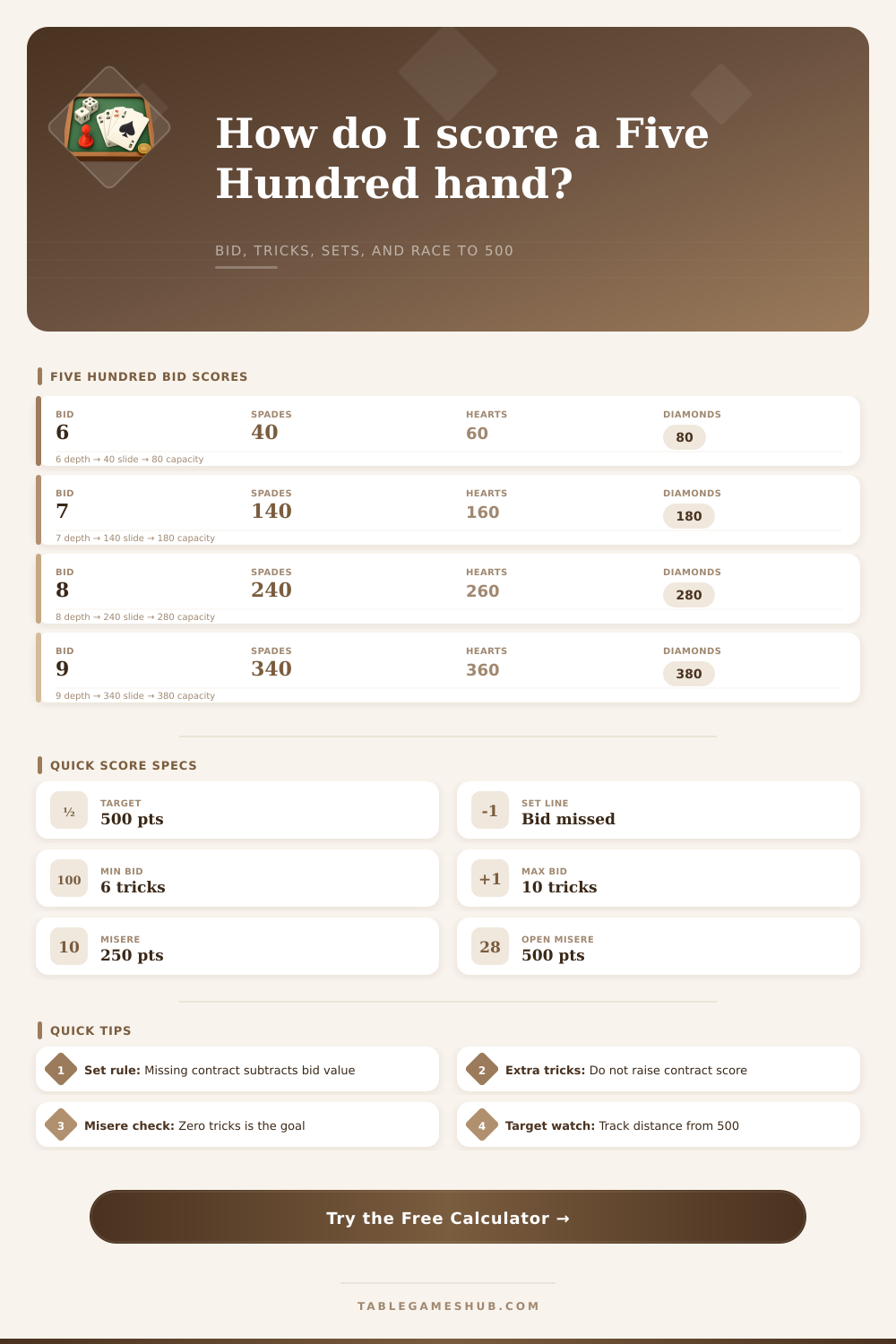
| Tricks Bid | Spades | Clubs | Diamonds | Hearts | No-Trump |
|---|---|---|---|---|---|
| 6 tricks | 40 | 60 | 80 | 100 | 120 |
| 7 tricks | 140 | 160 | 180 | 200 | 220 |
| 8 tricks | 240 | 260 | 280 | 300 | 320 |
| 9 tricks | 340 | 360 | 380 | 400 | 420 |
| 10 tricks | 440 | 460 | 480 | 500 | 520 |
| Contract | Goal | Success Score | Failed Score | Calculator Handling |
|---|---|---|---|---|
| Misere | Bidder wins 0 tricks | +250 | -250 | Tricks won must equal 0 |
| Open misere | Bidder wins 0 tricks with exposed hand | +500 | -500 | Tricks won must equal 0 |
| No-trump | Bidder reaches contracted tricks | Contract table | Negative bid value | No-trump is highest suit rank |
| Suit contract | Bidder reaches contracted tricks | Contract table | Negative bid value | Overtricks do not add value |
| Example Bid | Tricks Won | Undertricks | Bidder Score | Reason |
|---|---|---|---|---|
| 6 Spades | 5 | 1 | -40 | Contract missed |
| 7 Hearts | 7 | 0 | +200 | Contract made |
| 8 Diamonds | 6 | 2 | -280 | Set by two |
| 9 Clubs | 10 | 0 | +360 | Overtrick ignored |
| Misere | 1 | Special | -250 | Any trick loses |
| Before Score | Contract | Result | After Score | Status |
|---|---|---|---|---|
| 420 | 6 Hearts | Made | 520 | Reaches target |
| 360 | 8 Clubs | Made | 620 | Passes target |
| 470 | Misere | Failed | 220 | Falls back |
| 0 | Open misere | Made | 500 | Hits target |
The scoring process for Five Hundred begins after the last trick of the hand is played. The scoring process require both turning tricks into points and subtracting penalties for failed contracts. Each player must calculate how many trick points there team collected and how many penalty points there opponent will score for failing to meet the bid.
These calculations determine whether each player will move forward in the game or fall behind in the race to five hundred points. The calculations can become difficult during deals in which both misere contracts and defender tricks is occurring at the same time. Five Hundred rewards players who make careful bids rather than those who depend on luck to win the game.
How to Score in Five Hundred
Even the best hand can be lost to an overconfident bid. The target score in Five Hundred is five hundred points. Therefore, each bid has significant weight in the game.
For instance, if a player bids at eight tricks in the diamonds suit but fails to meet that bid, the player will lose two hundred eighty points from there score, regardless of whether the player missed the bid by one trick or three tricks. Many groups of players use house rules to determine how trick points from the defenders are scored. For instance, some house rules award ten points to the defenders for every trick they win from their opponents.
Other house rules completely ignore the trick points earned by the defenders. These house rules are important in determining how close to five hundred points the defenders will get before the bidder for the hand can earn another turn to bid on tricks for their opponents. It is essential to track both teams scores at the same time, especially when one team is close to five hundred points while the other is also close to five hundred points.
In misere contracts, players must calculate the risks of losing tricks rather than winning them. With a misere contract, if a player meets their bid for taking no tricks, they earn two hundred fifty points. However, if a player fails to meet a misere contract, they will lose two hundred fifty points.
An open misere contract doubles the points that are earned or lost from a successful or failed misere contract. However, an open misere contract also removes the tactics that a player can use to avoid mistakes on tricky contracts. Players usually use misere contracts when they have strong cards that will defend the tricks for their opponents.
The Five Hundred calculator will do the math for you once you enter your contract and the number of tricks taken during the hand. You will need to enter the score that each side has before this trick, as well. The calculator will apply the points for the bid that you made.
Additionally, the calculator will subtract the penalty for your contract if it is set. The calculator will also add the point values for the defender tricks if your house rules give the defenders points for the tricks they take. The calculator will also show the number of points each side is from the five hundred point target.
This target is essential for players to understand if they are winning or losing the game. Bidding errors usually occur when a player focuses on their own contract rather than the distance of each player to five hundred points. A player might make a seven of hearts bid because they have a strong hand.
However, they may not consider if their opponents are only forty points behind. Should the player’s contract fail and their opponents earn enough points from the defender tricks to reach five hundred points, then the player will have lost the game. The calculator will show both options for scoring for players to decide if making such a bid is worth the risk of losing the game.
The scoring of the defenders changes the strategies of the players who are not making bids on tricks for their opponents. The incentive for the defenders to win tricks gives their opponents a chance to reach five hundred points. Players should enter the scores of each side before the hand to see a clear picture of the score before the game rather than just knowing the bids of each player.
Overtricks dont earn points for the player who bid on the tricks. However, new players to Five Hundred may think that winning tricks beyond the bid earns the bidder some form of insurance for their bid. However, the overtricks are simply tricks that the defenders did not take during the hand.
This fact is important for bidding players to understand because it changes how they play their borderline suits. Sometimes, a bidder will lose a trick so as to focus their opponent on a different suit. The calculator will show the same score if a bidder takes the tricks they bid on or takes extra tricks; the calculator shows that overtricks dont earn any points for a player who bids on the tricks.
Late game can become very high-pressure for the players who are close to five hundred points. When a player is at four hundred thirty points and their opponent is at three hundred ninety points, an eight of diamond trick bid is worth two hundred eighty points but will cost the player two hundred eighty points should the bid fail. Before the game starts, each player should check the house rules for variations of scoring for misere contracts.
Some groups will decide that an open misere contract is an automatic win to five hundred points for the player who bid on the tricks. However, other groups will decide that an open misere contract will result in a five hundred point swing in the bidder’s favor. Additionally, other groups will limit the score to five hundred points so that a player who successfully completes an open misere does not go into negative points.
These rules should of been confirmed before the game starts to avoid arguments over the score after the tricks are taken. The hand games in Five Hundred usually consist of quiet hands but will develop into fast hands once a player reaches three hundred points. At this stage, players will decide whether they would like to bid on tricks or force their opponents to bid on tricks.
The Five Hundred calculator will allow anyone at the game to calculate the scores. The calculator will give each player a clear picture of the score of each player and how close they are to five hundred points. Five Hundred rewards the player who looks at the entire game table rather than the player who looks only at the one strong suit that they have in their hand.
With the game structured as it is, everyone will win in the race to five hundred points, but the game will move faster and there will be fewer arguments between players.