♚ Chess Piece Size Calculator
Match king height to board square size using USCF & FIDE regulation standards
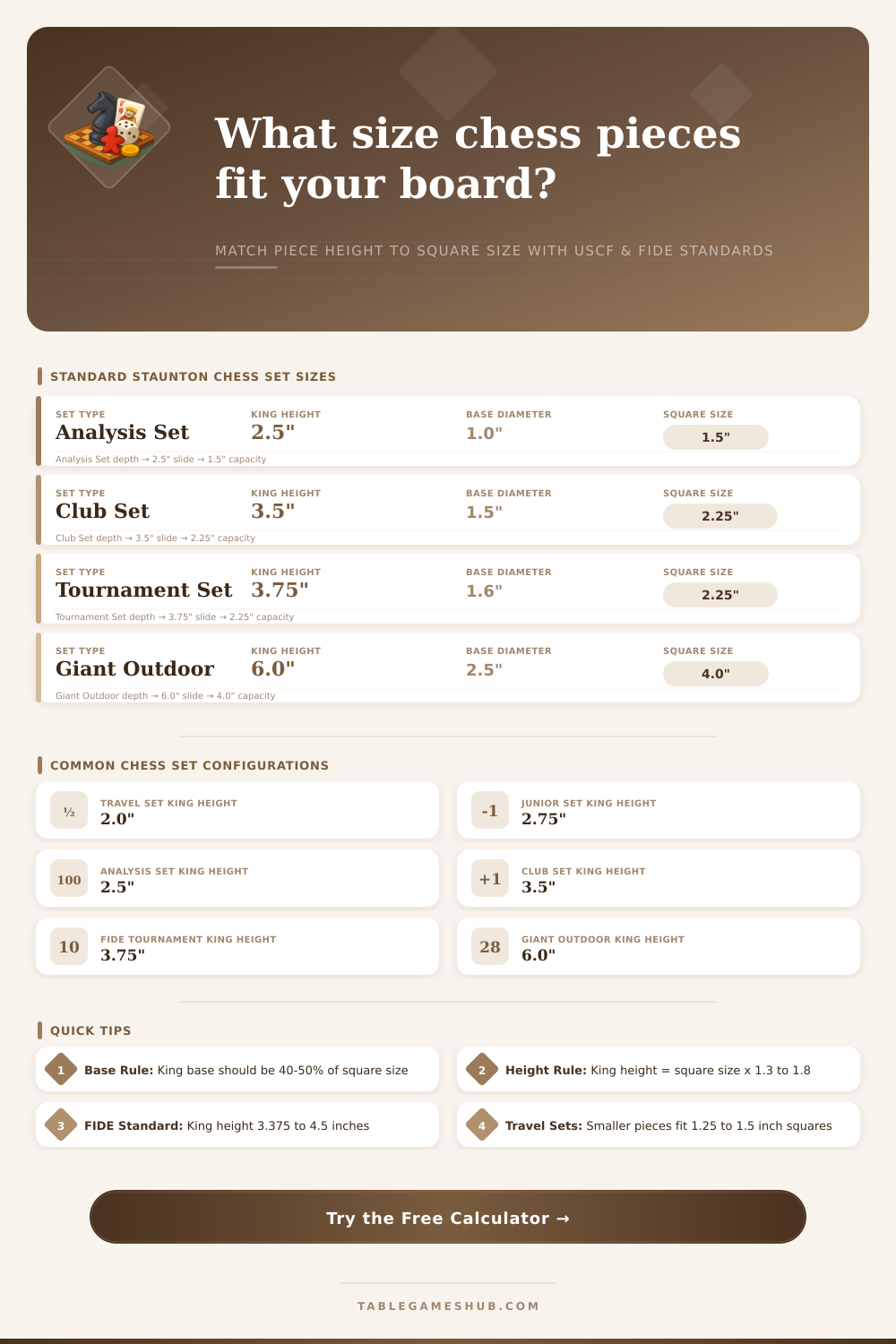
| Set Type | King Height | King Base | Square Size | Best Use |
|---|---|---|---|---|
| Pocket / Mini | 1.5" | 0.6" | 1.0" | Keychain / Display |
| Magnetic Travel | 1.75" | 0.7" | 1.1" | Travel & Commute |
| Travel Set | 2.0" | 0.8" | 1.25" | Casual Travel |
| Junior Set | 2.75" | 1.1" | 1.75" | Young Players |
| Analysis Set | 2.5" | 1.0" | 1.5" | Home Analysis |
| Club Set | 3.5" | 1.5" | 2.25" | Club & Casual Play |
| DGT Board | 3.5" | 1.5" | 2.165" | Electronic Boards |
| FIDE Tournament | 3.75" | 1.6" | 2.25" | Rated Tournament |
| Luxury Analysis | 4.0" | 1.7" | 2.5" | Premium Home |
| Giant Outdoor | 6.0" | 2.5" | 4.0" | Garden / Display |
| Parameter | Minimum | Maximum | Ideal |
|---|---|---|---|
| King Height | 3.375" (8.57cm) | 4.5" (11.43cm) | 3.75" (9.53cm) |
| King Base | 40% of square | 50% of square | 45% of square |
| Board Square | 2.0" (5.08cm) | 2.5" (6.35cm) | 2.25" (5.72cm) |
| King-to-Square Ratio | 1.3x square | 1.8x square | 1.6x square |
The standard measures of chess board are 20 inches by 20 inches or around 50.8 cm by 50.8 cm. This size allows you to use standard chess pieces comfortably and give enough space for a good game. Boards for tournaments usually range from 20 to 23.625 inches, which is 50.8 cm to 60 cm.
Every square on the board must have the same size, and the board itself should measure equally on all four sides.
Standard Chess Board and Piece Sizes
When you set up the board to start a game, half of the squares are taken by pieces, while the middle 32 squares stay free for the game. FIDE, the World Chess Federation, says that for competitive games, the squares be between 5 and 6 cm (around 1.97 to 2.36 inches). Boards regulated by USCF use 2.25-inch squares (5.7 cm), while FIDE-regulated boards have a bit bigger, with 2.375 inches (6.0 cm).
Widely, squares of 2 to 2.5 inches work well. For instance, without a border, 2 inches times 8 squares give a minimum of 16 inches, pluse whatever the outside edge adds.
The side of a square should be at least twice the diameter of the pawn, so that four pawns could fit on one square. Even so, that is an old rule, almost none follows that old FIDE rule about four pawns per square, not even FIDE itself with its official chess set.
FIDE says that the king be 9.5 cm high, which is about 3.75 inches. Sets with such height are the standard for official contests. The diameter of the king base should measure between 40 and 50 percent of its height.
Tournament specifications include a king of 9.5 cm, with the other pieces propperly smaller, queens at 8.5 cm, bishops at 7 cm and pawns at 5 cm.
When you buy chess pieces, the marked size usually relates to the height of the king. So, if a set is marked as 85mm, that means the king is 85mm high. The squares on the board should be about 1.25 to 1.33 times bigger than the diameter of the king base.
The base of the king should be 60 to 80 percent of the square size. Smaller pieces help the playability, but bigger pieces give a better look. Some source suggests that the ratio between king base and square be between 72 and 82 percent.
Standard tournament sets usually have a 1.5-inch base for 2.25-inch squares. Squares of 45 to 50mm work well for ordinary play with bigger pieces, that have king height of 90 to 99mm and base diameter around 35 to 38mm. A 2.25-inch square is good for that base size.
A smaller set is better when there are space restrictions. If the base is smaller than the square, any smaller size willwork well.