Elimination Number Calculator
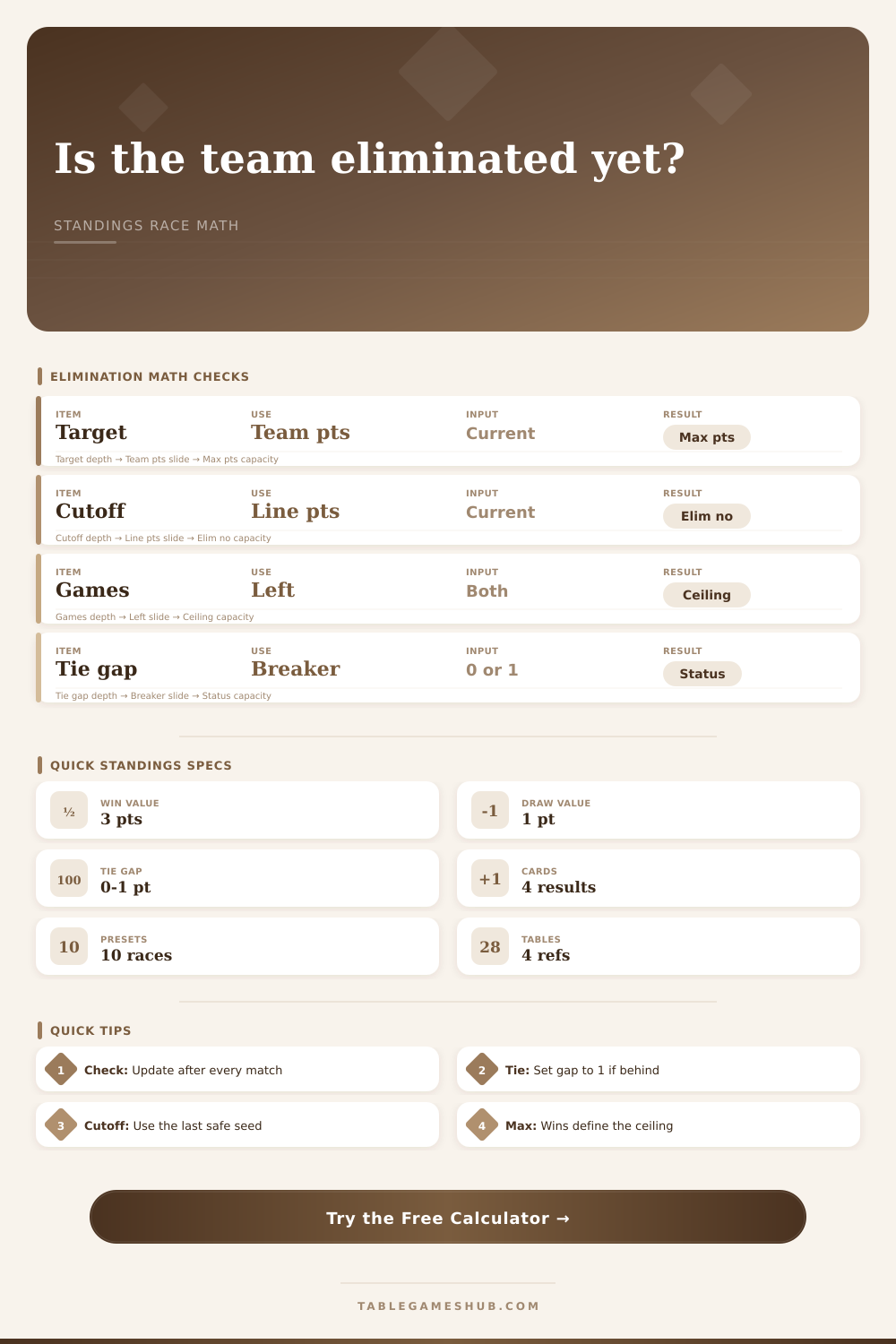
Check whether a team can still catch the cutoff line using current points, games remaining, scoring rules, and tiebreak position.
Target wins out
Use the calculator to compare the ceiling against the cutoff.
Split finish
Half of remaining points gives a quick middle-case test.
Cutoff idle
Shows whether the target can climb without help.
Cutoff average
Estimates pressure if the cutoff earns steady points.
| Status | Condition | Meaning | Typical Action |
|---|---|---|---|
| Alive | Cutoff points are below target adjusted max | The target can still catch or pass the cutoff line | Track the elimination number after every result |
| At Risk | Elimination number is less than one win | A single cutoff result may end the race | Check tiebreaks and remaining head-to-head games |
| Eliminated | Cutoff already exceeds the target adjusted maximum | Even winning all remaining games cannot clear the line | Confirm table corrections before finalizing |
| Uncatchable cutoff | Cutoff max also stays ahead of target scenarios | The line can rise beyond any realistic target finish | Use the cutoff max as the target benchmark |
| System | Win | Draw or OT | Best Use |
|---|---|---|---|
| Soccer league | 3 | 1 | Football tables, group stages, promotion and relegation races |
| Classic table | 2 | 1 | Older league formats and local round-robin competitions |
| Hockey-style | 2 | 1 | Leagues with overtime or shootout loser points |
| Winner-only | 1 | 0 | Match win tables where only wins count toward placement |
| Tiebreak Setting | Use When | Target Must Finish | Effect On Max |
|---|---|---|---|
| 0 points | Target owns or can still win the tiebreak | Level with cutoff may be enough | No penalty to target ceiling |
| 1 point | Cutoff owns the tiebreak | Above the cutoff on points | Target effective max is reduced by 1 |
| 2 points | Multi-team tiebreak or table correction cushion | Clearly above the cutoff cluster | Target effective max is reduced by 2 |
| Manual review | Head-to-head games remain | Depends on future shared results | Run both 0 and 1 point scenarios |
| Scenario | Target Points | Cutoff Points | What To Watch |
|---|---|---|---|
| Early race | Many points left | Cutoff max is volatile | Maximum possible points matters more than current gap |
| Late bubble | Few games left | Elimination number shrinks quickly | One cutoff win may decide the race |
| Tiebreak deficit | Needs an extra point | Level finish favors cutoff | Set the tiebreak gap to 1 or 2 |
| Target controls fate | Can exceed cutoff max | Cutoff cannot block every route | Compare target max against cutoff maximum |
The end-of-season picture is a mathematical puzzle, with the variables shifting as games are played. Your team is hovering around the cutline for the playoffs. A competitor sit safely above you. Everything counts. But everything doesn’t count equally. That’s where the elimination number comes into play.
This figure tell you precisely what your real-world leverage is in the hunt. How much can the top team fall without eliminating your hope? It’s important to note that people gets hung up on point differential right now. That doesn’t matter. If you’re 10 points out but have five games remaining while lead team has none, it doesn’t matter.
How the Elimination Number Calculator Works
The calculator takes everything into account: current standings, how many games remain and how each scoring rule impact things. It eliminates emotion from the equation and lets you see how it all work.
What does the tool measure? You aren’t going after points. You’re going after a limit. First look at the tiebreak gap. That’s what many folks don’t understand about it. A lot of times, a tie will be broken by head-to-head or goal differential. So if your opponent has the tiebreak edge over you, then you’ll need more points than they do, not just as many.
The tool accounts for that with its setting for a one-point tiebreak gap. That lowers maximum amount you can realisticly expect to achieve. You’d set it and think you’re in it but really aren’t.
Next up is the scoring system. In some sports, like soccer, you get 3 points for a victory. That puts the climb steeper. Other sports like hockey may be 2 points per game. This speeds up the race. This tool handles that difference without requiring you to re-calculate how many points one team scores over another by winning. Simply choose the scoring system for your league. You can find list of those systems in the reference table on this page. They’ll help explain why winning that sport feels different than usual. For example, in a 3-point system, the swing is greater and thus the elimination number falls quicker.
Human factors don’t compute on the calculator. There’s no place for momentum or morale or injuries. If the other team lose two games, maybe you’ve got a 20% chance of catching up based off the math. But what if the other team have an injured superstar? The situation is dynamic; the numbers aren’t. The calculator help define what is possible. Judgment helps determine whether it’s likely you’ll cross that boundary.
Games in hand are what late season races hinge upon. Having a temporary advantage when your team has two games in hand against one is an edge. Enter how many games remain for both sides and let it calculate. That imbalance provide openings. It indicates whether or not you can gain ground as the other team maintains a lead. It makes a static table dynamic. Transforms it from where teams sits now into where they might end up. You no longer focus on the standings; instead, you focus on possibilities.
But it doesn’t last long. The emotion of the season fades fast and the lesson sticks around. That knowing your number is the honesty pill. It ensures no early celebration, nor any pointless panic. It anchors the story with reality.
Any team, including Destiny, has to play by the same set of numbers. If the tool predicts a spot, it’s not a promise. It just shows what it takes. And whether you achieve that hinges on the following ninety minutes. You should of known this.
The math creates the setting. The game provides the outcome. The elimination number sets the conditions for it.