Edge of Darkness Calculator
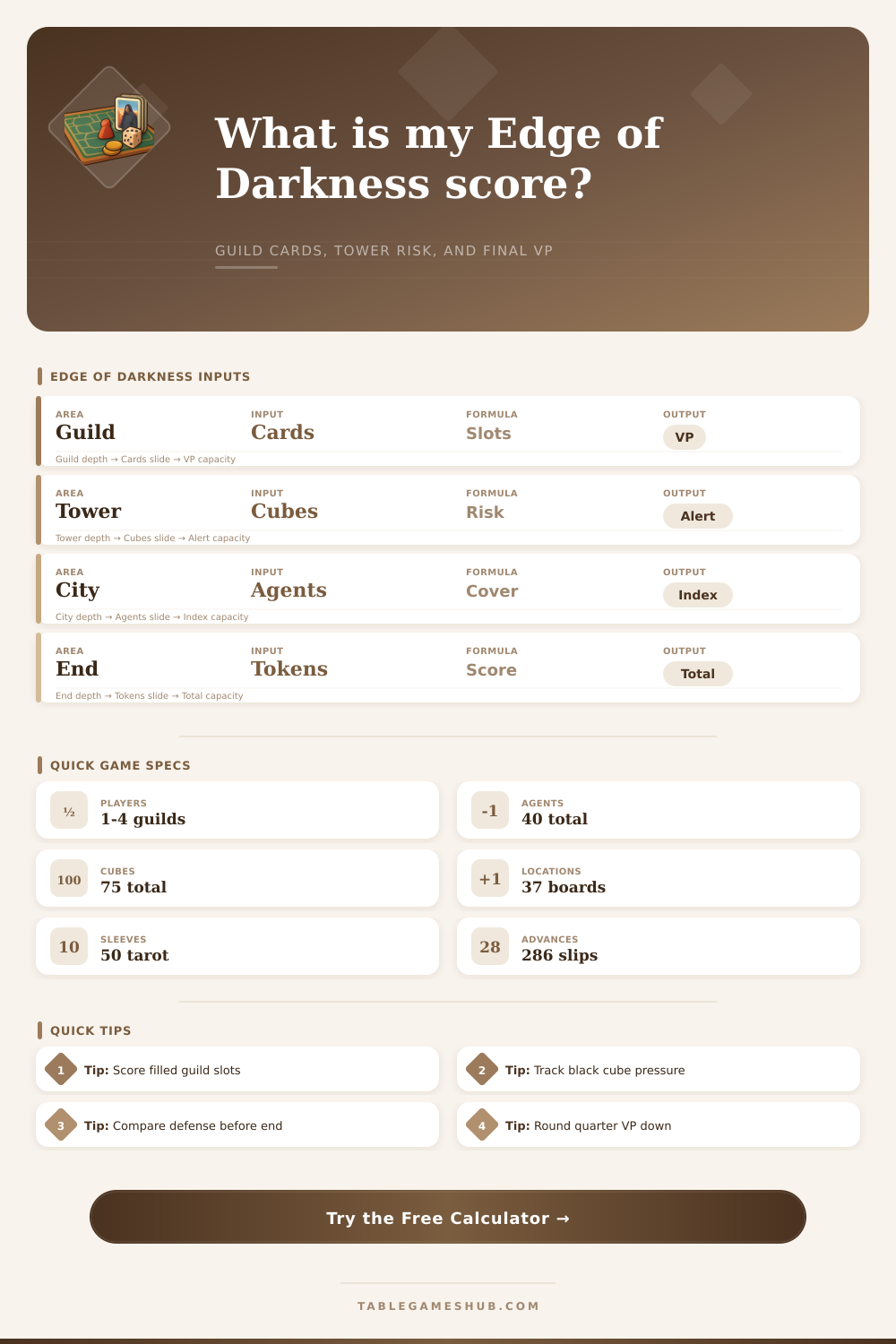
Estimate final prestige, guild-card slot value, threat tower pressure, agent coverage, location influence, and endgame scoring totals.
| Scoring Area | Calculator Input | Formula Used | Output Role |
|---|---|---|---|
| Reputation | Reputation tokens | 1 VP per token | Direct final prestige |
| Aegisian coins | Coins in coffers | 1 VP per coin | Direct final prestige plus majority race |
| Guild-card slots | Filled slots on owned cards | 1 VP per filled slot | Card-crafting engine value |
| Defense track | Track position | 1 VP per step | City protection score |
| Resource coffers | Influence and goodwill tokens | Floor(tokens / 4) | Quarter-point endgame material |
| Majority awards | Awards won | Awards x 2 VP | Most tokens, coins, guild cards, defense |
| Threat Tower Mix | Player Colors | Black Cubes | Bag Baseline |
|---|---|---|---|
| Solo defense | 15 player cubes | 15 black cubes | 30 cubes checked |
| 2 guild city | 30 player cubes | 15 black cubes | 45 cubes checked |
| 3 guild city | 45 player cubes | 15 black cubes | 60 cubes checked |
| 4 guild council | 60 player cubes | 15 black cubes | 75 cubes checked |
| Guild Build Signal | Low Range | Strong Range | Calculator Meaning |
|---|---|---|---|
| Slot fill rate | Under 45% | 70% or more | How dense your crafted guild cards are |
| Advancement tempo | Under 2 per card | 3 or more per card | How much card-crafting volume exists |
| Agent coverage | Under 55% | 80% or more | How widely your agents can contest locations |
| Location pressure | Under 1.5 tokens | 3 or more tokens | Influence density across active boards |
| Preset Profile | Main Focus | Risk Assumption | Best Result To Watch |
|---|---|---|---|
| Solo Aegis Defense | Defense track and tower control | Small bag, high black-cube share | Threat tower exposure |
| 4-Guild Full Council | Majority awards and coin pressure | Full 75-cube bag | Final VP estimate |
| Advancement Rush Guild | Slots and card-crafting density | Moderate attack card count | Guild engine fill |
| Location Control Build | Agents, locations, influence web | Wide city board contention | City control index |
When you finish a session of Edge of Darkness, the game components will be scattered across teh table. These game components represents the different metrics that can be used to calculate the score for each player. The player hall will contain the guild cards, filled with slot and advancements.
There may also be cube in the threat tower that can trigger attacks on the player. Furthermore, the agents will be located throughout the game board, and there will be token representing influence, reputation, and coin that are placed in small piles on the board. Because these components are scattered, it can be difficult for the players to determine the total score for each player.
How the Score Calculator Works
Thus, the calculator can transform each of these components into a single estimate of the player’s total score for the session. Using this prestige estimate, the players can gain an idea of their total score before the game end. Due to the complexity of the game, many players only keep track of the component that are the easiest to count.
Thus, the players only tend to count their reputation and coin tokens. The reason that these tokens are easier to count is that they contributes to the total victory points for the player. However, players tend to overlook their filled slot on their guild cards.
These filled slots contribute to the value of each player’s total score, as each filled slot represents a point that the player earn at the end of the game. Furthermore, the total number of guild cards that a player control will determine how many points the player will earn at the end of the game. The calculator weights the value of each player’s filled slot within their guild cards.
A player will lose to another player if they have a small number of guild cards with many filled slot rather than a larger number of guild cards with fewer filled slots. Another component that contribute to the score is the threat tower. However, the colored cubes within the threat tower create the threat tower’s effect.
The colored cubes represent threat to the player; black cubes represent the most threat to the player. The shared pressure of the threat tower, if measured by the exposure percentage, can tell the player how likely the rest of the bag will result in at least one attack on the player’s guild. A high percentage dont result in the player losing the game right away.
Still, a high percentage will force the player to make a decision as to which position they will place their agents in to either defend themselves against the threat tower or to fight for the majority award. The position and number of agents that are placed on the board contribute to the score; however, many players do not value this score. The placement of the agents determine when and if a player will be able to collect tokens from the game.
Thus, if a player does not place their agents in position where they can contest location for tokens, they will not recieve those token during the game. However, the calculator incorporates these variable to determine the total value that each player has within the game. The score that is represented by the defense track can also contribute to a player’s total score.
Furthermore, players can use their position on the defense track to break tie in the case that two or more players receive the same majority awards. Many players use the defense track as a means of escape from the game. However, if players do not invest in their defense track early in the game, they may find themself in a losing position compared to other players who invested in their defense tracks early in the game.
The calculator can display the value of the defense track for each player in comparison to the other scoring variable for each player. Before the final round of the game, players can run the numbers to determine their total score for the game. Furthermore, this can help players to make important decisions during the game.
For instance, if the slot that a player controls have a low rate of filling, they can decide to spend their turn crafting instead of contesting location for tokens. If the threat exposure percentage that the threat tower calculator measures is high, the player can use one of their agents to defend against the threat instead of collect a coin. These types of decision can aid the players in moving their prestige score estimate at the end of the game.
The calculator does not account for the social element of the game, such as table talk and memory. Furthermore, the calculator cannot calculate how other player may misjudge the threat tower. Although a player may appear to be behind in the game, they can still win if the other players forgets who has obtained a majority.
The prestige estimate is a helpful tool for players, but it doesnt allow players to understand how to react to the other players at the table.